Grunwald Battlefield
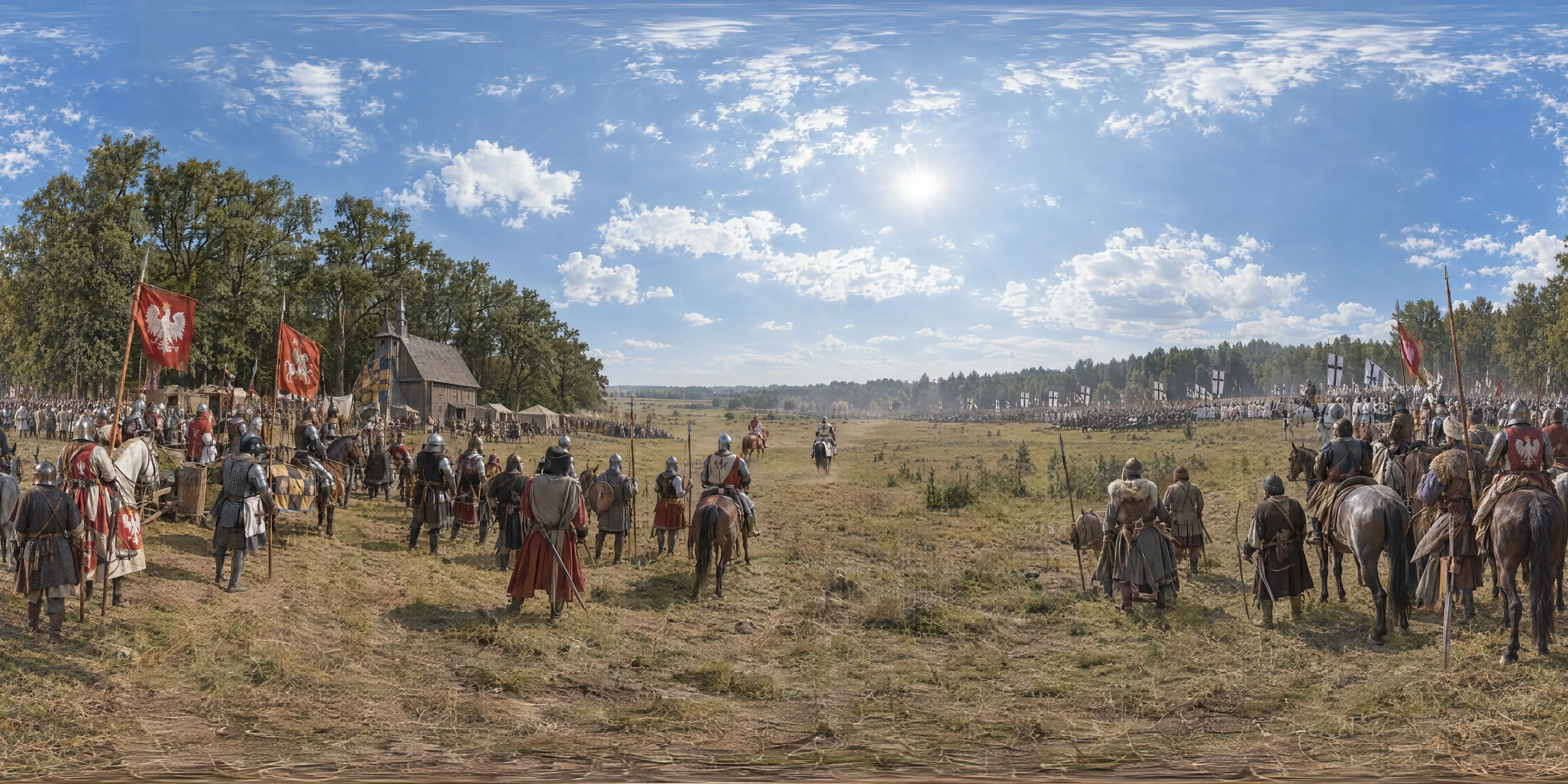
On the hot morning of 15 July 1410 the armies of King Władysław Jagiełło and Grand Duke Vytautas wait at the edge of the woods facing the Teutonic Order across the fields of Grunwald, until two heralds ride over with two naked swords from Grand Master Ulrich von Jungingen, a taunt to come out and fight. By evening the Order's army is broken and its Grand Master dead.
- Year
- 1410
- Where
- Masuria (Teutonic Prussia) · PL
- Era
- Renaissance
- Coordinates
- 53.477, 20.144
The moment
The battle began with a gift of two swords
On the morning of 15 July 1410 the army of King Władysław Jagiełło of Poland and Grand Duke Vytautas of Lithuania waited at the edge of the woods between the villages of Grunwald, Łodwigowo and Stębark, in the Teutonic state of Prussia. Across a broad, shallow valley the army of the Teutonic Order stood in the open, its knights sweating in plate armour under a hot sun.
The wait lasted hours. Then two heralds rode across the field, one wearing the arms of King Sigismund of Luxembourg, the other the red griffin of the Duke of Szczecin. Each carried a naked sword from Grand Master Ulrich von Jungingen, a taunt to come out of the trees and fight.
The episode is told by Jan Długosz, whose detailed chronicle was written several decades after the battle. Even the hour the fighting began is uncertain; estimates run from about nine in the morning to noon.
Half of Europe on one field
Under the great royal banner, a crowned white eagle on red, stood the Polish knights, with Czech and Moravian mercenaries in their ranks. Towards Stębark gathered Lithuanian and Ruthenian light horse and Tatar riders, under red banners bearing a white mounted knight.
Opposite were the brothers of the Order in white mantles with black crosses, and guest knights who had come from across Europe to fight under their own arms.
Nobody knows how many men were there. Historians' estimates run from 16,000 to 39,000 for the Polish-Lithuanian army and from 11,000 to 27,000 for the Order.
By evening the Grand Master was dead
The Order's army was broken, and Ulrich von Jungingen was killed. Between 203 and 211 of the roughly 270 brothers of the Order who fought died on the field, and afterwards only 1,427 men reported back to Marienburg, the Order's capital, to claim their pay.
The victory did not destroy the Order. The siege of Marienburg, today's Malbork, began on 26 July and was lifted on 19 September. The Peace of Thorn, signed in February 1411, gave Poland only the Dobrzyń Land.
Why Poles still ride out every July
Grunwald is the best-known victory in Polish history. Jan Matejko painted it, Henryk Sienkiewicz retold it in The Knights of the Cross, and every July thousands of re-enactors gather on the field itself, where a monument was raised in 1960 for the 550th anniversary.
The two swords became national symbols. They were kept in the Crown Treasury at Wawel and carried before kings at coronations. They escaped the Prussian plunder of the treasury in 1795 and passed to the Czartoryski collection at Puławy, then to a village presbytery at Włostowice. In 1853 a tsarist patrol found them there and confiscated them as illegal weapons. They have not been seen since.
The memory is shared and contested. Lithuania remembers the battle as Žalgiris and stresses Vytautas's part, and German nationalism answered in 1914 with a Tannenberg myth of its own. The field was never fully excavated, so where each army stood is known only roughly.
Sources
Further reading
Tagged
- poland
- lithuania
- grunwald
- masuria
- teutonic-order
- jagiello
- battle
- medieval
Published
See also

1410
Old Town Square, Prague
On 9 October 1410 the Old Town councillors reward the clockmaker Mikuláš of Kadaň for the astronomical dial he has built on the town hall tower, the heart of today's Prague orloj. Below it the market square trades as usual in the year Wycliffe's books are burned in Prague and Jan Hus is excommunicated.

15th century AD
Great Wall of China, Jinshanling
Around 1500, Ming China rebuilds the Great Wall in brick and stone across the mountain ridges north of Beijing: a battlemented rampart with watchtowers that climbs and plunges over the peaks as far as the eye can see, the most ambitious fortification ever built.

1492
Guanahani (San Salvador Island), Bahamas
At dawn on 12 October 1492, Christopher Columbus and about 40 Spanish sailors land at a Lucayan-Taíno island in the Bahamas they will rename *San Salvador*: the encounter that begins five centuries of Atlantic exchange and the destruction of indigenous Caribbean populations.