Courtyard of the Kings, El Escorial
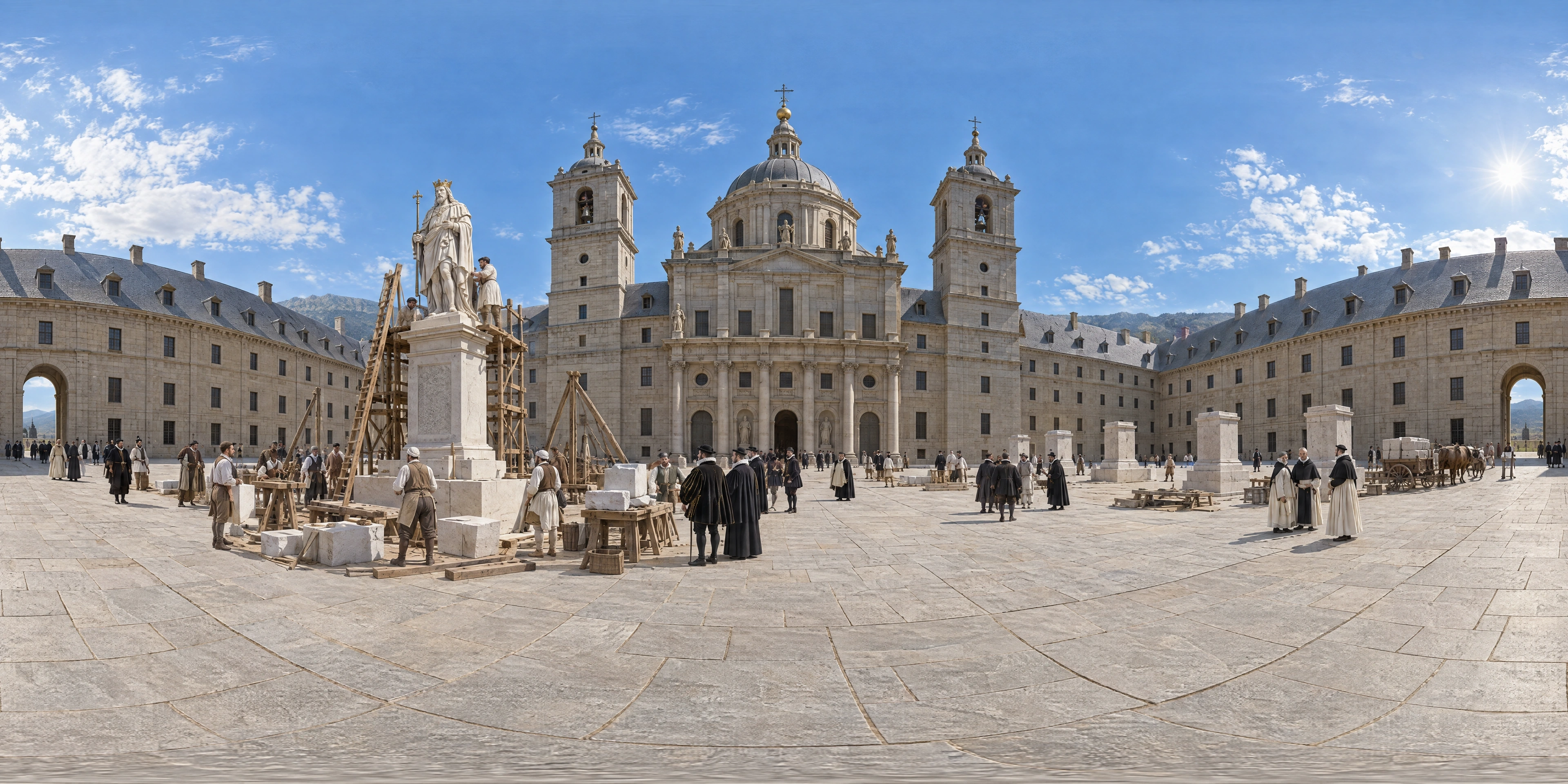
On 13 September 1584, twenty-one years after the first stone, Philip II watches the last stone of El Escorial set in the Courtyard of the Kings, marked with a cross. The granite monastery-palace designed by Juan Bautista de Toledo and Juan de Herrera, with its domed basilica, is finished in all its essentials.
- Year
- 1584
- Where
- Castile (Community of Madrid) · ES
- Era
- Renaissance
- Coordinates
- 40.589, -4.148
The moment
The last stone was marked with a cross
On 13 September 1584, in the Courtyard of the Kings at San Lorenzo de El Escorial, masons set the last stone of the building while Philip II watched. It was a granite ashlar cut with a cross, fitted high on a pilaster in the courtyard.
The first stone had been laid on 23 April 1563. In slightly less than 21 years a quadrangle of about 224 by 153 metres had risen at the foot of the Guadarrama mountains. The king was 57. Beside him stood the master of works, the Hieronymite friar Antonio de Villacastín.
A battle, a saint and a gridiron
Philip built El Escorial to commemorate the Spanish victory at St Quentin in Picardy in 1557, won on the feast of St Lawrence, and he dedicated it to that saint. Tradition says the grid of courtyards recalls the gridiron on which Lawrence was martyred. Historians are less sure, since the layout was not unique to El Escorial and its origin is disputed.
It was to be a monastery for Hieronymite monks, a basilica, a palace and a library. Above all it was a tomb, for his parents, Charles V and Isabella of Portugal, for himself and for his descendants.
The first architect, Juan Bautista de Toledo, died in 1567. His apprentice Juan de Herrera, generally regarded as the architect of El Escorial, finished it in the severe, almost unornamented granite style that Spaniards still call herreriano.
Six kings of Judah, not all yet in place
The basilica closes the east end of the courtyard, between two bell towers. Behind its front rises the dome on a drum pierced by eight windows; its lantern, spire, bronze ball and cross were set in June 1582, according to the monastery's chronicler, José de Sigüenza.
High on the front stand six colossal kings of Judah by Juan Bautista Monegro, carved in granite with white marble faces and hands and crowns and sceptres of gilded bronze. Their hoisting began in April 1584 and ended in March 1585. On the day of the last stone, only some of them were on their pedestals, and the record does not say which. Around the courtyard, plain granite ranges with rows of windows carried grey slate roofs from the king's own quarries at Bernardos.
Where Spain buries its kings
Philip lived to see his building in use. He died there on 13 September 1598, fourteen years to the day after the last stone, in rooms beside the basilica with a view of the high altar.
Below that altar lies the Pantheon of the Kings. Its 26 marble sepulchres hold Spanish monarchs from Charles V onward, with two exceptions, Philip V and Ferdinand VI.
For Spaniards El Escorial is the Golden Age and the Habsburg monarchy in stone, the place generations of schoolchildren are taken to see. UNESCO declared it a World Heritage Site on 2 November 1984. Augustinian friars now keep the monastery the Hieronymites once filled.
Sources
Further reading
Tagged
- spain
- el-escorial
- madrid
- philip-ii
- habsburg
- renaissance
- monastery
- juan-de-herrera
Published
See also

1500
Golden Roof, Innsbruck
In 1500 King Maximilian I, who often holds court in Innsbruck, completes a splendid oriel on the princely residence, roofed with 2,657 fire-gilded copper shingles. From its loggia, the Golden Roof, he and his court watch tournaments and performances in the square below.

1492
Guanahani (San Salvador Island), Bahamas
At dawn on 12 October 1492, Christopher Columbus and about 40 Spanish sailors land at a Lucayan-Taíno island in the Bahamas they will rename *San Salvador*: the encounter that begins five centuries of Atlantic exchange and the destruction of indigenous Caribbean populations.

1539
Château de Chambord
On 18 December 1539 Francis I receives his old rival, Emperor Charles V, at Chambord, the vast hunting castle whose keep, bristling with chimneys, lanterns and dormers, has just been finished in the marshes of Sologne. The emperor, crossing France on his way to Ghent, is said to be dazzled; the visit shows off the French Renaissance at its most ambitious.