Golden Roof, Innsbruck
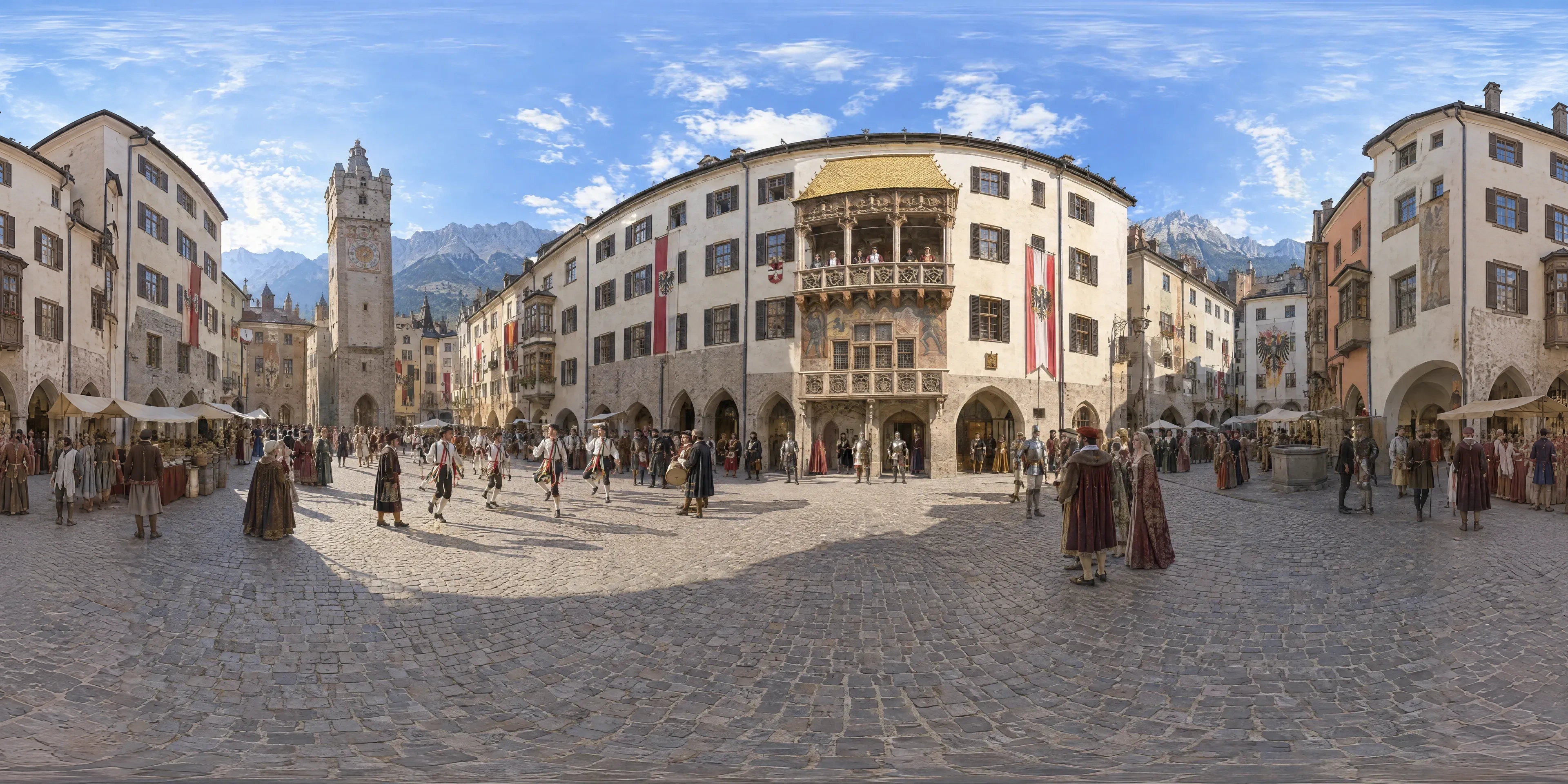
In 1500 King Maximilian I, who often holds court in Innsbruck, completes a splendid oriel on the princely residence, roofed with 2,657 fire-gilded copper shingles. From its loggia, the Golden Roof, he and his court watch tournaments and performances in the square below.
- Year
- 1500
- Where
- Tyrol · AT
- Era
- Renaissance
- Coordinates
- 47.268, 11.393
The moment
A roof of 2,657 gilded shingles
In 1500 King Maximilian I, who often held court in Innsbruck, completed a splendid oriel on the front of the princely residence, the Neuhof. Its roof is covered with 2,657 copper shingles, fire-gilded, and Tyroleans call it the Goldenes Dachl, the little golden roof.
The sources disagree on the dates. Some place the work in 1494 to 1496, others in 1497 to 1500. The builder was the court architect Niklas Türing the Elder, and the project is linked to Maximilian's marriage to Bianca Maria Sforza of Milan.
A royal box over the square
The oriel was built to watch from. From its open loggia Maximilian and his court followed tournaments and performances in the square below, where the main street of walled Innsbruck widens.
It was also built to be seen. The balustrade carries a row of carved reliefs: leaping Morris dancers, and Maximilian with both his wives, Mary of Burgundy and Bianca Maria. In 1500 Jörg Kölderer painted the walls with knights bearing banners, coats of arms and scenes of courtly life.
The reliefs on the building today are careful replicas. The originals are in the Tyrolean State Museum, the Ferdinandeum.
Innsbruck around 1500
Above the roofs rose, then as now, the grey rock wall of the Nordkette. Around the square stood three- and four-storey stone houses with arcades at street level, the Lauben, and projecting bay windows. Nearby rose the town tower, built around 1450 beside the old town hall. Merchants travelling the Brenner road passed through.
Some of the most photographed sights around the square are later. The Rococo stucco of the Helbling House dates from about 1725, the carved reliefs of the Katzung House from about 1530, and the Court Church from 1553 to 1563.
Why Tyrol's emblem is a king's balcony
Maximilian, remembered as "the last knight", made Innsbruck a centre of the Holy Roman Empire. The Golden Roof is Tyrol's best-known landmark and the emblem of the Habsburgs' rise to world power, which began in his reign.
Today the building houses a museum, the Maximilianum, and the office of the Alpine Convention, the treaty of the Alpine states.
For Austrians the little gilded roof recalls the years when a Tyrolean town, squeezed between mountains on the road to Italy, was one of the places from which a king ran an empire. It still draws crowds to the square it was built to overlook.
Sources
Further reading
Tagged
- austria
- innsbruck
- tyrol
- maximilian-i
- habsburg
- late-gothic
- renaissance
- golden-roof
Published
See also

1539
Château de Chambord
On 18 December 1539 Francis I receives his old rival, Emperor Charles V, at Chambord, the vast hunting castle whose keep, bristling with chimneys, lanterns and dormers, has just been finished in the marshes of Sologne. The emperor, crossing France on his way to Ghent, is said to be dazzled; the visit shows off the French Renaissance at its most ambitious.

15th century AD
Great Wall of China, Jinshanling
Around 1500, Ming China rebuilds the Great Wall in brick and stone across the mountain ridges north of Beijing: a battlemented rampart with watchtowers that climbs and plunges over the peaks as far as the eye can see, the most ambitious fortification ever built.

1410
Grunwald Battlefield
On the hot morning of 15 July 1410 the armies of King Władysław Jagiełło and Grand Duke Vytautas wait at the edge of the woods facing the Teutonic Order across the fields of Grunwald, until two heralds ride over with two naked swords from Grand Master Ulrich von Jungingen, a taunt to come out and fight. By evening the Order's army is broken and its Grand Master dead.