Château de Chambord
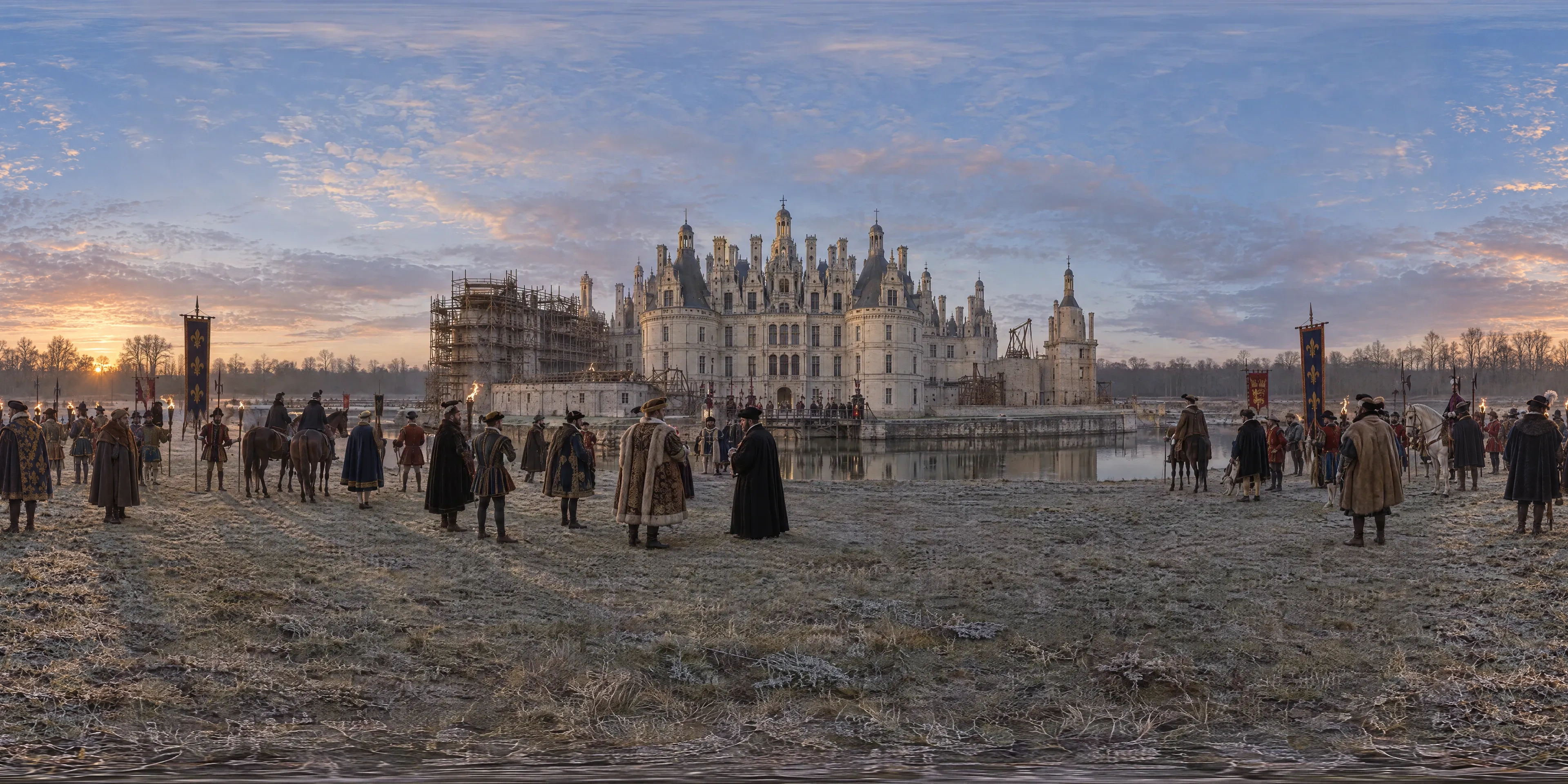
On 18 December 1539 Francis I receives his old rival, Emperor Charles V, at Chambord, the vast hunting castle whose keep, bristling with chimneys, lanterns and dormers, has just been finished in the marshes of Sologne. The emperor, crossing France on his way to Ghent, is said to be dazzled; the visit shows off the French Renaissance at its most ambitious.
- Year
- 1539
- Where
- Loire Valley (Sologne) · FR
- Era
- Renaissance
- Coordinates
- 47.617, 1.516
The moment
The emperor arrived before the wings were built
In the night of 18 to 19 December 1539 Francis I received his old rival, the Emperor Charles V, at Chambord. Charles was crossing France from Spain to Ghent, his birthplace, to punish the city for refusing to pay its share of his war costs, and the king used the passage to show off the most extravagant building in his kingdom.
The keep had just been finished: a huge block of pale tuffeau limestone rising out of the forest and marshes of Sologne, with a round tower at each corner and a roofline crowded with carved chimneys, stair turrets, dormers and lanterns inlaid with dark slate. The emperor is said to have been dazzled.
The rest was a building site. The royal wing was rising in scaffolding, and the matching chapel wing had barely begun. A century later the chapel still had no roof.
Twenty-eight years of work for forty-two nights
Francis signed the order to begin on 6 September 1519. Construction ran until 1547 under the overseer Pierre Nepveu, the plan changed repeatedly, and some 1,800 workers are said to have taken part.
For all that effort, the king barely lived there. Francis spent 42 days at Chambord in a reign of 32 years. It was a hunting seat and a statement, set in what is now the largest walled forest park in Europe, some 50 square kilometres inside a wall 32 km long.
The emperor's visit did not end the rivalry. In 1552, at Chambord, Francis's son Henry II signed a treaty with German princes who were fighting Charles V.
A staircase with two flights, and perhaps Leonardo
No plans survive. Historians think it likely that Leonardo da Vinci, who settled at Amboise at the end of 1516 and died there in May 1519, had a hand in the design, along with the Italian architect Domenico da Cortona.
The idea most often linked to Leonardo is the staircase at the heart of the keep: two spiral flights winding around each other beneath the great lantern, so that people going up and coming down need never meet. A drawing by Andrea Palladio shows a central staircase with four flights, of which only two were built.
Why the French call it the Renaissance in stone
Chambord is the emblem of the French Renaissance, and "Francis I, protector of arts and letters" is a named topic of the primary history programme in CM1. The state bought the estate in 1930 for eleven million gold francs, and it has been a UNESCO World Heritage Site since 1981.
It has also sheltered the nation's art. On 28 August 1939, as the Louvre emptied ahead of the war, the Mona Lisa left Paris for Chambord with 50 other masterpieces. In all, 37 convoys and 3,690 paintings passed through the castle, many moving on to refuges further south.
Sources
Further reading
Tagged
- france
- loire-valley
- chambord
- francis-i
- charles-v
- renaissance
- chateau
- royal-court
Published
See also

1500
Golden Roof, Innsbruck
In 1500 King Maximilian I, who often holds court in Innsbruck, completes a splendid oriel on the princely residence, roofed with 2,657 fire-gilded copper shingles. From its loggia, the Golden Roof, he and his court watch tournaments and performances in the square below.

15th century AD
Great Wall of China, Jinshanling
Around 1500, Ming China rebuilds the Great Wall in brick and stone across the mountain ridges north of Beijing: a battlemented rampart with watchtowers that climbs and plunges over the peaks as far as the eye can see, the most ambitious fortification ever built.

1410
Grunwald Battlefield
On the hot morning of 15 July 1410 the armies of King Władysław Jagiełło and Grand Duke Vytautas wait at the edge of the woods facing the Teutonic Order across the fields of Grunwald, until two heralds ride over with two naked swords from Grand Master Ulrich von Jungingen, a taunt to come out and fight. By evening the Order's army is broken and its Grand Master dead.