Frauenkirche, Dresden
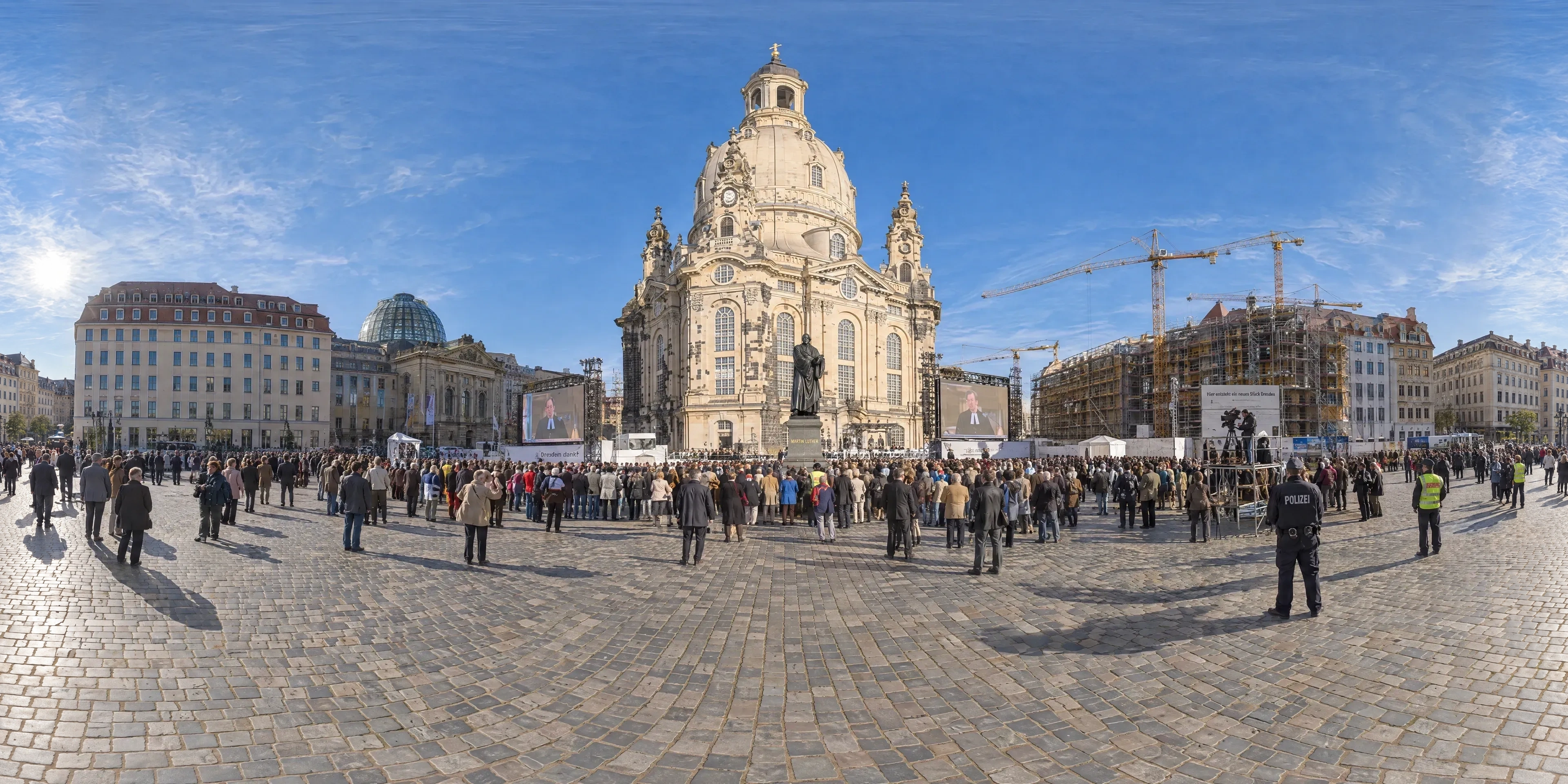
On 30 October 2005 the rebuilt Frauenkirche is consecrated, sixty years after the air raids of February 1945 turned it into a heap of rubble that stood as a memorial against war throughout East German times. Some 60,000 people follow the service on screens on the Neumarkt, beneath a golden cross made by the son of a British bomber pilot.
- Year
- 2005
- Where
- Saxony · DE
- Era
- Contemporary
- Coordinates
- 51.052, 13.741
The moment
A ruin kept as a warning
George Bähr's Frauenkirche was built between 1726 and 1743, a Protestant church crowned by a great stone dome known as the stone bell. After the air raids on Dresden in February 1945, the dome collapsed on the morning of 15 February, at about ten o'clock.
The rubble stayed where it fell. Throughout the East German years the heap lay in the middle of the city, and in 1966 it was officially declared a memorial against war. From 13 February 1982 people gathered there with candles each year to remember the dead.
Rebuilt stone by stone
In February 1990 the Call from Dresden, drafted by the pastor Karl-Ludwig Hoch, appealed for the church to be rebuilt. Clearing of the rubble began on 4 January 1993, and the foundation stone was laid on 27 May 1994.
The ruin was treated as an archaeological site. More than 8,500 original stones were salvaged, and about 3,800 were set back into the new building. The blackened old stones fleck the pale new sandstone, and larger dark patches mark surviving fragments of a corner tower and the choir.
The rebuilding cost 180 million euros. About 115 million came from donations from around the world; the federal government, the state of Saxony and the city of Dresden shared the rest.
A cross from Britain
The gilded orb and cross on the lantern were made by the British silversmith Alan Smith, whose father had been a bomber pilot in the raids of 1945. The Duke of Kent presented them in February 2000, and the cross went up on 22 June 2004.
On 30 October 2005 Bishop Jochen Bohl consecrated the church. Inside sat 1,700 invited guests, and Federal President Horst Köhler gave the main address. Outside, some 60,000 people followed the service on giant screens on the Neumarkt, where new Baroque-style facades were still rising behind scaffolding.
Why Germans see reconciliation in it
For Germans the Frauenkirche has become the great symbol of reconciliation and of reunified Germany. Its consecration was broadcast live across the country, sixty years after the raids and fifteen years after reunification.
The memory it rests on is still contested. The bombing of Dresden is exploited by the far right as a story of German victimhood alone. The rebuilt church tells a different one: a ruin kept for decades as a warning against war, raised again with gifts from around the world, and crowned with a cross made by the son of a man who had flown against the city.
Sources
Further reading
Tagged
- germany
- dresden
- saxony
- frauenkirche
- reconciliation
- reunification
- baroque
- 21st-century
Published
See also

2012
Olympic Stadium, London
At about 9.25 pm on 27 July 2012, in Danny Boyle's 'Isles of Wonder' ceremony, five glowing rings forged in a staged industrial revolution rise over the Olympic Stadium in Stratford and rain sparks. Watched by some 900 million people, it opens the Games many Britons remember as a high point of national pride.

1989
Brandenburg Gate, Berlin
On the night of November 9–10, 1989, East and West Berliners climb the Berlin Wall in front of the Brandenburg Gate, chipping at the concrete with hammers and dancing on top: the symbolic collapse of the Iron Curtain.

1682
Place d'Armes, Versailles
On 6 May 1682 Louis XIV makes Versailles the permanent seat of his court and government, turning his father's hunting lodge, now wrapped in new wings, into the stage of absolute monarchy. The palace is still a vast building site: the Hall of Mirrors is being decorated, the Grand Commun is just begun and the north wing not yet started.