Place d'Armes, Versailles
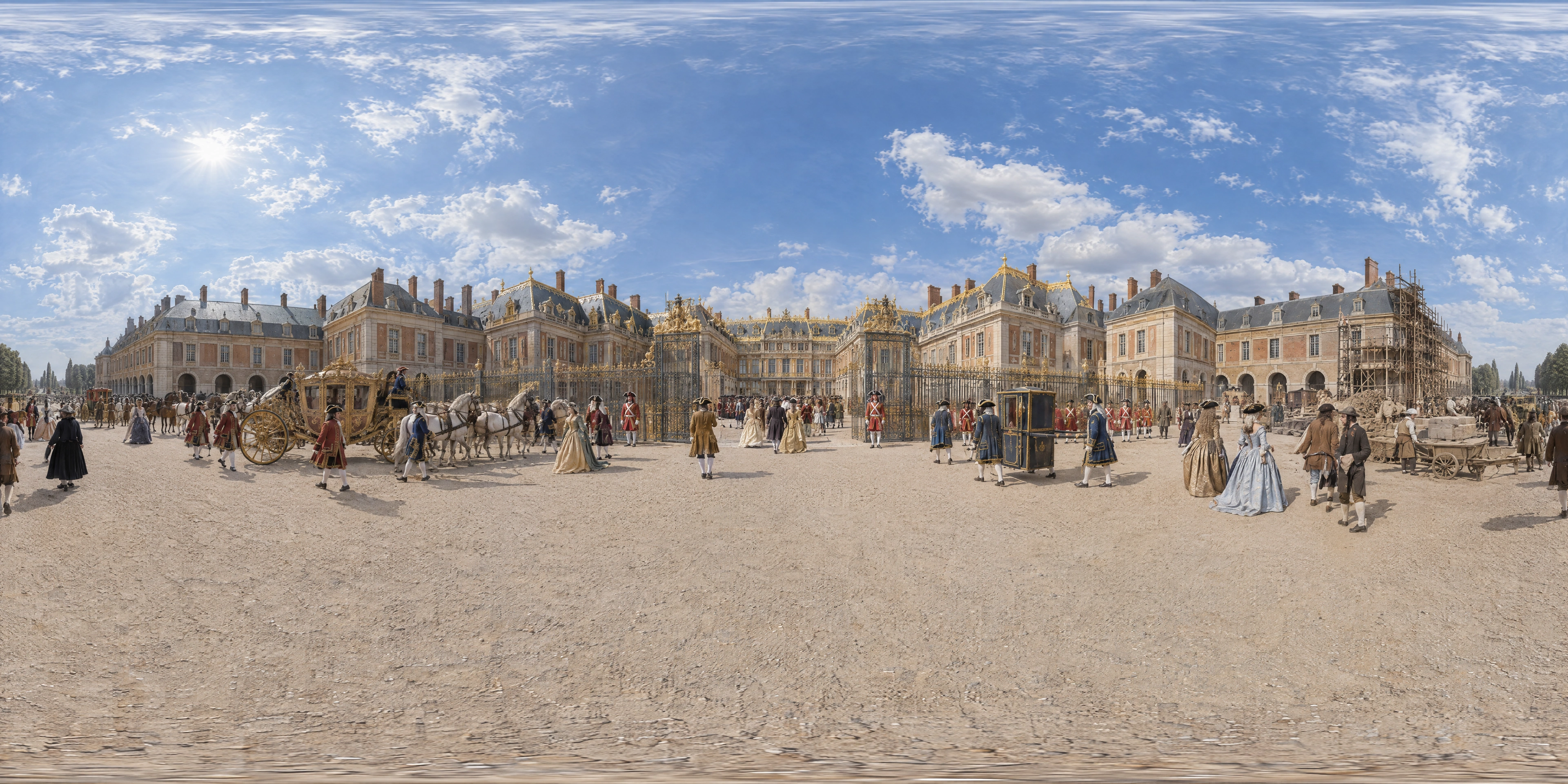
On 6 May 1682 Louis XIV makes Versailles the permanent seat of his court and government, turning his father's hunting lodge, now wrapped in new wings, into the stage of absolute monarchy. The palace is still a vast building site: the Hall of Mirrors is being decorated, the Grand Commun is just begun and the north wing not yet started.
- Year
- 1682
- Where
- Île-de-France · FR
- Era
- Early modern
- Coordinates
- 48.804, 2.124
The moment
No ceremony marked the move
On 6 May 1682 Louis XIV made Versailles the permanent seat of his court and government. There was no grand ceremony and no official announcement. Opinion among the nobility was divided, and the king simply moved in. By 1687 nobody doubted that Versailles was the real capital of France.
The king, the court and the government would stay for 107 years, until 6 October 1789, apart from the Regency of 1715 to 1723.
A hunting lodge at the heart of a palace
At the centre of it all stood a much smaller building. In 1623 Louis XIII built a hunting lodge on a hill in wooded marshland 19 km west of Paris, and from 1631 to 1634 the architect Philibert Le Roy replaced it with a château of red brick and pale stone.
His son never pulled it down. Wrapped in new wings, it still closes the Marble Court at the back of the stepped courtyards, its steep slate roofs glittering with gilded lead ornaments.
What set Louis XIV building was a party. On 17 August 1661 his finance minister Nicolas Fouquet entertained him at the château of Vaux-le-Vicomte, and the team behind it, the architect Louis Le Vau, the gardener André Le Nôtre and the painter Charles Le Brun, went on to shape Versailles.
Still a building site on moving day
In May 1682 Versailles was far from finished. From 1678 Jules Hardouin-Mansart ran the works, with a large workforce of former soldiers. The Ministers' Wings flanking the forecourt dated from 1678 and 1679, and the long south wing had just been completed, but the Hall of Mirrors was still being decorated. The Grand Commun, for the kitchens and servants, had barely begun. Where the north wing and the chapel would rise, from 1685 and 1699, there were only older buildings and builders' yards.
Facing the palace across the Place d'Armes, between the avenues from Paris, Saint-Cloud and Sceaux, stood the brand-new Great and Small Stables, built from 1679 to 1682. Today the palace spreads under some 10 hectares of roof, with 2,143 windows, 1,252 chimneys and 67 staircases.
Why the Republic still meets here
"Louis XIV, the Sun King at Versailles" is one of the reigns every French pupil studies in CM1. The palace is also the lasting symbol of royal extravagance paid for by heavy taxation, and its life as a royal seat ended when the women's march of 5 October 1789 forced the royal family back to Paris.
Later regimes found new uses for it. Louis-Philippe opened it in 1837 as a museum to "all the glories of France". The German Empire was proclaimed in the Hall of Mirrors on 18 January 1871, and the treaty ending the First World War was signed in the same room in June 1919.
It still serves the state. The two houses of Parliament meet there in congress to amend the Constitution, as they did in March 2024 to enshrine the freedom to have an abortion.
Sources
Further reading
Tagged
- france
- ile-de-france
- versailles
- louis-xiv
- absolute-monarchy
- baroque
- early-modern
- royal-court
Published
See also

1618
Prague Castle (Ludwig Wing)
On May 23, 1618, Bohemian Protestant nobles throw two imperial Catholic regents out of the upper window of the Ludwig Wing of Prague Castle, triggering the Thirty Years' War.

1650s
Tōkaidō road, Mt. Fuji
Around 1650 AD, a daimyō and his retinue of 2,000 retainers march along the Tōkaidō road past Mt. Fuji on the mandatory alternate-year residence journey to Edo: the Tokugawa shogunate's masterstroke of social control.

1640s
Taj Mahal under construction, Agra
Around 1640, the white marble dome of the Taj Mahal rises on its riverside platform at Agra: some twenty thousand workers and a thousand elephants raising Shah Jahan's tomb for his wife Mumtaz Mahal, partway through a project that will take more than twenty years.