Olympic Stadium, London
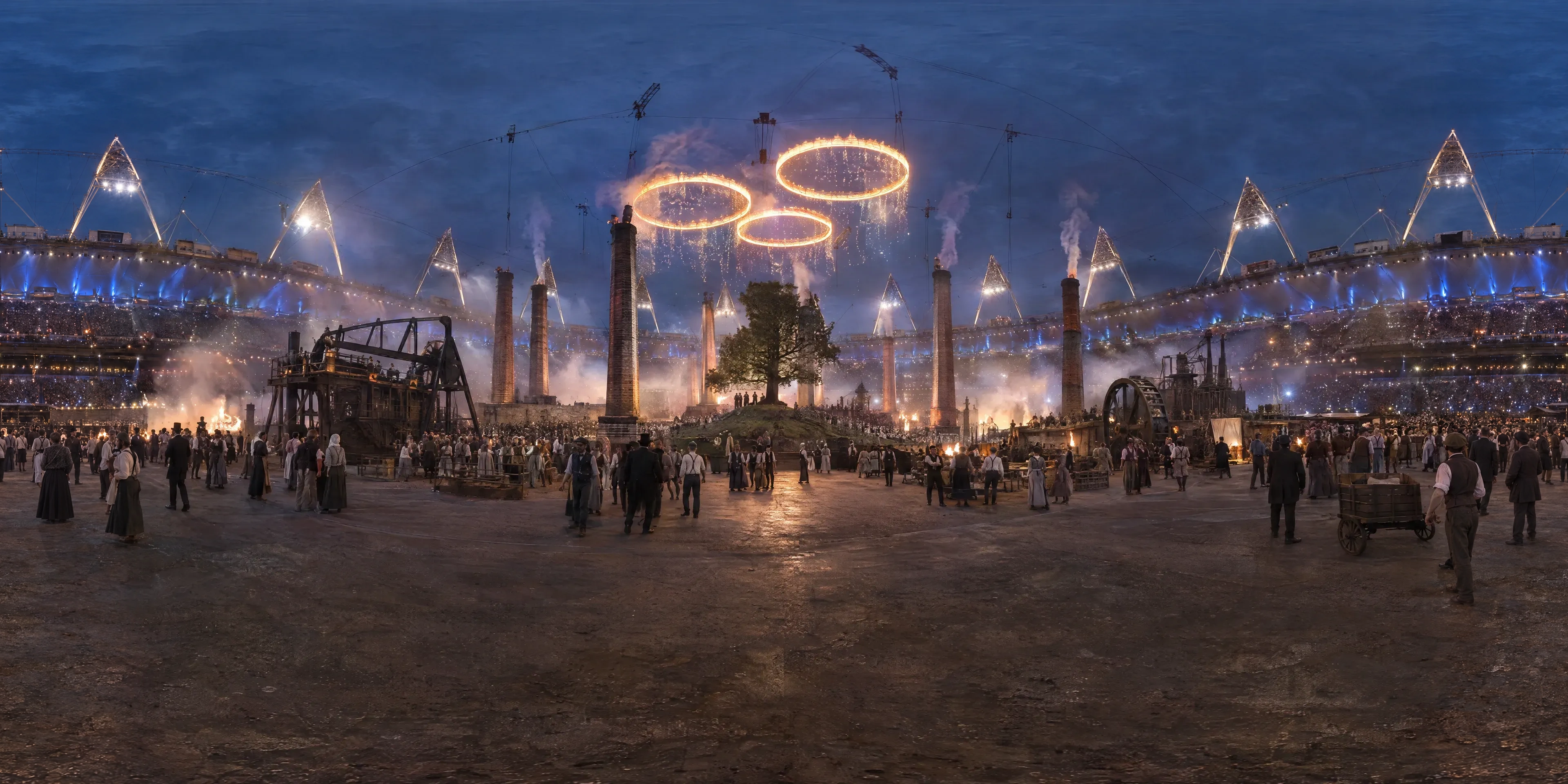
At about 9.25 pm on 27 July 2012, in Danny Boyle's 'Isles of Wonder' ceremony, five glowing rings forged in a staged industrial revolution rise over the Olympic Stadium in Stratford and rain sparks. Watched by some 900 million people, it opens the Games many Britons remember as a high point of national pride.
- Year
- 2012
- Where
- London · GB
- Era
- Contemporary
- Coordinates
- 51.539, -0.017
The moment
The biggest scene change in theatre history
Shortly after 9 on the evening of Friday 27 July 2012, the green meadow that filled the new Olympic Stadium in Stratford began to disappear. A great shout and a drumbeat, amplified by 965 performers beating upturned buckets and bins under the percussionist Evelyn Glennie, announced the section called Pandemonium.
The three-tonne oak on top of a model of Glastonbury Tor lifted, and industrial workers poured out of the hill and the stadium entrances until the cast reached 2,500 volunteers. They rolled away the grass. Seven smoking chimneys rose from the ground with steeplejacks on top, along with five beam engines, six looms, a crucible and a water wheel. The director, Danny Boyle, called it the biggest scene change in theatre history, and he had been advised not to attempt it.
Isles of Wonder, borrowed from The Tempest
Boyle's title came partly from Caliban's speech in Shakespeare's The Tempest, and the ceremony used it twice. Its opening words, "Be not afeard, the isle is full of noises", were inscribed on the 23-tonne Olympic Bell that Bradley Wiggins rang to begin the show, five days after winning the Tour de France. Kenneth Branagh, playing the engineer Isambard Kingdom Brunel, recited the speech from the Tor. He had replaced Mark Rylance three weeks before the night.
The sequence ran from rural Britain through the Industrial Revolution into the twentieth century. Volunteers marched as suffragettes, as the Jarrow Crusade and as the first Caribbean migrants off the Empire Windrush in 1948, and the stadium kept a minute's silence for the dead of both world wars, during which many in the audience stood unprompted.
Five rings forged in the arena
At the centre, workers cast a ring of glowing metal. Four more glowing rings were carried high over the stadium on wires toward the centre, the fifth rose from the forge, and when the five met above the arena as the Olympic symbol they rained sparks of silver and gold. It became the image of the night, reproduced around the world.
The rest of the ceremony celebrated the NHS, children's literature and pop music, and included a film in which the Queen, playing herself, greeted Daniel Craig's James Bond with "Good evening, Mr Bond" before the pair appeared to parachute into the stadium. It cost an estimated £27 million, about twice the original budget, against £65 million for Beijing in 2008.
Why Britons remember one night fondly
An estimated 900 million people watched worldwide, and it became the most viewed opening ceremony in the UK and the United States. Critics called it a masterpiece and a love letter to Britain, and many Britons still remember it as a rare moment of shared national pride.
It nearly lost one of its most discussed sections. In 2016 Boyle said that he had come under pressure from the then culture secretary, Jeremy Hunt, to cut back the NHS tribute, and saved it only by threatening to resign and take the volunteers with him. The stadium has changed too: since 2016 it has been the home ground of West Ham United.
Sources
Further reading
Tagged
- united-kingdom
- england
- london
- olympics
- london-2012
- opening-ceremony
- danny-boyle
- 21st-century
Published
See also

1666
Bankside, Southwark
At dusk on Sunday 2 September 1666 Samuel Pepys sits in a little alehouse on Bankside and watches the City of London burn across the Thames, 'one entire arch of fire' from the Three Cranes opposite to beyond London Bridge and up the hill. Driven by an east wind, the Great Fire will destroy most of the medieval City and Old St Paul's in four days.

2005
Frauenkirche, Dresden
On 30 October 2005 the rebuilt Frauenkirche is consecrated, sixty years after the air raids of February 1945 turned it into a heap of rubble that stood as a memorial against war throughout East German times. Some 60,000 people follow the service on screens on the Neumarkt, beneath a golden cross made by the son of a British bomber pilot.

1960
Arch of Constantine, Rome
At about 7.45 pm on 10 September 1960, after running the Appian Way barefoot between torches held by Italian soldiers, Ethiopia's Abebe Bikila breaks the tape under the Arch of Constantine in a world-best time. Rome's first Olympics showed off an Italy reborn after the war, and Bikila won in the capital of the country that had invaded his own.