Tree of Gernika and the Assembly House
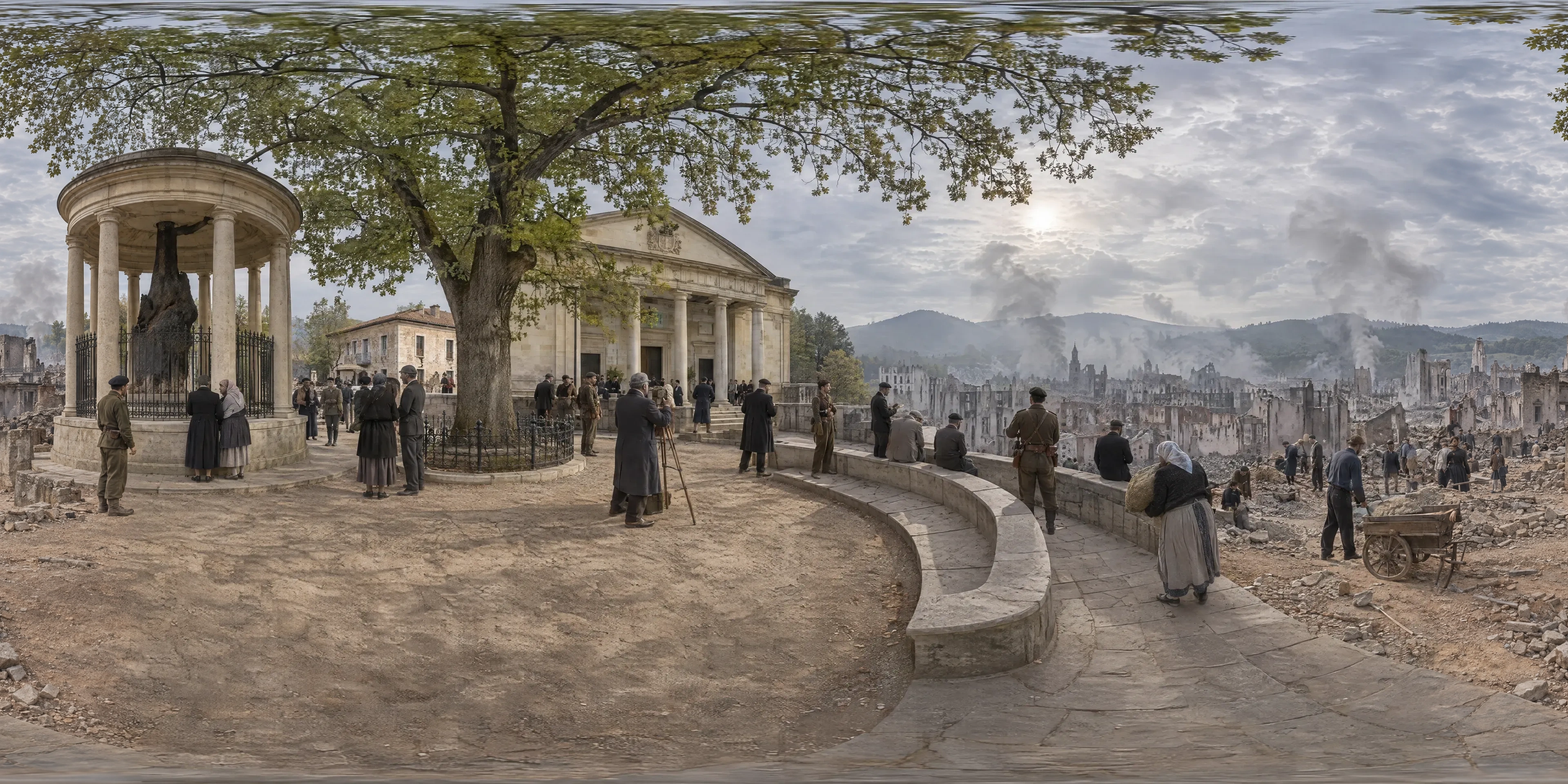
On the morning of 27 April 1937, the day after German and Italian aircraft fighting for Franco bombed and burned Gernika, smoke still rises from the ruins of the Basque town. Up the hill the Assembly House of Biscay and the oak of Gernika, symbol of Basque liberties, stand untouched.
- Year
- 1937
- Where
- Biscay (Basque Country) · ES
- Era
- modern_early
- Coordinates
- 43.315, -2.679
The moment
The town burned, the oak did not
On Monday 26 April 1937, a market day, aircraft of the German Condor Legion and the Italian Aviazione Legionaria, fighting on Franco's side in the Spanish Civil War, bombed the Basque town of Gernika from late afternoon into the evening. Fires burned through the night.
By the morning of 27 April about 85 per cent of the town's buildings had been destroyed. Walls stood roofless, and charred timbers were still smouldering.
On the rise above the town, the Casa de Juntas, the assembly house of Biscay, and the oak in front of it were undamaged.
An assembly that met under a tree
For centuries the representatives of Biscay gathered under an oak at Gernika to make their laws. Tradition dates the oldest documented tree to the fourteenth century. Rulers came here to swear to respect Biscay's fueros, its laws and liberties: Ferdinand the Catholic in 1476, Isabella in 1483. The last to take the oath was the regent María Cristina, in 1839.
The assembly house behind the tree is neoclassical, built between 1826 and 1833. The oak standing in 1937 was a young, straight tree planted in the nineteenth century before a small stone tribune. Nearby, in a small round temple built in 1926, lay the dead trunk of the Old Tree, which had lived from 1742 to 1892.
What was reported, and what is still disputed
Foreign correspondents reached the ruins within hours. George Steer's report in The Times on 28 April told the world that the town had been destroyed from the air by German aircraft. Franco's side denied responsibility and claimed that retreating Republican forces had burned Gernika themselves, and his regime kept to that version for decades.
The number of dead is still disputed. Estimates range from about 126 to more than 1,600, the higher figure being the one announced by the Basque government at the time.
In Paris, Pablo Picasso painted Guernica for the pavilion of the Spanish Republic at the International Exposition of 1937. The canvas returned to Spain in 1981 and hangs in the Museo Reina Sofía in Madrid.
Where every lehendakari takes office
José Antonio Aguirre, the first president of the Basque government, swore his oath under the tree in October 1936, and every lehendakari since has taken office there.
The oak that survived the bombing died in 2004, killed by a fungus. Its successor, planted in 2005, died in 2015. The present tree, grown from an acorn of the one before, was planted on 2 March 2015.
The town was rebuilt, and the ruins of 1937 are gone. The assembly house still stands as it did that morning, with a descendant of the old oak in front of it, and for Basques the two remain the symbol of their liberties.
Sources
Further reading
Tagged
- spain
- basque-country
- gernika
- biscay
- spanish-civil-war
- tree-of-gernika
- aftermath
- 1937
Published
See also

1944
Omaha Beach, Normandy
At 6:30 a.m. on June 6, 1944, the first waves of American soldiers from the 1st and 29th Infantry Divisions wade ashore at Omaha Beach under heavy German machine-gun fire in the bloodiest landing of D-Day.

1939
Lower Wenceslas Square, Prague
On the morning of 15 March 1939, in a heavy fall of wet snow, German columns roll down Wenceslas Square as Hitler's troops occupy what remains of Czechoslovakia. Thousands of Praguers watch from the pavements, weeping, booing and singing the national anthem; that evening Hitler reaches Prague Castle, and the next day he proclaims the Protectorate of Bohemia and Moravia.

1945
Mt. Suribachi, Iwo Jima
At midday on February 23, 1945, six United States Marines raise a larger replacement American flag on a length of iron pipe atop Mt. Suribachi on Iwo Jima, captured in Joe Rosenthal's photograph.