Gräfenberg Spa, Jeseník
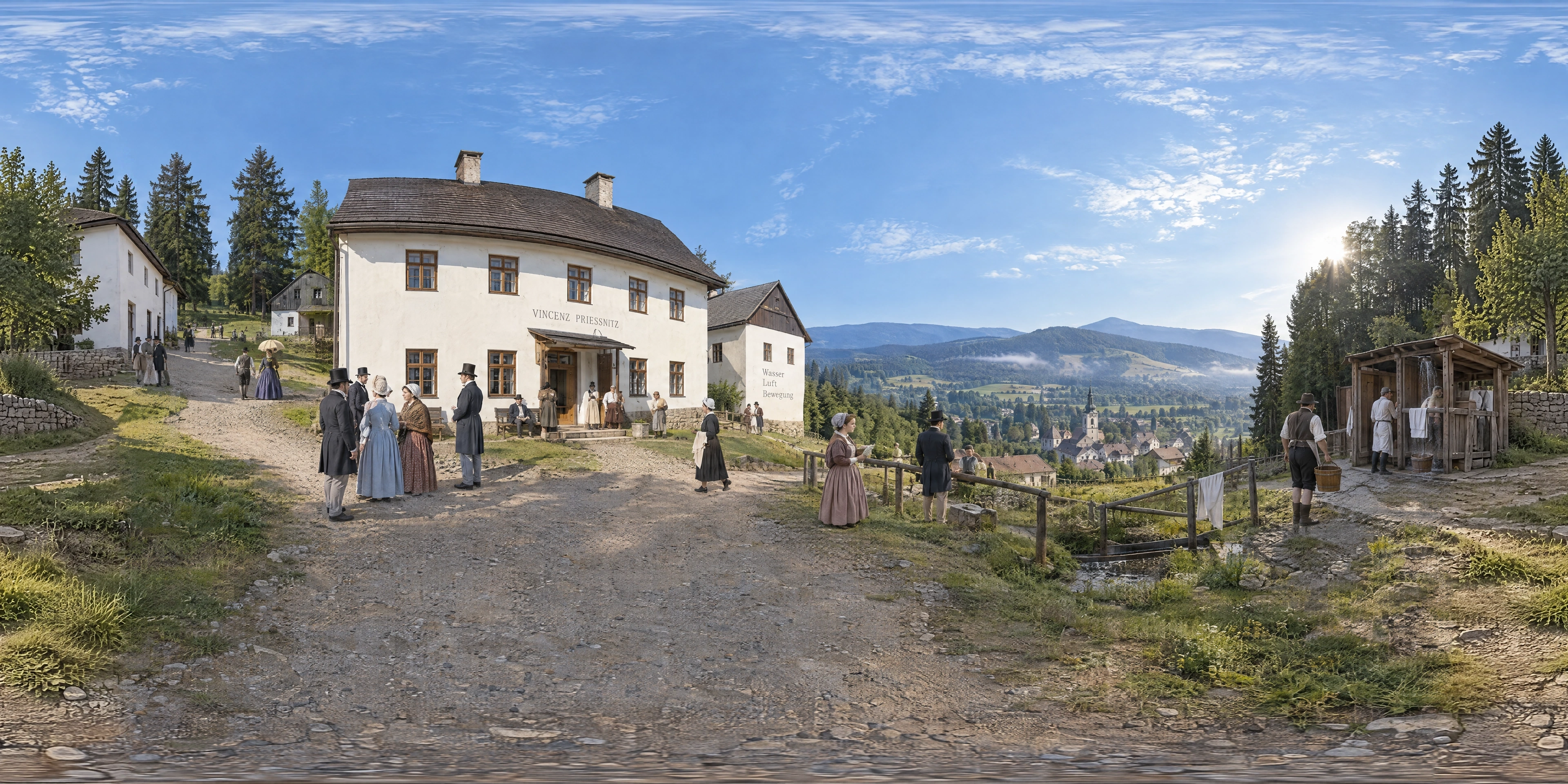
In 1839 some 1,500 patients, among them a monarch, 22 princes and 149 counts and countesses, climb to Gräfenberg in the Jeseníky mountains of Austrian Silesia to take the cold-water cure of Vincenz Priessnitz, a self-taught farmer whose spa is the first hydrotherapy resort in the world; 120 doctors come to study his methods.
- Year
- 1839
- Where
- Silesia · CZ
- Era
- Industrial
- Coordinates
- 50.242, 17.188
The moment
A farmer, a roebuck and three broken ribs
Vincenz Priessnitz was born on 4 October 1799 at Gräfenberg, a hamlet on a hillside of the Jeseníky mountains above the small Silesian town of Freiwaldau, today's Jeseník. He had no medical training. He was a farmer.
Two stories explain his method. The first is a legend: as a boy he watched a wounded roebuck come to a pool to bathe its injured leg.
The second is documented. In 1816 a cart accident broke his ribs, and a doctor judged the injury fatal; Priessnitz treated himself with wet bandages and plenty of drinking water, and within a year he had recovered.
Tried as a quack, acquitted every time
Local doctors called him an impostor. He was taken to court more than once and acquitted each time, because inspections found that he healed with water alone, and in 1838 he received official permission to run his spa.
The regime was demanding. Patients were wrapped in wet sheets until they sweated, then plunged into cold water; they stood under douches of icy spring water falling from up to six metres; they drank at least twelve glasses of water a day, walked hard, ate plain food and sometimes fasted.
A monarch, 22 princes and 149 counts
By 1839 the hamlet of about fifteen cottages, some 650 metres up, had become the first hydrotherapy resort in the world. That year about 1,500 patients climbed the hill, among them a monarch, 22 princes and 149 counts and countesses.
Some 120 doctors came too, to study what the farmer was doing.
The spa itself was modest. Priessnitz's two-storey masonry house of 1822 was the first on the hill, and in the 1830s he added plain guest and treatment houses among timber farmsteads, hay meadows and spruce forest. The douche huts stood at the forest edge, fed by water led down from mountain springs.
Why Czechs still say "priessnitz"
Priessnitz died on 26 November 1851 and was buried in a tomb in a chapel on Kopa hill. His original spa is now the Museum of Vincenz Priessnitz at Lázně Jeseník, and the Art Nouveau sanatorium that bears his name was built in 1910.
His name outlived his resort. Every Czech household knows the cold wet compress called a priessnitz, and in 2014 his healing methods were entered on the national list of intangible cultural heritage.
Gräfenberg is the pride of Czech Silesia, but the heritage is shared. Priessnitz was a German-speaking Silesian in the Austrian Empire, and his spa belongs to the common Czech and German history of the region, where a farmer with no medical training brought Europe's aristocracy to the cold cure.
Sources
Further reading
Tagged
- czechia
- silesia
- jesenik
- priessnitz
- spa
- hydrotherapy
- biedermeier
- everyday-life
Published
See also

1897
Giant Ferris Wheel, Prater, Vienna
On 3 July 1897, a hot summer day, Vienna's Giant Ferris Wheel opens in the Prater, built by English engineers for the jubilee of Emperor Franz Joseph's 50 years on the throne. Its 30 cabins turn up to 64.75 m above the canals of the 'Venice in Vienna' pleasure park, making it one of the largest wheels in the world; a ride costs a gulden.

1881
National Theatre, Prague
On the afternoon of 12 August 1881, two months after its opening, the National Theatre, built over thirteen years from the pennies of a whole nation, catches fire and loses its copper dome, auditorium and stage. Within 47 days the Czechs collect a million gulden to rebuild it, and it reopens in 1883.

1869
Court Opera on the Ringstraße, Vienna
On the evening of 25 May 1869 Emperor Franz Joseph opens the new Court Opera, the first great public building on Vienna's Ringstraße, with Mozart's Don Giovanni sung in German. Neither of its architects lives to see the night: both died in 1868, after Viennese mockery of the 'sunken box'.