Court Opera on the Ringstraße, Vienna
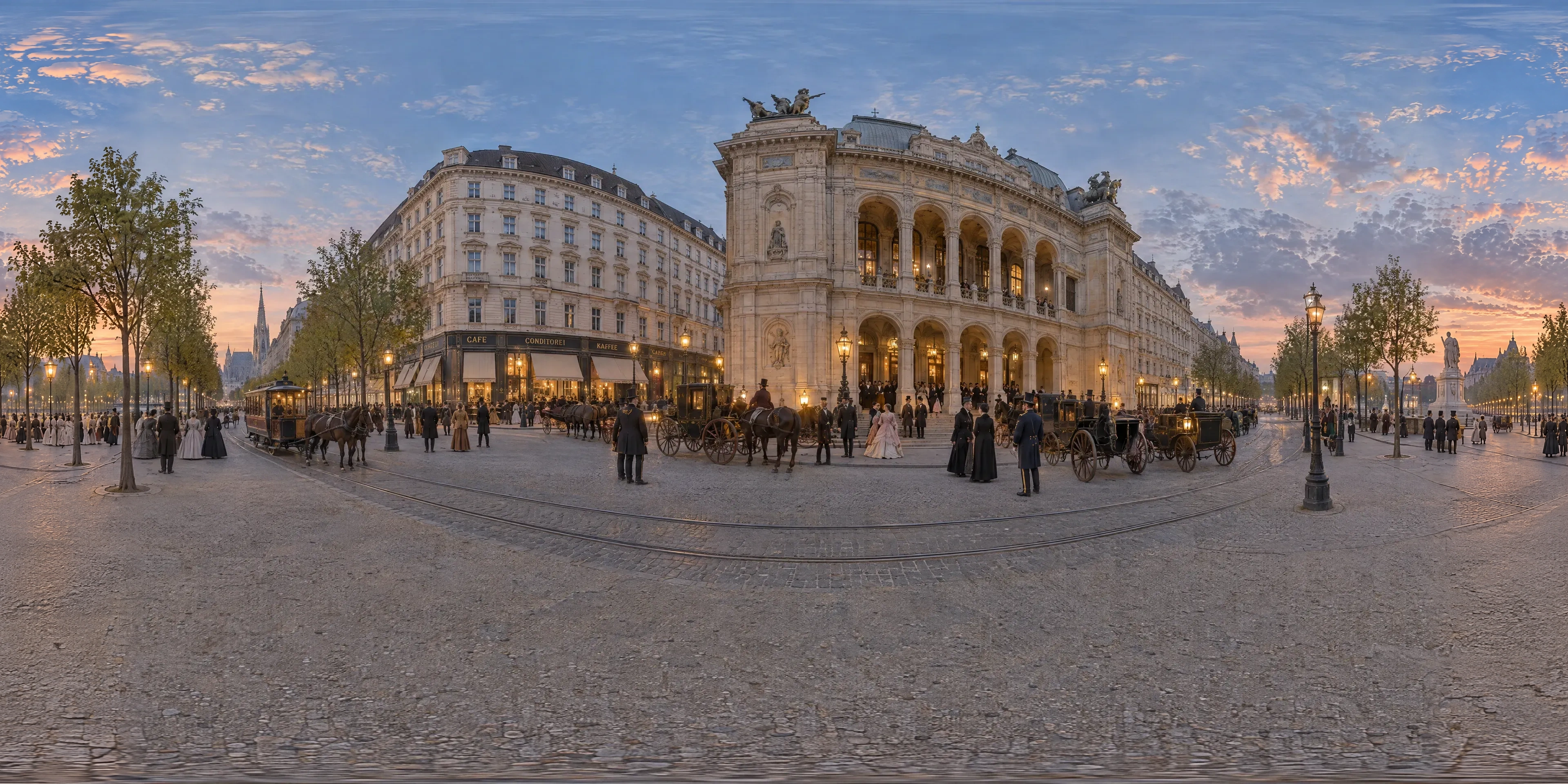
On the evening of 25 May 1869 Emperor Franz Joseph opens the new Court Opera, the first great public building on Vienna's Ringstraße, with Mozart's Don Giovanni sung in German. Neither of its architects lives to see the night: both died in 1868, after Viennese mockery of the 'sunken box'.
- Year
- 1869
- Where
- Vienna · AT
- Era
- Industrial
- Coordinates
- 48.203, 16.370
The moment
The first great building on the Ring
On the evening of 25 May 1869 Emperor Franz Joseph opened the new Court Opera in Vienna with Mozart's Don Giovanni, sung in German. It was the first great public building on the Ringstraße, the boulevard laid out where the city walls had stood and opened in 1865.
The house was built between 1861 and 1869 in Neo-Renaissance style and clad in pale limestone, with an arcaded driveway where carriages drew up and an open loggia above.
Mocked as a sunken box
The Viennese did not love it at first. The building sat about a metre below the raised level of the Ring, and critics called it a sunken box and the Königgrätz of architecture, after the army's defeat of 1866.
Neither architect lived to see the opening. Eduard van der Nüll took his own life in 1868, and his partner, August Sicard von Sicardsburg, died of tuberculosis shortly afterwards.
The building outlasted its critics. The house the Viennese mocked in 1869 is the one they rebuilt after the Second World War.
Vienna in May 1869
Around the opera the Ring was still young, with double avenues of young trees and horse-drawn trams running along it. Opposite stood the Heinrichhof of 1861 to 1863, the city's grandest apartment block. Kärntner Straße led into the old town, with the Gothic spire of St Stephen's above the roofs.
Behind the opera the river Wien still ran open, crossed by the Elisabeth Bridge with its eight marble statues. It was vaulted over only in the 1890s.
Much of the Ring was still to come: the Hotel Sacher in 1876, and the Burgtheater, Parliament, City Hall and museums further along.
Why the State Opera is Austria's stage
On 12 March 1945 bombs destroyed the auditorium and the stage, with nearly all the scenery and costumes. The house reopened on 5 November 1955 with Beethoven's Fidelio, conducted by Karl Böhm, in the year Austria regained its sovereignty.
Today the Vienna State Opera is the country's great cultural stage, with 1,709 seats and 567 standing places. The Vienna Philharmonic recruits its members from the opera orchestra, and every carnival season the Opera Ball fills the house.
The Ringstraße it opened remains the defining monument of Franz Joseph's Vienna. For Austrians the opera on its corner is where that Vienna begins: the first of the boulevard's great public buildings, mocked in its day and now a national symbol.
Sources
Further reading
Tagged
- austria
- vienna
- ringstrasse
- opera
- franz-joseph
- historicism
- 19th-century
- mozart
Published
See also

1897
Giant Ferris Wheel, Prater, Vienna
On 3 July 1897, a hot summer day, Vienna's Giant Ferris Wheel opens in the Prater, built by English engineers for the jubilee of Emperor Franz Joseph's 50 years on the throne. Its 30 cabins turn up to 64.75 m above the canals of the 'Venice in Vienna' pleasure park, making it one of the largest wheels in the world; a ride costs a gulden.

1867
Coronation Mound at the Chain Bridge, Pest
On 8 June 1867, crowned king in Buda to seal the Compromise with Austria, Franz Joseph rides across the Chain Bridge to Pest, swears the constitutional oath and gallops up a mound heaped from the earth of every county of the kingdom to cut the air with St Stephen's sword towards the four points of the compass. The ceremony seals the birth of Austria-Hungary.

1955
Upper Belvedere, Vienna
Around noon on Sunday 15 May 1955, just after the State Treaty is signed in the Marble Hall of the Upper Belvedere, Foreign Minister Leopold Figl steps onto the balcony with the Allied foreign ministers and holds up the signed treaty to the crowd waiting in the palace garden. After ten years of occupation, Austria is free.