Giant Ferris Wheel, Prater, Vienna
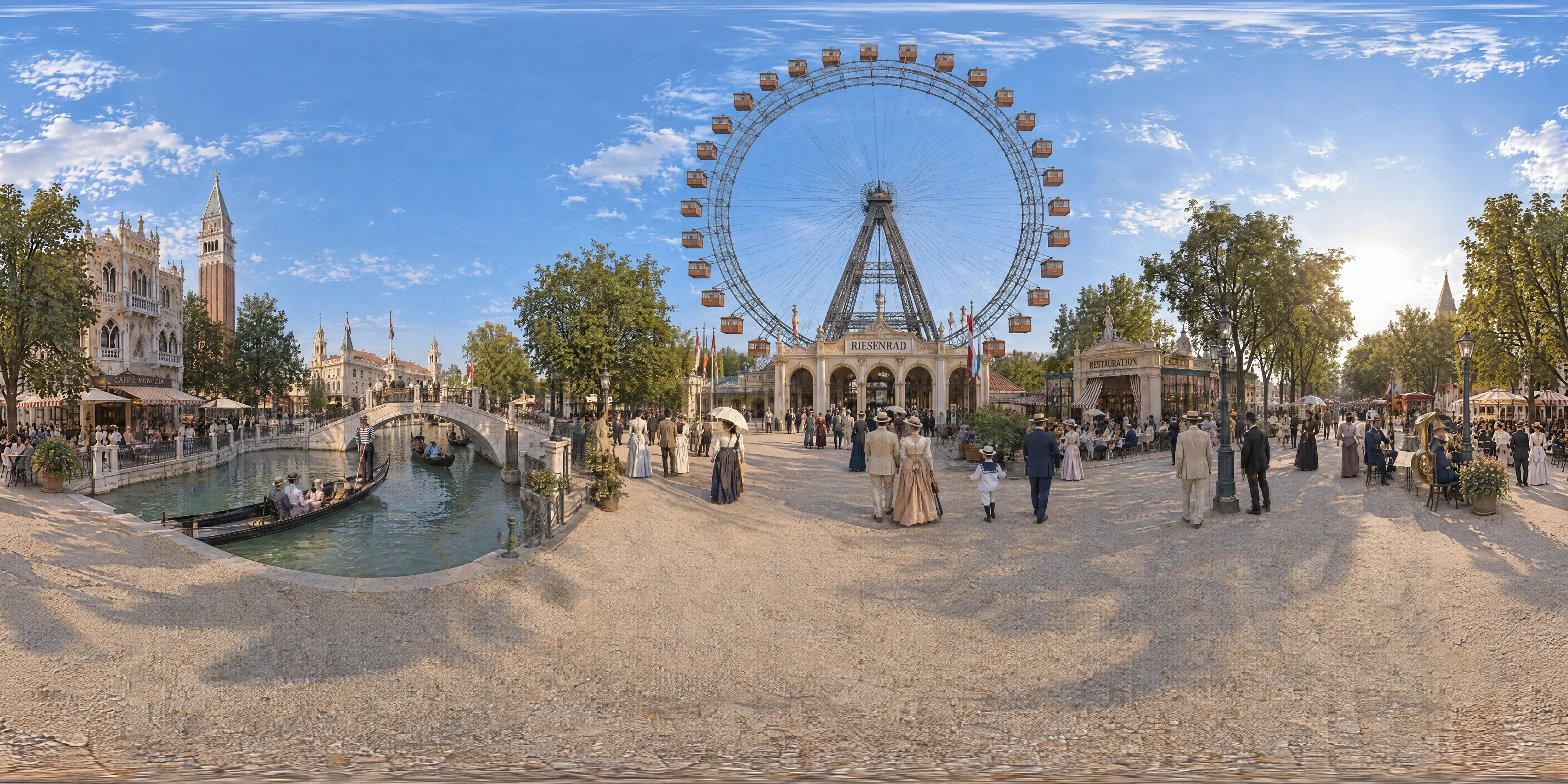
On 3 July 1897, a hot summer day, Vienna's Giant Ferris Wheel opens in the Prater, built by English engineers for the jubilee of Emperor Franz Joseph's 50 years on the throne. Its 30 cabins turn up to 64.75 m above the canals of the 'Venice in Vienna' pleasure park, making it one of the largest wheels in the world; a ride costs a gulden.
- Year
- 1897
- Where
- Vienna · AT
- Era
- Industrial
- Coordinates
- 48.217, 16.395
The moment
Built for an emperor's jubilee
On 3 July 1897, a hot summer day, Vienna's Giant Ferris Wheel opened in the Prater. It was built for the golden jubilee of Emperor Franz Joseph, fifty years on the throne, and it was English work: designed by the engineers Harry Hitchins and Hubert Cecil Booth and constructed by Walter Basset. The jubilee itself fell in 1898, so the wheel was ready a year early.
The riveted steel wheel reached 64.75 metres at its highest point. Thirty wooden cabins, each with six windows along its side, hung from the rim. On opening day it ran from four in the afternoon until eleven at night, and a ride cost one gulden.
Venice beside the Danube
The wheel rose beside Venice in Vienna, a pleasure park opened in 1895 on the Kaiserwiese, the emperor's meadow in the Prater. It played at being Venice, with canals, gondolas and gondoliers, humpbacked bridges, facades of palazzi and bell towers around small squares, and café terraces.
Around it spread the Prater itself, Vienna's great park on the Danube side of the city, with its old trees, booths and inns.
Too expensive to demolish
The wheel very nearly vanished. A demolition permit was issued in 1916, but there was no money to carry out the work, and the wheel survived.
When the Grande Roue de Paris was pulled down in 1920, the Vienna wheel became the tallest Ferris wheel still standing anywhere. It kept the title for 65 years, until an 85-metre wheel went up in Japan in 1985.
The Second World War left it badly damaged, and when it was rebuilt only 15 cabins were hung instead of 30. That is how it has turned since 1947.
Its history has a darker page. Its later owner, Eduard Steiner, was dispossessed by the Nazis in 1938 and murdered in Auschwitz.
Why the wheel is Vienna's signature
In 1949 the wheel starred in The Third Man, and film-makers have come back to it ever since, from The Living Daylights to Before Sunrise.
For Austrians it is one of the best-loved landmarks in the country, the symbol of the Prater and of fin-de-siècle Vienna. It appears on countless postcards of the city.
It began as a foreign novelty for an imperial jubilee. Its great rival in Paris came down in 1920; the Vienna wheel is still turning, and it is hard to picture the city's skyline without it.
Sources
Further reading
Tagged
- austria
- vienna
- prater
- riesenrad
- fin-de-siecle
- franz-joseph
- 19th-century
- everyday-life
Published
See also

1869
Court Opera on the Ringstraße, Vienna
On the evening of 25 May 1869 Emperor Franz Joseph opens the new Court Opera, the first great public building on Vienna's Ringstraße, with Mozart's Don Giovanni sung in German. Neither of its architects lives to see the night: both died in 1868, after Viennese mockery of the 'sunken box'.

1810
Theresienwiese, Munich
On 17 October 1810 a horse race on a meadow outside Munich crowns the celebrations for the wedding of Crown Prince Ludwig of Bavaria and Princess Therese of Saxe-Hildburghausen; 50,000 spectators watch from the hillside, and the field is named Theresienwiese after the bride. Repeated the next year, the race becomes the Oktoberfest.

1839
Gräfenberg Spa, Jeseník
In 1839 some 1,500 patients, among them a monarch, 22 princes and 149 counts and countesses, climb to Gräfenberg in the Jeseníky mountains of Austrian Silesia to take the cold-water cure of Vincenz Priessnitz, a self-taught farmer whose spa is the first hydrotherapy resort in the world; 120 doctors come to study his methods.