Holsten Gate, Lübeck
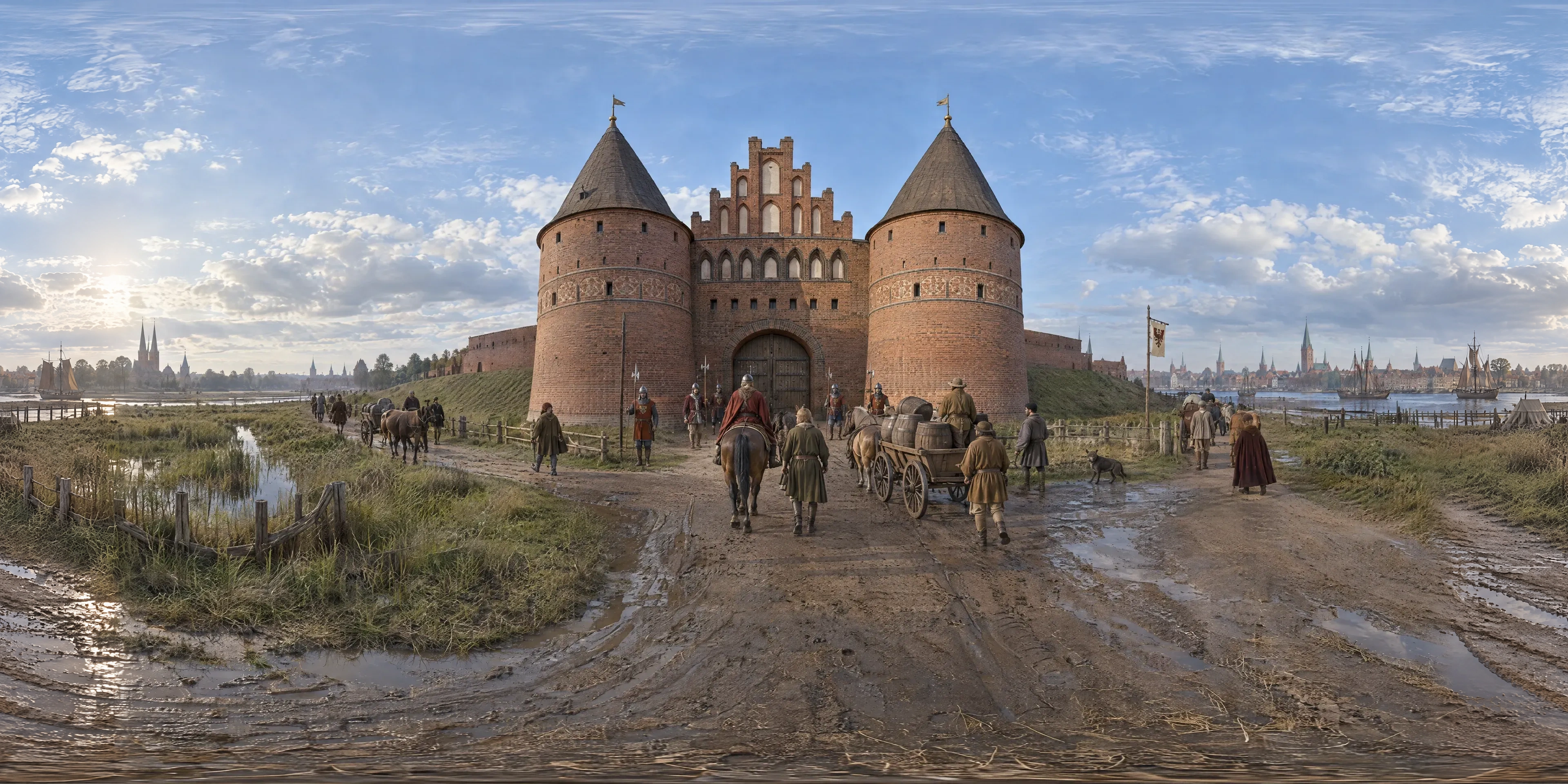
In 1478 Lübeck's city architect Hinrich Helmstede completes a massive new gate on the road to Holstein, raised on an artificial mound with walls up to 3.5 m thick against the cannon of a new age. Behind it lies the leading city of the Hanseatic League, whose ships and salt trade dominate the Baltic.
- Year
- 1478
- Where
- Schleswig-Holstein (Hanseatic Lübeck) · DE
- Era
- Renaissance
- Coordinates
- 53.866, 10.678
The moment
A gate built for the age of cannon
In 1478 Lübeck finished a new gate on the road west into Holstein. Work had begun in 1464 under the city's master builder, Hinrich Helmstede, and what he built was closer to a fortress than a doorway.
It stands on an artificial mound about seven metres high, raised in marshy ground west of the river Trave. Two round towers of red brick flank a gabled central block with an arched passage.
The design shows where danger was expected. On the field side the walls are up to 3.5 metres thick and pierced by gun ports on three levels. On the city side they are less than a metre thick. Two bands of terracotta plaques run round the building, patterned with lilies, thistle leaves and shields bearing Lübeck's eagle.
The marsh had its say. The south tower sank during construction, and the gate still leans.
The leading city of the Hanse
Behind the gate lay the leading city of the Hanseatic League, the alliance of merchant towns whose ships and salt trade dominated the Baltic.
From the road the skyline was already Lübeck's own. Across the Trave, on the hill of the old town, the twin brick spires of St Mary's rose about 125 metres.
Much of what now surrounds the gate was not there. For about a century the Holstentor was the outermost gate on this road, until a Renaissance outer gate was added in 1585. The brick salt warehouses beside it came later too, the first of them in 1579.
Saved by a single vote
By the nineteenth century the gate was in a dangerous state. In 1863 Lübeck's citizens voted to restore it rather than pull it down, by a majority of one vote.
The restoration ran from 1865 to 1871. It rebuilt the gables and roofs, whose original shape is not known, and added the inscriptions. On the field side a Latin motto reads CONCORDIA DOMI FORIS PAX, harmony within, peace outside. On the city side stand the letters S.P.Q.L., for the Senate and People of Lübeck, between the years 1477 and 1871.
Why Germans carried it in their wallets
From 1960 to 1991 the Holstentor was on the 50-mark note. In 2006 it appeared on the first of Germany's two-euro coins honouring the federal states, the one for Schleswig-Holstein.
Today the gate houses a museum of the city's history, and Lübeck's old town has been a UNESCO World Heritage Site since 1987.
For Germans the squat, leaning gate stands for the Hanse itself, the medieval trading power every pupil meets in school, and for the city that led it. Few buildings in the country are so instantly recognised, and few came so close to being lost.
Sources
Further reading
Tagged
- germany
- lubeck
- hanseatic-league
- late-medieval
- brick-gothic
- city-gate
- salt
- trade
Published
See also

1543
Cathedral Hill, Frombork
In late May 1543 Nicolaus Copernicus, a 70-year-old canon of the Warmian chapter, dies at Frombork; by tradition the first printed copy of his De revolutionibus, the book that sets the Earth moving around the Sun, reached him on his last day. The walled cathedral hill, beside which he lived and watched the sky for more than thirty years, looks out over the Vistula Lagoon.

1444
Florence Cathedral, Florence
In 1444, Brunelleschi's revolutionary double-shell brick dome over Santa Maria del Fiore in Florence approaches completion: the largest masonry dome in the world, raised without scaffolding.

15th century AD
Great Wall of China, Jinshanling
Around 1500, Ming China rebuilds the Great Wall in brick and stone across the mountain ridges north of Beijing: a battlemented rampart with watchtowers that climbs and plunges over the peaks as far as the eye can see, the most ambitious fortification ever built.