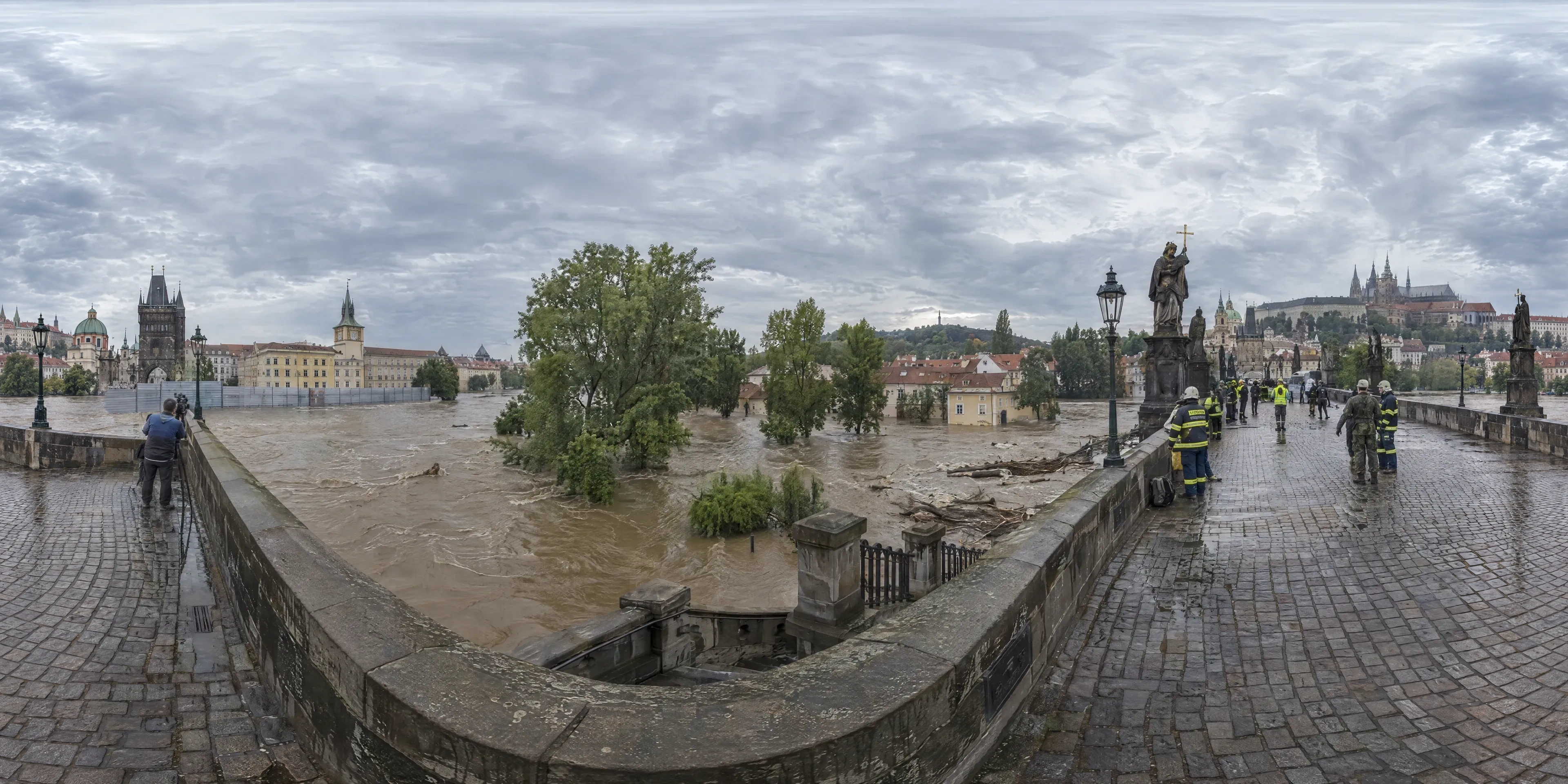
Kampa from Charles Bridge, Prague
At noon on 14 August 2002 the Vltava peaks at 5,160 cubic metres per second, Prague's worst flood in centuries. Kampa and the lower Lesser Town stand under water to the first floor, every bridge is closed to all but rescuers, and on the Old Town bank the mobile barriers hold with barely half a metre to spare.
- Year
- 2002
- Where
- Bohemia · CZ
- Era
- Contemporary
- Coordinates
- 50.087, 14.409
The moment
The river peaked at noon
At noon on Wednesday 14 August 2002 the Vltava reached its peak in Prague: 5,160 cubic metres per second at the Chuchle gauge, the city's worst flood in centuries.
Below Charles Bridge, the square Na Kampě had disappeared under fast brown water that reached the first-floor windows of its old houses. The trees of Kampa park stood in the flood, and the Čertovka millrace had merged with the river.
Every bridge in the city was closed to all but rescuers. On the Old Town bank, a wall of mobile aluminium barriers held back the river with barely half a metre to spare.
Charles Bridge held
The bridge itself survived the flood undamaged: all sixteen arches, built between 1357 and 1402, stood firm. It had not always been so lucky: in 1890 a flood destroyed three of its arches, and in 1432 another damaged three pillars.
In 2002 it was closed to everyone but rescuers, and the river raced under its Gothic arches, below the Baroque statues, higher than anyone alive had seen it.
Eighteen metro stations and a sea lion
Kampa was only one of the neighbourhoods hit. Karlín, Holešovice and Libeň suffered worst of all, with a real danger that buildings would collapse, and about 40,000 people were evacuated from Prague.
The metro flooded too: some 18 stations went under water, and the damage to the system alone was put at about 7 billion koruna.
The zoo was hit as well. Gaston, one of its sea lions, escaped from his flooded enclosure and swam down the river all the way into Germany; he was caught in Dresden, but died soon after.
The disaster every adult Czech remembers
No one died in Prague, but across the country the floods killed 17 people. Some 225,000 people had to leave their homes, and the damage came to between 70 and 73 billion koruna.
It is the natural disaster every adult Czech remembers, and the sight of Kampa under water is part of that shared memory.
The city learned from it. Permanent flood defences have since been built along the Lesser Town bank, where in 2002 there were none. On an ordinary summer day Charles Bridge is full of visitors again; on 14 August 2002 it stood almost empty above the highest water Prague had seen in generations.
Sources
Further reading
Tagged
- czechia
- prague
- flood
- vltava
- kampa
- charles-bridge
- 2002
- 21st-century
Published
See also

1357
Charles Bridge, Prague
In 1357 Emperor Charles IV lays the foundation stone of a new stone bridge on the Old Town bank near St Clement's, fifteen years after ice and floodwater wrecked the Judith Bridge. Tradition sets the moment at 5:31 on 9 July, a palindrome of odd numbers; the bridge will take 45 years to finish.

1881
National Theatre, Prague
On the afternoon of 12 August 1881, two months after its opening, the National Theatre, built over thirteen years from the pennies of a whole nation, catches fire and loses its copper dome, auditorium and stage. Within 47 days the Czechs collect a million gulden to rebuild it, and it reopens in 1883.

2012
Olympic Stadium, London
At about 9.25 pm on 27 July 2012, in Danny Boyle's 'Isles of Wonder' ceremony, five glowing rings forged in a staged industrial revolution rise over the Olympic Stadium in Stratford and rain sparks. Watched by some 900 million people, it opens the Games many Britons remember as a high point of national pride.