Karl-Marx-Platz (Augustusplatz), Leipzig
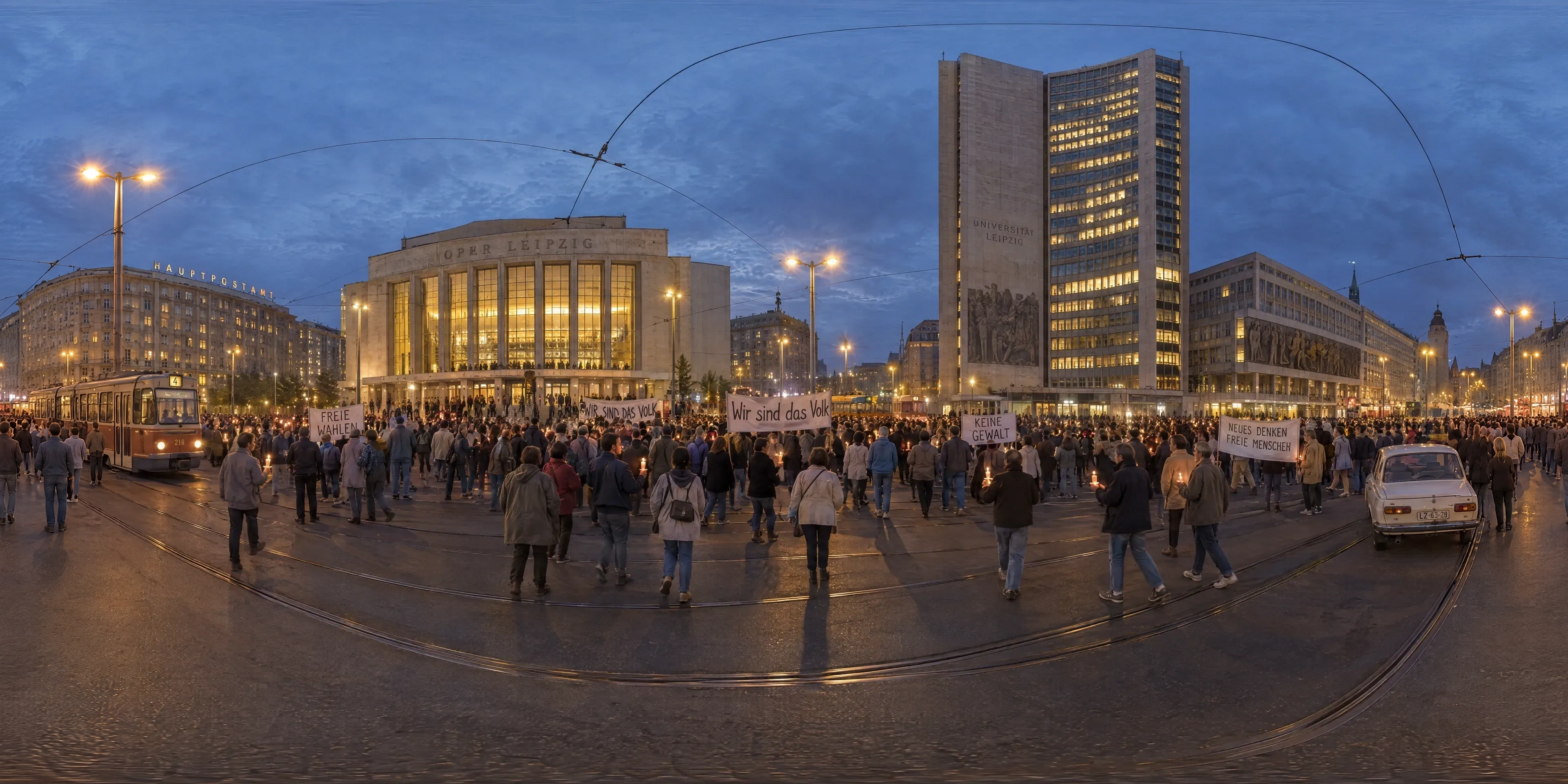
On the evening of 9 October 1989 more than 70,000 people leave the peace prayers in Leipzig's churches and march around the inner ring past armed police and militia, carrying candles and chanting 'Wir sind das Volk' and 'Keine Gewalt'. The security forces hold back, and the peaceful revolution breaks through, a month before the Berlin Wall falls.
- Year
- 1989
- Where
- Saxony (GDR) · DE
- Era
- Contemporary
- Coordinates
- 51.339, 12.381
The moment
Seventy thousand on the ring
On the evening of Monday 9 October 1989 some 70,000 people walked around Leipzig's inner ring road. They came from the peace prayers held at five o'clock in St Nicholas' Church and three other churches in the city centre, and many carried lit candles. They chanted "Wir sind das Volk", we are the people, and "Keine Gewalt", no violence.
Armed police and factory militia waited in the side streets. The East German leadership had prepared for a violent crackdown. It never came, and why the order to intervene was never given is still debated.
Six names on the loudspeakers
From six o'clock the city's loudspeakers carried an appeal for calm on both sides, read by the conductor Kurt Masur. It was signed by six men: Masur, the cabaret artist Bernd-Lutz Lange, the theologian Peter Zimmermann, and three local secretaries of the ruling SED, Kurt Meyer, Jochen Pommert and Roland Wötzel.
The prayers themselves were not new. Monday evening prayers for peace had been held in St Nicholas' since 20 September 1982.
A square renamed with every regime
The crowds gathered on Karl-Marx-Platz, the vast square on the inner ring. Its name changed with the politics of the day: the Social Democratic city government renamed Augustusplatz after Marx in 1928, the Nazis restored the old name in 1933, and the East German state brought Marx back in 1953. It became Augustusplatz again on 3 October 1990, the day of German reunification.
In 1989 it was ringed by the buildings of the socialist city. To the north stood the pale Opera House of 1960. To the west rose the university's main building with the huge bronze relief Aufbruch of 1973, Karl Marx at its centre, and the university tower of 1972, about 142 metres high and shaped like an open book. To the south stood the Gewandhaus concert hall of 1981 and the Mende fountain of 1886.
One building was missing. In May 1968 the authorities had dynamited the university church of St Paul, which had come through the war with little damage. The Paulinum, the assembly hall that recalls its shape, opened only in December 2017.
Why Leipzig lights candles every October
Leipzig's 9 October is remembered as the decisive day of the peaceful revolution. The security forces held back, and the protest broke through. A month later, on 9 November, the Berlin Wall fell, and within a year Germany was reunified.
The city marks the day every year with a Festival of Lights. For Germans it stands for something rare in their history: a revolution that won because it stayed peaceful.
Sources
Further reading
Tagged
- germany
- leipzig
- gdr
- peaceful-revolution
- monday-demonstrations
- 1989
- saxony
- 20th-century
Published
See also

2005
Frauenkirche, Dresden
On 30 October 2005 the rebuilt Frauenkirche is consecrated, sixty years after the air raids of February 1945 turned it into a heap of rubble that stood as a memorial against war throughout East German times. Some 60,000 people follow the service on screens on the Neumarkt, beneath a golden cross made by the son of a British bomber pilot.

1989
Brandenburg Gate, Berlin
On the night of November 9–10, 1989, East and West Berliners climb the Berlin Wall in front of the Brandenburg Gate, chipping at the concrete with hammers and dancing on top: the symbolic collapse of the Iron Curtain.

2012
Olympic Stadium, London
At about 9.25 pm on 27 July 2012, in Danny Boyle's 'Isles of Wonder' ceremony, five glowing rings forged in a staged industrial revolution rise over the Olympic Stadium in Stratford and rain sparks. Watched by some 900 million people, it opens the Games many Britons remember as a high point of national pride.