Bay of Naples from Mergellina
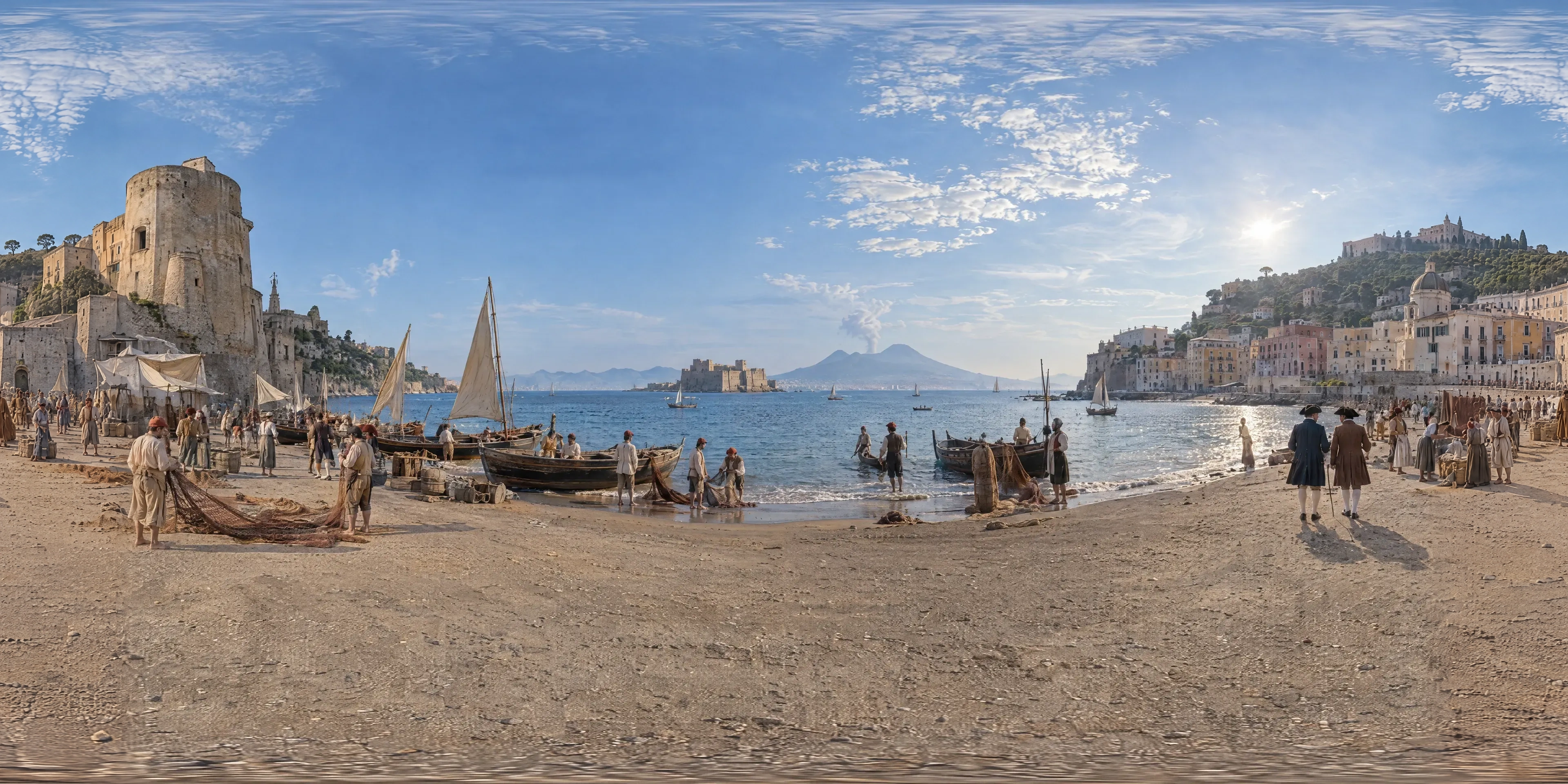
In the 1770s fishermen draw their boats up on the beach of Mergellina while, across the bay, Vesuvius trails a plume of smoke directly behind Castel dell'Ovo. Naples is then the largest city in Italy, capital of the Bourbon kingdom and a magnet for Grand Tour travellers.
- Year
- 1770s
- Where
- Campania (Kingdom of Naples) · IT
- Era
- Early modern
- Coordinates
- 40.829, 14.220
The moment
A fishing beach at the edge of a capital
In the 1770s Mergellina was a fishing village at the western end of Naples, under the green hill of Posillipo. Its fishermen drew their wooden boats with lateen sails up onto the sand and spread their nets to dry.
No single event belongs to this beach. It is an everyday view, and its value is what it shows: the bay of Naples before the modern city reshaped its shore.
Close by stood a watchtower built in 1564 against Barbary raiders. Above the village rose the church of Santa Maria del Parto, founded by the poet Jacopo Sannazaro.
A volcano that never stopped smoking
Across the water, directly behind the squat fortress of Castel dell'Ovo on its islet, stood the cone of Vesuvius, 17 kilometres away. Between 1631 and 1944 it smoked almost continuously, and in the 1770s a plume of smoke drifted from its summit.
It was also busy. The British envoy, Sir William Hamilton, witnessed major eruptions in the summer of 1766 and the autumn of 1767, sent reports and samples to the Royal Society, and in 1776 published his volcanic letters as Campi Phlegraei, illustrated by Pietro Fabris.
The capital that drew the Grand Tour
Naples was then the largest city in Italy and the capital of the Bourbon kingdom of King Ferdinand and Queen Maria Carolina, a daughter of the Austrian empress Maria Theresa. Seen from Mergellina, it rose in tiers of palaces and domes up to the star-shaped Castel Sant'Elmo and the Certosa di San Martino on the ridge.
It was a magnet for travellers. Hamilton, envoy from 1764 to 1800, entertained a stream of visitors, among them the young Mozart in 1770 and the music historian Charles Burney, and he sold his first collection of ancient vases to the British Museum.
To the right the bay opened toward the Sorrento peninsula, with Capri faint on the horizon.
The view every Italian knows
This is the view of Naples that Italians know by heart: the smoking volcano behind the castle on the sea. The 1770s show it in the century when the Bourbon capital was a European centre of music, learning and travel.
The shore has changed more than the view. The gardens of the Villa Reale were laid out along it in 1778 to 1780, the seafront boulevard of Via Caracciolo was built on reclaimed land between 1869 and 1880, and the Sebeto fountain was moved to Mergellina only in 1939.
The exact line of the eighteenth-century beach, and how many villas then dotted Posillipo, are known only approximately. The castle, the hill and the volcano are where they were.
Sources
Further reading
Tagged
- italy
- naples
- campania
- vesuvius
- bourbon
- grand-tour
- 18th-century
- bay-of-naples
Published
See also

1741
Coronation Hill, Pressburg (Bratislava)
Sunday, 25 June 1741: freshly crowned in St Martin's Cathedral, 24-year-old Maria Theresa rides up an earthen mound by the Danube and swings St Stephen's sword to the four corners of the world, vowing to defend Hungary. That September the Hungarian estates, gathered in this city, pledged her 'our life and blood' and saved her throne.

79
Pompeii
On a late October afternoon in 79 AD, Mount Vesuvius unleashes a Plinian eruption that buries Pompeii under meters of pumice and ash within hours.

1618
Prague Castle (Ludwig Wing)
On May 23, 1618, Bohemian Protestant nobles throw two imperial Catholic regents out of the upper window of the Ludwig Wing of Prague Castle, triggering the Thirty Years' War.