Prague Castle (Ludwig Wing)
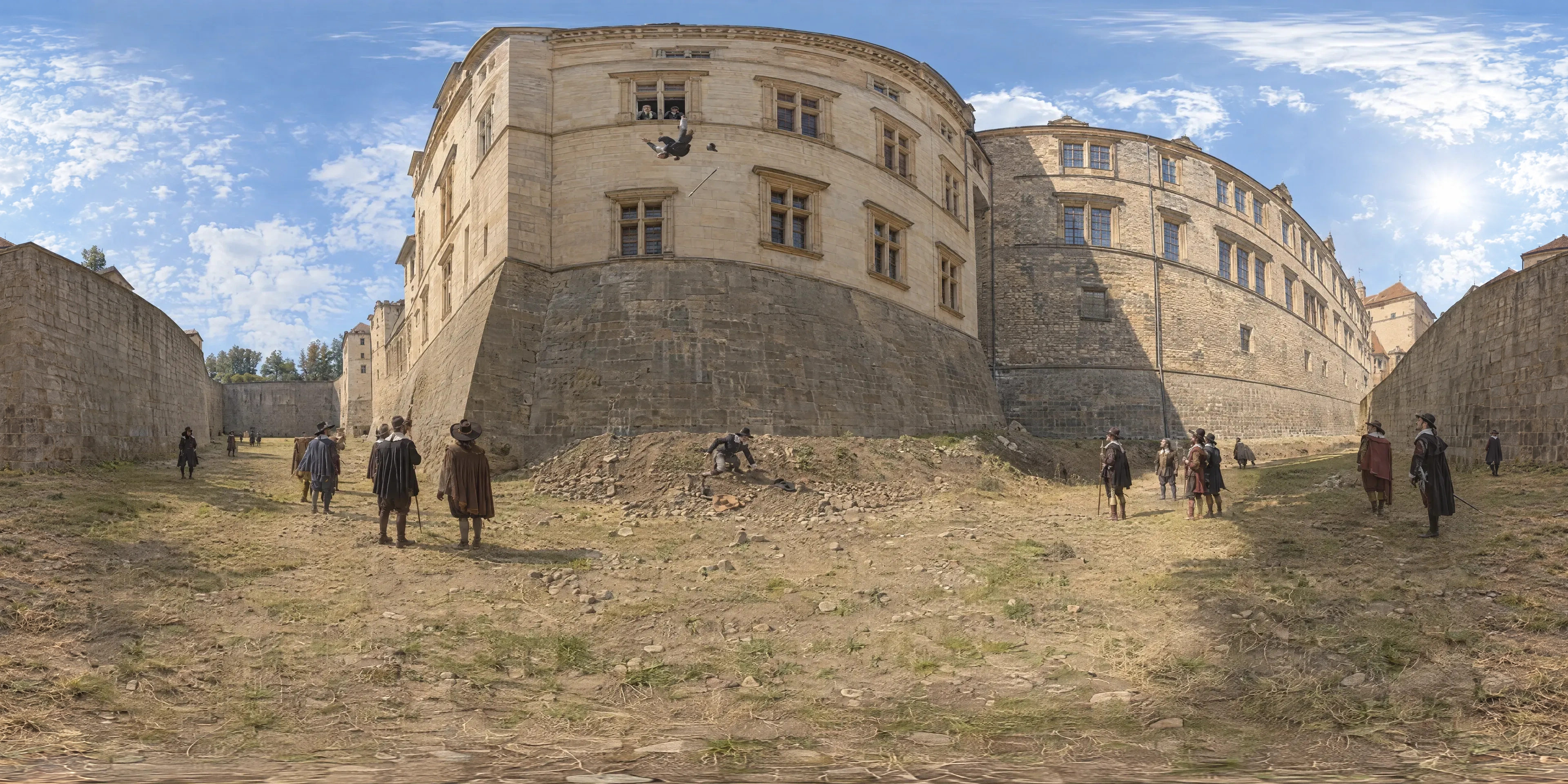
On May 23, 1618, Bohemian Protestant nobles throw two imperial Catholic regents out of the upper window of the Ludwig Wing of Prague Castle, triggering the Thirty Years' War.
- Year
- 1618
- Where
- Prague, Bohemia · CZ
- Era
- Early modern
- Coordinates
- 50.090, 14.402
The moment
A continental war begun by a defenestration
The Second Defenestration of Prague, on 23 May 1618, is one of the most narrowly localised events to start a major continental war.
Two Catholic imperial regents (Vilém Slavata and Jaroslav Bořita z Martinic) and their secretary Filip Fabricius were dragged from a meeting of the Bohemian Estates in Prague Castle and thrown out of a fourth-storey window into the dry moat 21 metres below.
All three survived the fall.
Within two years the act had drawn in the Holy Roman Empire, the Spanish Habsburgs, Sweden, France, Denmark, the United Provinces, and most of the smaller German states in what became the Thirty Years' War, the deadliest European war before the twentieth century.
Why they survived the fall
The Catholic explanation, widely circulated at the time, was that the Virgin Mary had intervened to save the regents.
The Protestant explanation was that the men had landed in a pile of horse manure in the moat that had broken their fall.
A third more prosaic explanation, supported by modern reconstruction of the castle's moat in 1618, is that the moat was steeply sloped at the base of the wall and the men had partly slid rather than fallen.
Slavata was 36, Martinic was 36, Fabricius was 38. All three got up, brushed themselves off, and ran. Fabricius was ennobled by Emperor Matthias later that year with the surname von Hohenfall, "of the high fall", which his descendants kept until the line died out in 1726.
Not the first time
This was not the first Prague defenestration.
The First Defenestration of Prague, on 30 July 1419, had launched the Hussite Wars when followers of the reformer Jan Hus threw seven Catholic councillors of the New Town from the window of the New Town Hall.
The 1618 event deliberately echoed the earlier one as a Protestant statement of continuity with the Hussite tradition.
The Bohemian Protestants elected a Calvinist king (Friedrich V of the Palatinate, the "Winter King") to replace the Catholic Habsburg Ferdinand II. Friedrich's army was crushed at the Battle of White Mountain outside Prague on 8 November 1620, after which Bohemia became a Habsburg crown land for the next 298 years.
The cost of the war
The Thirty Years' War (1618–1648) killed perhaps eight million people, about 20 per cent of the population of the German lands, and reset European geopolitics.
The Peace of Westphalia in 1648 is often cited as the birth of the modern nation-state system, with its principle of sovereign territorial states recognising each other's right to self- determination.
The whole structure of the modern international order (UN charters, recognised borders, diplomatic immunity, non-interference in internal affairs) descends from the treaties that ended a war started by three men being thrown out of a window in Prague.
Further reading
Tagged
- bohemia
- prague
- defenestration
- thirty-years-war
- habsburg
Published
See also

1741
Coronation Hill, Pressburg (Bratislava)
Sunday, 25 June 1741: freshly crowned in St Martin's Cathedral, 24-year-old Maria Theresa rides up an earthen mound by the Danube and swings St Stephen's sword to the four corners of the world, vowing to defend Hungary. That September the Hungarian estates, gathered in this city, pledged her 'our life and blood' and saved her throne.

1357
Charles Bridge, Prague
In 1357 Emperor Charles IV lays the foundation stone of a new stone bridge on the Old Town bank near St Clement's, fifteen years after ice and floodwater wrecked the Judith Bridge. Tradition sets the moment at 5:31 on 9 July, a palindrome of odd numbers; the bridge will take 45 years to finish.

1410
Old Town Square, Prague
On 9 October 1410 the Old Town councillors reward the clockmaker Mikuláš of Kadaň for the astronomical dial he has built on the town hall tower, the heart of today's Prague orloj. Below it the market square trades as usual in the year Wycliffe's books are burned in Prague and Jan Hus is excommunicated.