Coronation Hill, Pressburg (Bratislava)
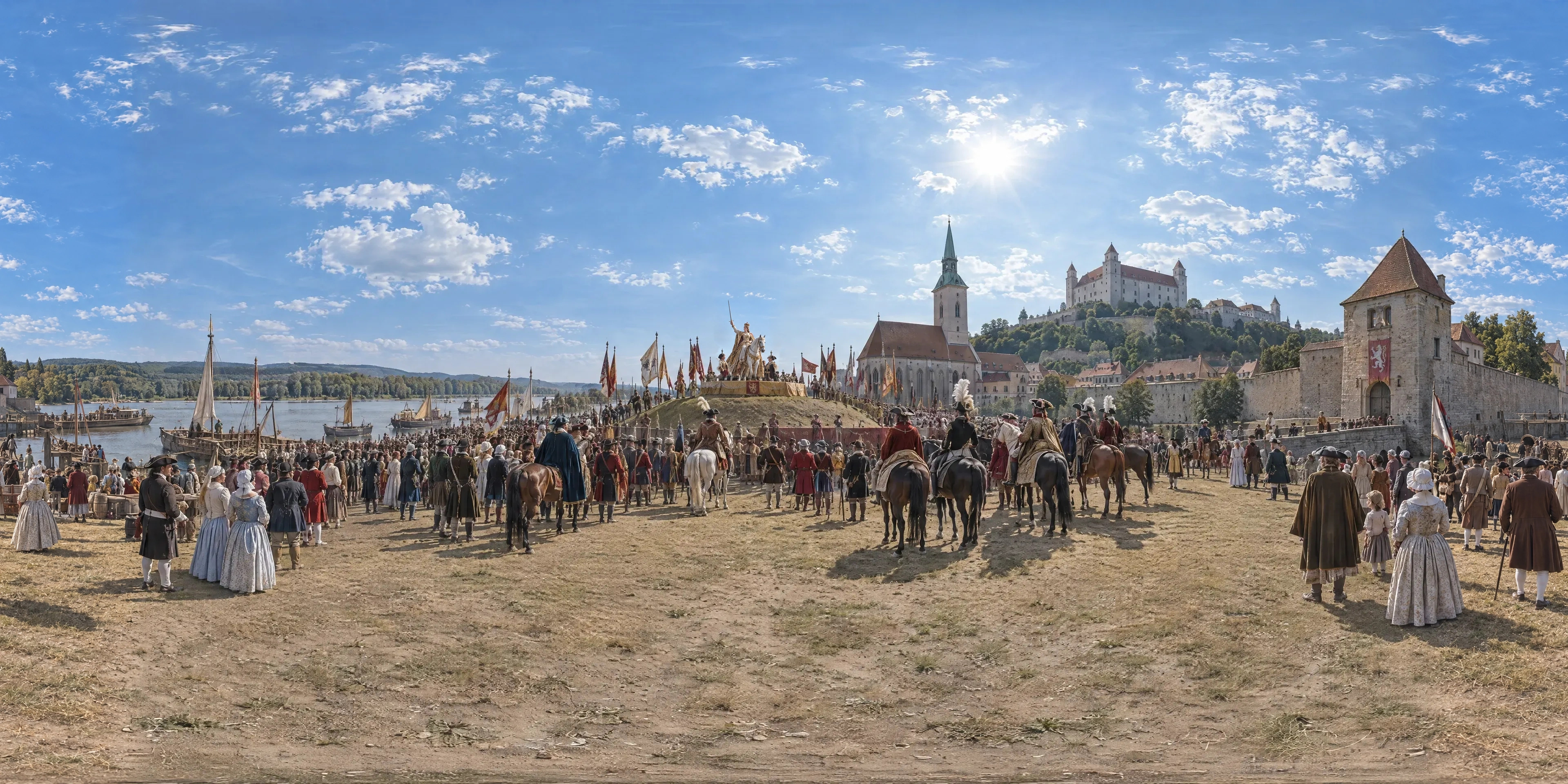
Sunday, 25 June 1741: freshly crowned in St Martin's Cathedral, 24-year-old Maria Theresa rides up an earthen mound by the Danube and swings St Stephen's sword to the four corners of the world, vowing to defend Hungary. That September the Hungarian estates, gathered in this city, pledged her 'our life and blood' and saved her throne.
- Year
- 1741
- Where
- Pressburg (Pozsony), coronation city of the Kingdom of Hungary · SK
- Era
- Early modern
- Coordinates
- 48.140, 17.110
The moment
Crowned as king, not queen
On Sunday 25 June 1741, in St Martin's Cathedral in Pressburg, today's Bratislava, the primate Imre Esterházy placed the Holy Crown of Hungary on the head of Maria Theresa, aged 24. She was crowned with the title of king, rex, because Hungarian tradition had no place for a woman ruling in her own right.
Pressburg was the coronation city of the Kingdom of Hungary. With the old coronation town of Székesfehérvár in Ottoman hands, eleven monarchs and eight royal consorts were crowned here between 1563 and 1830.
Four strokes of the sword on a hill of soil
After the crowning came the ride. The new sovereign, in full regalia, rode on horseback up an artificial mound built of soil from all parts of the kingdom, on the open riverside ground outside the town walls.
At the top she raised St Stephen's sword to each of the four cardinal points, a vow to defend the kingdom in every direction. The magnates of the kingdom, county banners and a large crowd surrounded the mound.
The town looked older than it does now. The castle above was a massive rectangular palace with four corner towers, its shape since the 1640s; the town walls, with the Fishermen's Gate and moat, were intact until demolition began in 1775; and no bridge yet crossed the Danube.
Our life and blood
Maria Theresa needed Hungary badly. Her father, Charles VI, had spent his reign winning recognition of the Pragmatic Sanction of 1713, which secured her succession, but when he died in October 1740 several powers went back on their word, and in December Frederick II of Prussia invaded Silesia.
In September 1741 she appealed to the Hungarian Diet in Latin, wearing the Holy Crown and presenting her infant son Joseph. The estates answered with the pledge that entered legend, their "life and blood", and the troops they raised helped save her throne.
Why Bratislava still stages coronations
For 267 years Bratislava was the coronation city of Hungarian kings, and Maria Theresa's crowning is the proudest memory of Pressburg's golden age. The city re-enacts a coronation every year.
The cathedral wears the memory on its tower. In 1741 the Gothic tower rose only one belfry storey above the church roof; since 1847 its neo-Gothic spire has carried a gilded replica of the Holy Crown on a cushion, weighing 150 kilograms.
The memory is shared and contested. A Hungarian coronation in today's Slovak capital is framed differently in Slovak, Hungarian and Austrian history, and the monument to Maria Theresa raised on the riverside square in 1897 was destroyed by Czechoslovak legionnaires in 1921. The square where the coronation hill once stood is now named after Ľudovít Štúr.
Sources
Further reading
Tagged
- slovakia
- bratislava
- pressburg
- coronation
- maria-theresa
- habsburg
- 18th-century
- danube
Published
See also

1655
Dam Square and the New Town Hall, Amsterdam
On 29 July 1655 Amsterdam's burgomasters process from the Prinsenhof to the Dam to inaugurate Jacob van Campen's new Town Hall, a classical palace for a city of merchants, though it is still far from finished. Six companies of civic guards fire three volleys as the city at the height of its Golden Age celebrates.

1682
Place d'Armes, Versailles
On 6 May 1682 Louis XIV makes Versailles the permanent seat of his court and government, turning his father's hunting lodge, now wrapped in new wings, into the stage of absolute monarchy. The palace is still a vast building site: the Hall of Mirrors is being decorated, the Grand Commun is just begun and the north wing not yet started.

1747
Sanssouci Palace, Potsdam
On 1 May 1747 Frederick II of Prussia inaugurates Sanssouci, the small summer palace built to his own sketches on top of six curved vineyard terraces outside Potsdam, though not all its rooms are finished. Here the philosopher king will spend every summer, playing the flute and gathering Voltaire and other guests at his table.