Great Mosque of Córdoba
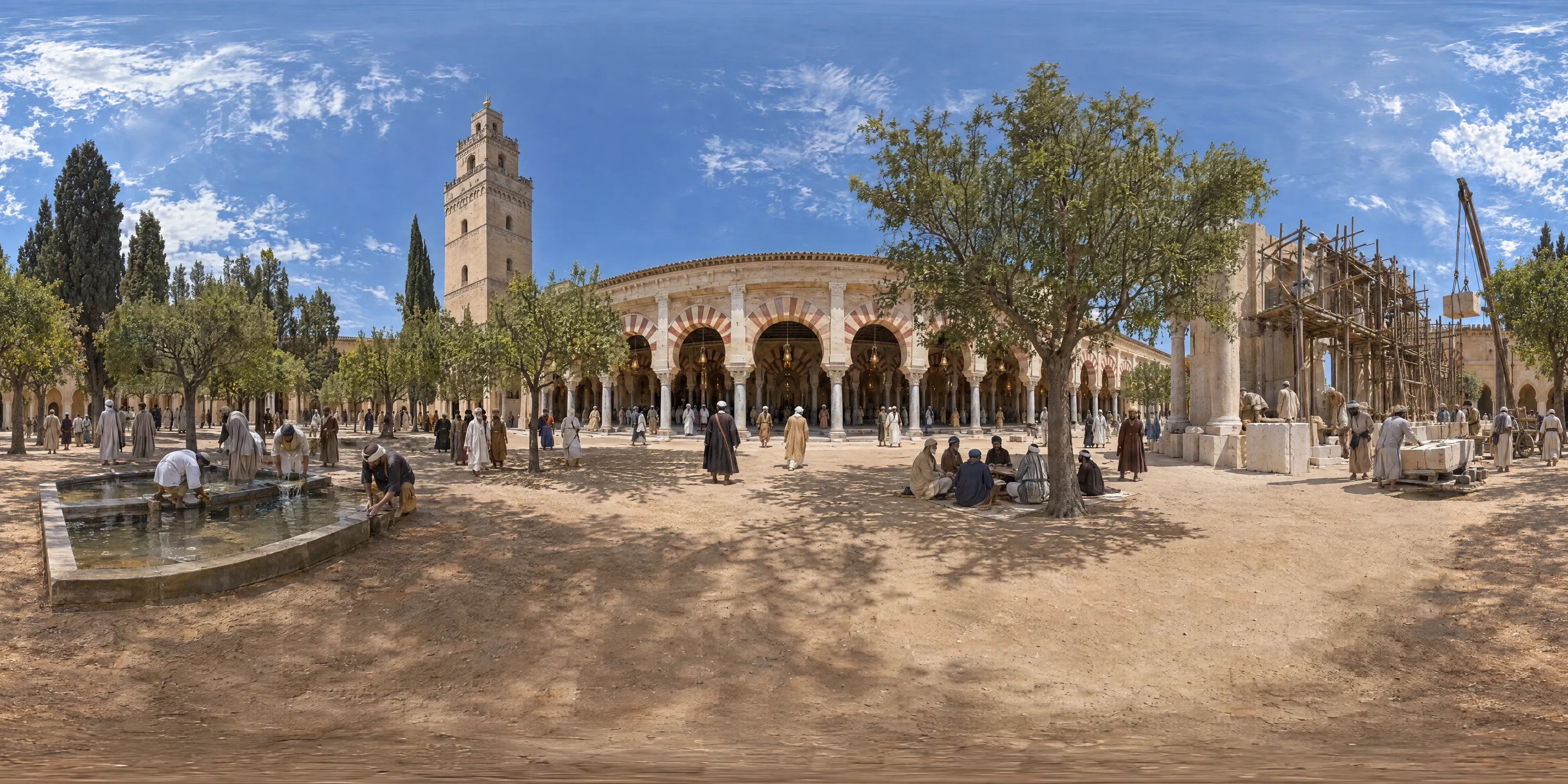
In 987 Almanzor, the all-powerful chamberlain of Caliph Hisham II, begins the third and largest enlargement of the Great Mosque of Córdoba, eight new aisles to the east that make it the largest mosque anywhere outside Abbasid Iraq. From the courtyard, open arches reveal the forest of red-and-white double arches inside.
- Year
- 987
- Where
- Al-Andalus (Andalusia) · ES
- Era
- Medieval
- Coordinates
- 37.880, -4.779
The moment
The mosque could only grow east
In 987 Almanzor, the chamberlain who ruled al-Andalus in the name of the caliph Hisham II, began the last and largest enlargement of the Great Mosque of Córdoba.
The building already held two centuries of history. The first mosque went up under Abd al-Rahman I in the 780s and had been extended southward twice, by Abd al-Rahman II and by al-Hakam II, whose domed mihrab was barely two decades old.
Almanzor could not continue south, where the ground falls to the Guadalquivir, and the caliphal palace blocked the west. So he built sideways: eight new aisles along the east flank, with the courtyard lengthened to match. The result was the largest mosque anywhere outside Abbasid Iraq. It also left al-Hakam's mihrab off the central axis of the prayer hall, where it has stood off-centre ever since.
Some of the red is paint
Inside, hundreds of marble columns carry two tiers of arches, a horseshoe arch below and a round arch above, and turn the prayer hall into a forest. The voussoirs alternate red and pale.
In the older halls the red is brick. In Almanzor's aisles the voussoirs are all stone, and the red stripes are painted on in ochre to imitate the brick. Under the enlarged courtyard his builders dug a great cistern for rainwater, a square tank divided into nine vaulted compartments.
Judges sat in the courtyard
The courtyard, the sahn, was more than an entrance. Men washed at ablution basins before prayer, teachers gathered pupils in the shade of the arcades, and judges heard cases there.
On its north side rose the minaret of Abd al-Rahman III, finished in 958: about 47 metres high on a square base 8.5 metres wide.
The man behind the new aisles was at the height of his power. Almanzor took Coimbra in 987, the year the work began, and in 997 he sacked Santiago de Compostela. The chronicles say the bells of its cathedral were carried to Córdoba and made into lamps for the mosque. When Ferdinand III took the city in 1236, according to the chronicler Lucas of Tuy, he sent them back to Santiago on the shoulders of Muslim captives.
Eight centuries a cathedral, still called la Mezquita
Since 1236 the building has been Córdoba's cathedral. Chapels filled its outer arches, a Renaissance nave was built into its heart between 1523 and 1607, and from 1593 the minaret disappeared inside a bell tower. The orange trees that name the courtyard, the Patio de los Naranjos, are first recorded in 1512.
For Spaniards the Mezquita is the image of the Caliphate of Córdoba, the high point of al-Andalus in every history course and one of the most visited monuments in the country. It is also a live argument. Its name, its ownership and the weight its Islamic past should carry are debated in politics and in the press.
The name on its official website, Mezquita-Catedral, keeps both histories in one name. Most people in Córdoba simply say la Mezquita.
Sources
Further reading
Tagged
- spain
- cordoba
- andalusia
- al-andalus
- caliphate
- mosque
- islamic-architecture
- medieval
Published
See also

1357
Charles Bridge, Prague
In 1357 Emperor Charles IV lays the foundation stone of a new stone bridge on the Old Town bank near St Clement's, fifteen years after ice and floodwater wrecked the Judith Bridge. Tradition sets the moment at 5:31 on 9 July, a palindrome of odd numbers; the bridge will take 45 years to finish.

1253
Basilica of Saint Francis, Assisi
On 25 May 1253 Pope Innocent IV consecrates the new basilica raised over the tomb of Francis of Assisi, just 27 years after the saint's death, before crowds of grey-robed friars and townspeople. Later painted by Cimabue and Giotto, it became the spiritual heart of the country whose patron saint Francis is.

537
Hagia Sophia, Constantinople
On December 27, 537 AD, Emperor Justinian I dedicates the newly built Hagia Sophia in Constantinople: its 32-meter dome rising on pendentives in a structural feat that defines Byzantine architecture.