Dike Gap at Ouwerkerk
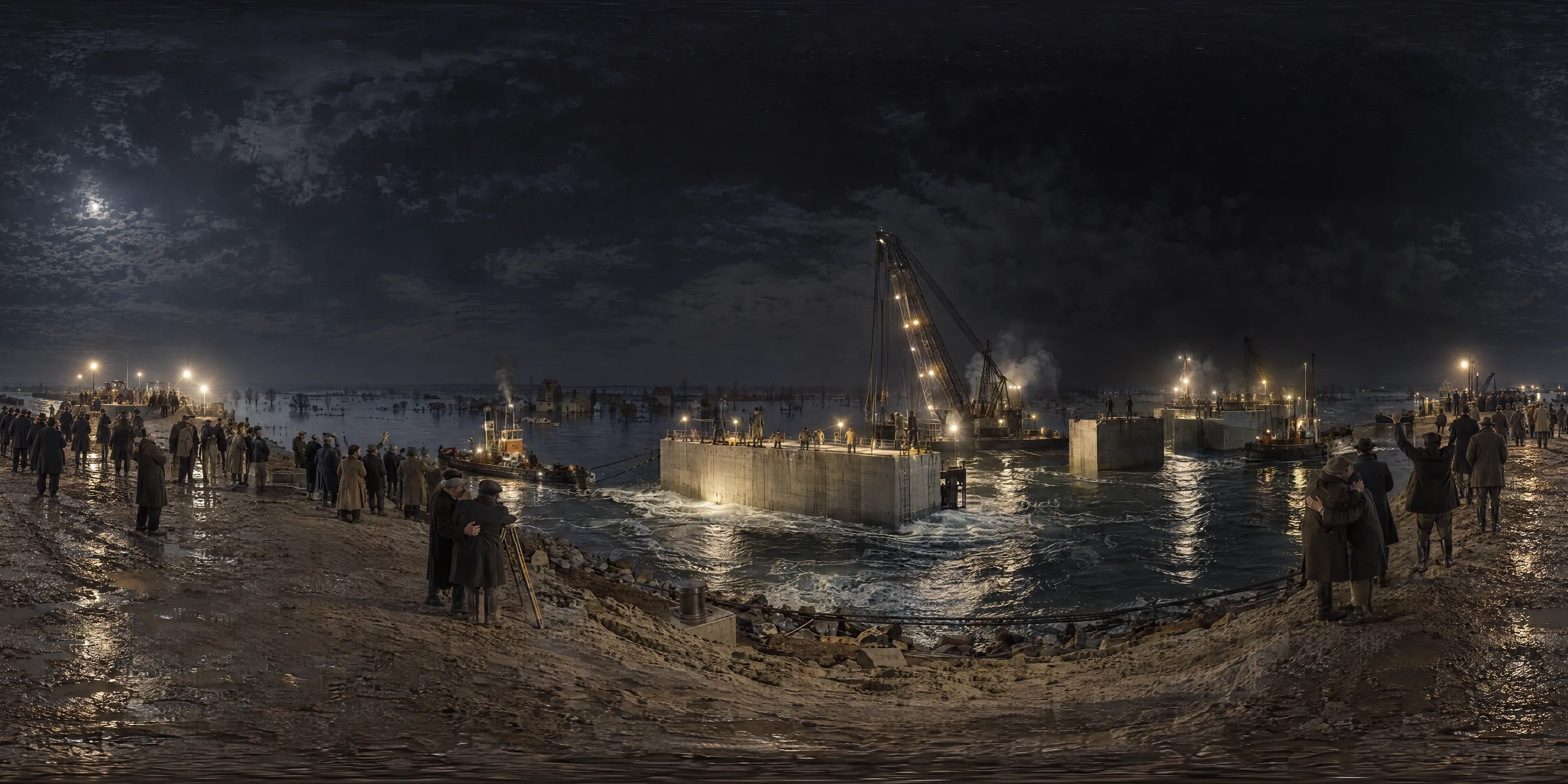
Three minutes before midnight on 6 November 1953, under searchlights and sodium lamps, the fourth concrete Phoenix caisson settles into the last open breach of the February flood at Ouwerkerk, on Duiveland. Sirens and cheers break out: nine months after the disaster that killed 1,836 people, the last dike gap is closed.
- Year
- 1953
- Where
- Zeeland · NL
- Era
- modern_postwar
- Coordinates
- 51.618, 3.981
The moment
The last gap closed at three minutes to midnight
Late on Friday 6 November 1953, on the sea dike south of Ouwerkerk on the Zeeland island of Duiveland, tugboats pushed a fourth huge concrete caisson into the last open breach left by the flood of that February. Valves were opened, water poured into its compartments, and it settled onto the bottom beside the three already in place.
At 23:57 the sirens sounded. The cheering on the dike went on for minutes. Nine months after the disaster, the last of the dike gaps was closed.
The work ran through a moonless, starry night under searchlights and yellow sodium lamps.
Harbour sections built for D-Day
The caissons had been made for another war. They were Phoenix caissons, about 60 metres long and 20 metres wide, built in Britain as sections of the artificial harbours for the Allied invasion of Normandy in 1944.
These four had not come from Normandy. They had been serving as breakwaters at Portland, on the south coast of England, and were towed across the North Sea to Zeeland. Designed to shelter an invasion fleet, they now held back the tide.
Nine months under water
On the night of 31 January to 1 February 1953 a storm surge broke the dikes of Zeeland, South Holland and North Brabant in many places. In the Netherlands 1,836 people died, 91 of them in Ouwerkerk.
Most breaches were closed within months. Ouwerkerk's was the last. Until November the tide still flowed in and out of the polder behind it, over drowned fields and wrecked farms. The village had had no church tower since 1945, when it was blown up in the last months of the war, and its new church and detached tower came only in 1956 and 1957.
The caissons never left the dike
The flood is one of the fifty windows of the Canon of the Netherlands, and it led directly to the Delta Works, the chain of dams, sluices and storm-surge barriers built over the following decades to keep the sea out of the southwest.
The four caissons at Ouwerkerk stayed in the dike. They became protected monuments on 28 July 1965, and since 2 April 2001 they have housed the Watersnoodmuseum, the national centre of knowledge and remembrance for the flood of 1953.
Visitors now walk through the concrete boxes that were towed across the North Sea to close the last gap.
Sources
Further reading
Tagged
- netherlands
- zeeland
- ouwerkerk
- watersnoodramp
- north-sea-flood
- phoenix-caissons
- water-management
- 1953
Published
See also

1953
Summit of Mount Everest
At 11:30 on 29 May 1953, the New Zealand beekeeper *Edmund Hillary* and the Nepalese Sherpa *Tenzing Norgay* stand on the 8 849-metre summit of *Mount Everest*: the first humans confirmed to reach the highest point on Earth.

1989
Brandenburg Gate, Berlin
On the night of November 9–10, 1989, East and West Berliners climb the Berlin Wall in front of the Brandenburg Gate, chipping at the concrete with hammers and dancing on top: the symbolic collapse of the Iron Curtain.

1979
Victory Square, Warsaw
On the afternoon of Saturday 2 June 1979, on his first visit home as pope, John Paul II says Mass for about half a million people on Victory Square in communist Warsaw and prays that the Holy Spirit will renew the face of the earth, adding "this land". The words are remembered as the spark of the Solidarity movement.