Temples of Hera at Poseidonia (Paestum)
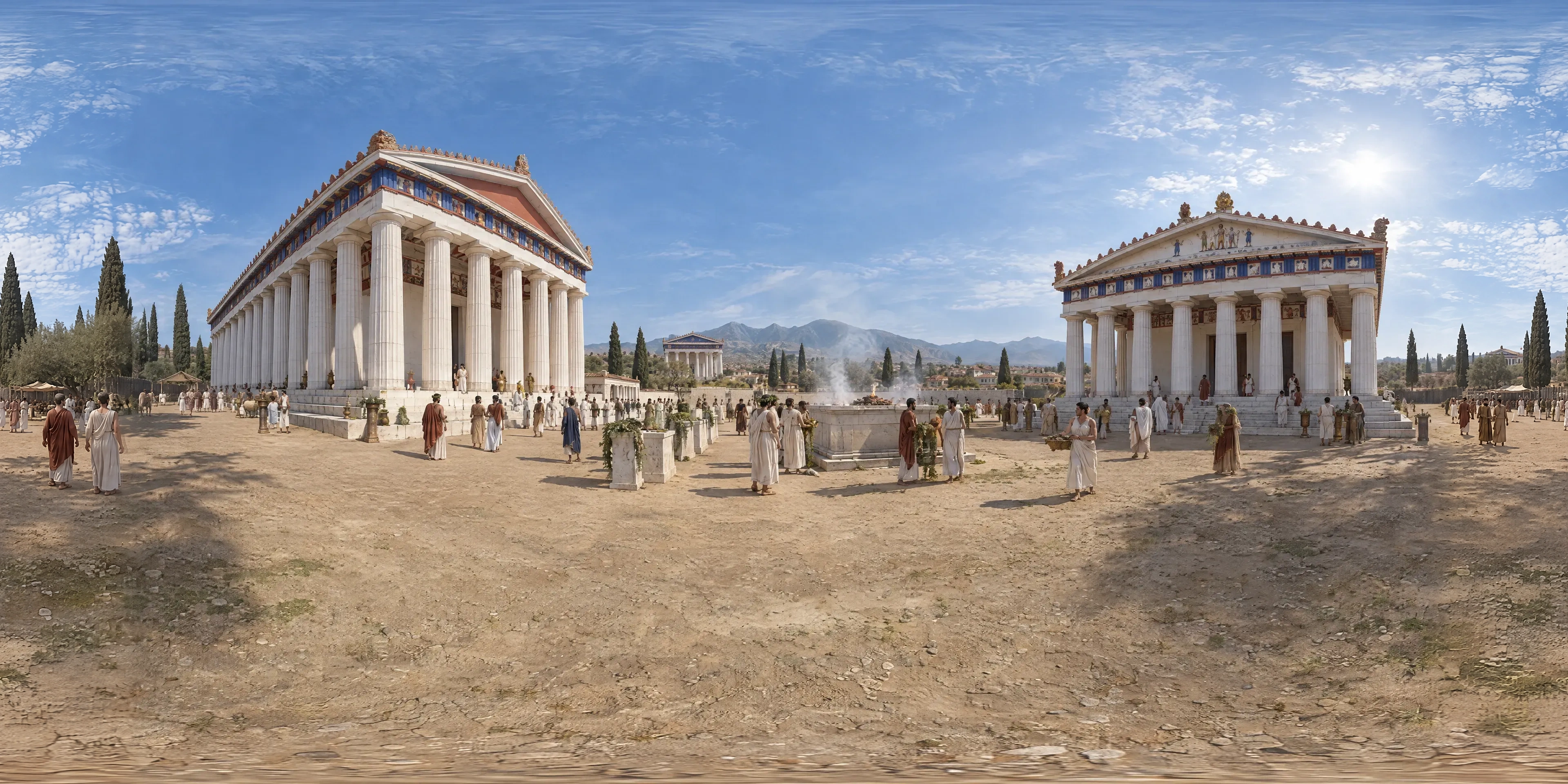
Around 450 BC the Greek colonists of Poseidonia gather at the altar of their newest temple, a massive Doric house for Hera still gleaming with fresh marble-dust stucco, beside an older temple to the same goddess built a century before. It is Magna Graecia at its height, when Greek cities on the Italian coast rivalled those of Greece itself.
- Year
- 450s BC
- Where
- Campania (Magna Graecia) · IT
- Era
- Classical antiquity
- Coordinates
- 40.420, 15.007
The moment
A Greek city on the plain of the Sele
Around 600 BC, Greek colonists from Sybaris founded a city on the coastal plain of the Sele, in Campania, and named it Poseidonia. By the middle of the fifth century BC it was one of the prosperous cities of Magna Graecia, the Greek south of Italy that rivalled Greece itself.
It was still lightly defended. Around 450 BC an earthen rampart and a timber palisade protected it; the stone walls, some 4.75 kilometres of them, came later.
What it had instead were temples. Three Doric temples, built between about 550 and 450 BC, still stand, two of them side by side in the southern sanctuary.
Limestone dressed as marble
The newest of them was finished around 460 to 450 BC. It measures about 24.5 by 60 metres, with six columns across the ends and fourteen along the sides, each 8.88 metres tall, heavier in proportion than the fashion of the day and cut with 24 flutes instead of the usual 20.
Its stone was local porous limestone. The Greeks did not leave it bare: they covered it in a stucco of powdered marble, so the temple read as white, with touches of red and deep blue paint on capitals and mouldings, as reconstructed from surviving traces.
Its metopes and pediments were left plain, without sculpture. Inside, two storeys of columns carried the roof over the cella.
Two temples to one goddess
The new temple is usually attributed to Hera, although it was long misnamed the Temple of Neptune, and some scholars link it to Zeus or Poseidon as well.
Beside it stood an older temple of Hera, built about a century earlier, around 550 to 525 BC. It has an unusual front of nine strongly swelling columns, and its terracotta roof was edged with lion-head spouts and palmette antefixes.
Half a kilometre to the north, the temple of Athena of about 500 BC completed the set. In front of the new temple stood a long stone altar for the city's sacrifices.
Why Italians learn it before Rome
Poseidonia changed hands twice. The Lucanians took it at the end of the fifth century BC, and in 273 BC Rome founded a Latin colony there and called it Paestum.
Then the plain turned against the city. Changes in drainage made it swampy and malarial, pirates raided the coast, and by the Middle Ages the site was abandoned; only the eighteenth-century road south from Naples brought it back to notice, and Piranesi published etchings of the temples in 1778.
That long neglect preserved them. The scholar A. W. Lawrence called the temple of Hera the best preserved of all Greek temples, and in 1968 a painted tomb of about 470 BC, the Tomb of the Diver, was found nearby.
Paestum became a UNESCO World Heritage Site in 1998. For Italian schoolchildren it is the textbook image of Magna Graecia, the Greek chapter of their history that comes before Rome.
Sources
Further reading
Tagged
- italy
- paestum
- poseidonia
- magna-graecia
- ancient-greece
- temple
- campania
- classical
Published
See also

79
Pompeii
On a late October afternoon in 79 AD, Mount Vesuvius unleashes a Plinian eruption that buries Pompeii under meters of pumice and ash within hours.

120s
Roman Forum, Rome
Around 120 AD, the Roman Forum is the crowded heart of an empire of fifty million: temples, basilicas and triumphal arches packed along the Sacred Way beneath the Capitol, with Trajan's new column and forum rising alongside.

193
Legionary Fortress of Carnuntum
On 9 April 193, twelve days after the murder of Emperor Pertinax in Rome, the Pannonian legions proclaim their governor Lucius Septimius Severus emperor at Carnuntum, capital of Upper Pannonia on the Danube frontier. He wins the civil war that follows, founds the Severan dynasty and raises Carnuntum to the rank of a colony.