Palais Garnier, Paris
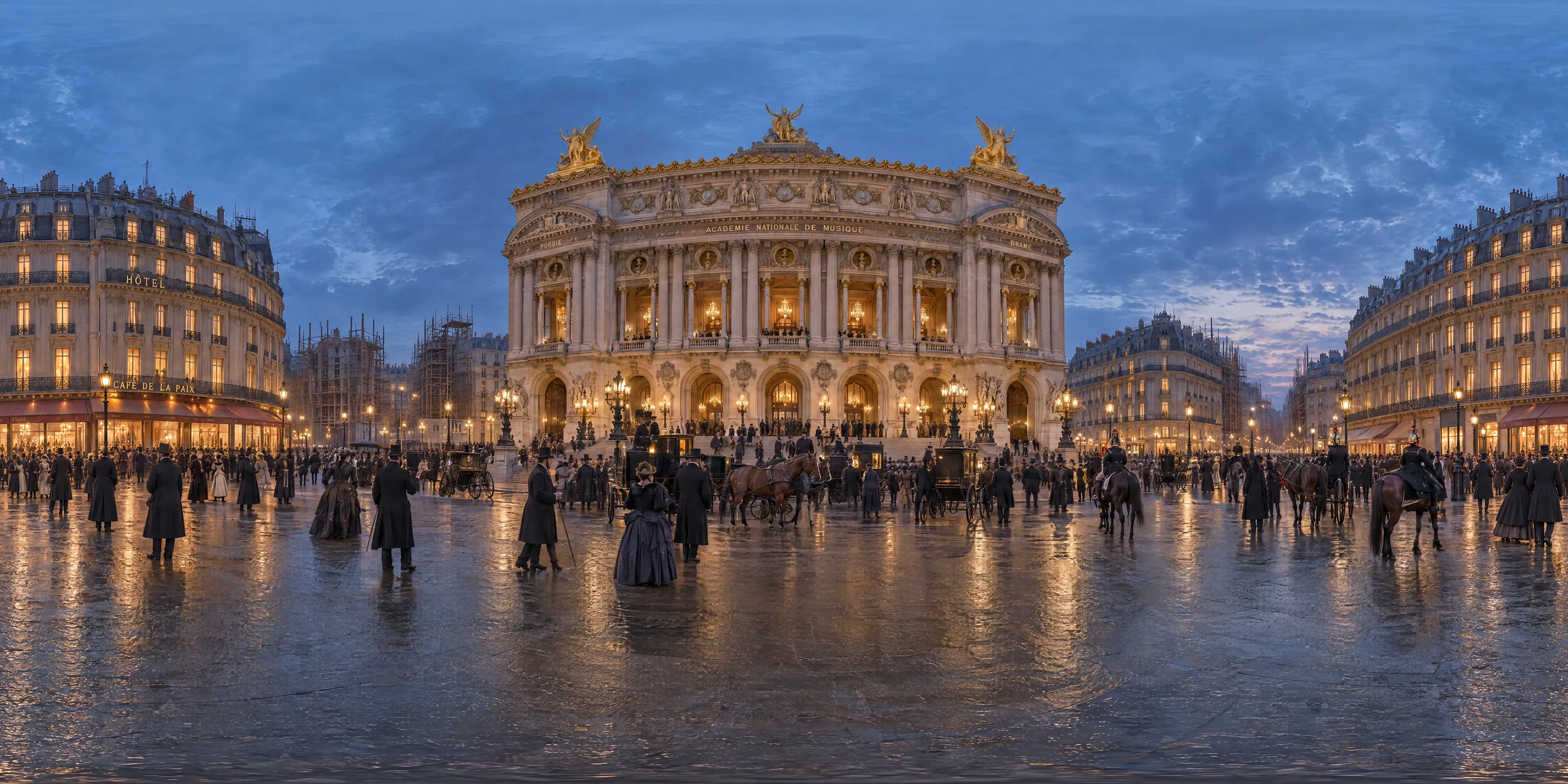
On the evening of Tuesday 5 January 1875 President MacMahon inaugurates Charles Garnier's opera house, fourteen years in the making, before the Lord Mayor of London, the Burgomaster of Amsterdam, the Spanish royal family and some 2,000 guests, while the avenue meant to frame it is still a building site. Garnier himself has had to pay for his seat.
- Year
- 1875
- Where
- Paris · FR
- Era
- Industrial
- Coordinates
- 48.870, 2.332
The moment
The architect paid for his own seat
On the evening of Tuesday 5 January 1875 Marshal Mac-Mahon, President of the Republic, inaugurated the new Opéra before the Lord Mayor of London, the Burgomaster of Amsterdam, the Spanish royal family and nearly 2,000 guests. The programme ran from Auber's overture to La Muette de Portici and two acts of Halévy's La Juive to the blessing of the daggers from Meyerbeer's Les Huguenots and Delibes's ballet La Source.
Charles Garnier had to buy his place in a second-tier box. Sources disagree on whether he was invited at all, and the press mocked an administration that charged the architect to attend the opening of his own monument. The same day he was made an officer of the Legion of Honour.
Designed after a bomb, won with a modest motto
The building began as an imperial project. After an assassination attempt on Napoleon III outside the old opera house in the rue Le Peletier on 14 January 1858, the emperor decided to build a new theatre on a broad, safer street. Garnier, then 35, entered the competition under the motto "I aspire to much, I expect little", and on 30 May 1861 he was declared the unanimous winner.
Legend has the Empress Eugénie complaining that his style was neither Greek nor Louis XV, not even Louis XVI, and Garnier replying that it was Napoleon III.
A lake under the foundations
Digging soon struck groundwater. Steam pumps ran day and night for eight months without drying the site, so Garnier built a vast concrete tank and let it fill, using the weight of the water to resist the pressure from below. The tank became a reserve for firefighters, and the source of the underground lake that Gaston Leroux made famous in The Phantom of the Opera.
The work took almost fifteen years. The façade was unveiled for the Universal Exhibition on 15 August 1867, but the war of 1870 and the Commune stopped the site, and money to finish it was found only after fire destroyed the old Le Peletier hall in October 1873.
That January night the façade glowed with coloured marble and gilded bronze. Busts of composers from Mozart to Meyerbeer lined the loggia, and at the foot of the front stood Carpeaux's group La Danse, splashed with ink by an unknown vandal in 1869. The dome was sheathed in new copper, not yet green. Behind the guests, the avenue de l'Opéra was a stub among building sites; it was completed only after 1876.
Why Paris still calls it the Opéra
For the French, the Palais Garnier is the showpiece of Haussmann's Paris, the transformation of the capital that pupils study at school, and one of the most famous buildings in the country. Until the Opéra Bastille opened in 1989 it was simply the Paris Opera.
Its best-known addition is modern. In 1964 a ceiling by Marc Chagall, commissioned by the culture minister André Malraux, was unveiled above the auditorium, and the building still mixes the two ages: Second Empire gold below, twentieth-century colour above.
Sources
Further reading
Tagged
- france
- paris
- opera-garnier
- haussmann
- third-republic
- belle-epoque
- 19th-century
- architecture
Published
See also

1869
Court Opera on the Ringstraße, Vienna
On the evening of 25 May 1869 Emperor Franz Joseph opens the new Court Opera, the first great public building on Vienna's Ringstraße, with Mozart's Don Giovanni sung in German. Neither of its architects lives to see the night: both died in 1868, after Viennese mockery of the 'sunken box'.

1897
Giant Ferris Wheel, Prater, Vienna
On 3 July 1897, a hot summer day, Vienna's Giant Ferris Wheel opens in the Prater, built by English engineers for the jubilee of Emperor Franz Joseph's 50 years on the throne. Its 30 cabins turn up to 64.75 m above the canals of the 'Venice in Vienna' pleasure park, making it one of the largest wheels in the world; a ride costs a gulden.

1804
Notre-Dame de Paris
On 2 December 1804, Napoleon Bonaparte crowns himself Emperor of the French inside Notre-Dame de Paris, taking the gold laurel wreath from Pope Pius VII's hands and placing it on his own head, the gesture David captured in the most famous coronation painting of the nineteenth century.