Leaning Tower of Pisa
Around 1370, the bell tower of Pisa is finally finished after two centuries, and it already leans, its marble tiers curving as builders fought the soft ground, beside the great cathedral and round baptistery on the green cathedral square.
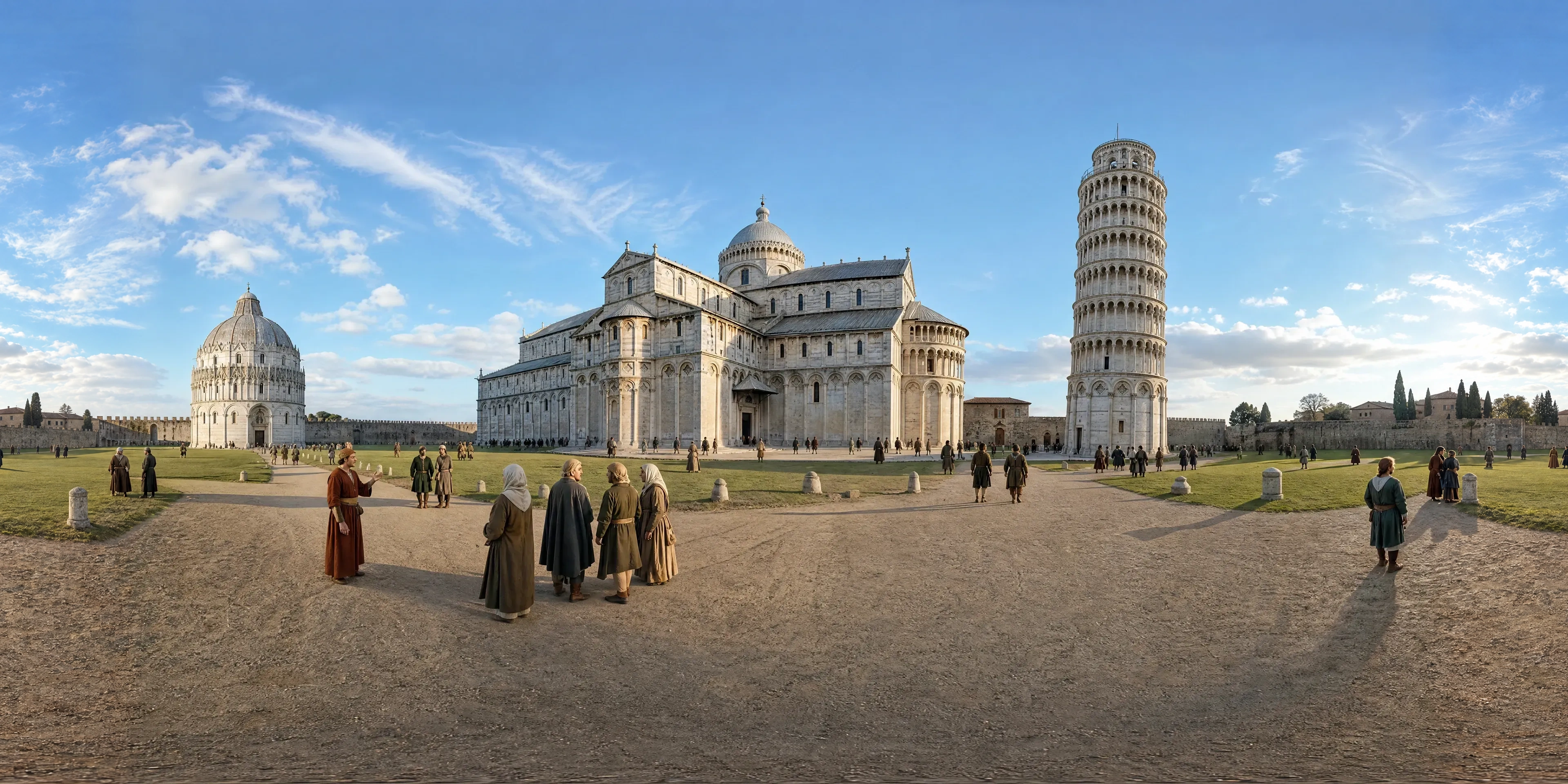
- Year
- 1370s
- Where
- Tuscany · IT
- Era
- Medieval
- Coordinates
- 43.723, 10.397
The moment
Two hundred years to build a lean
The tower was begun in 1173 as the bell tower of Pisa's cathedral. It started to lean almost at once, while only a few storeys were up, because its foundations were too shallow for Pisa's soft, marshy subsoil.
Work then stopped for decades at a time, as Pisa fought its wars. That delay, by pure luck, let the ground settle and consolidate between stages, which probably saved the tower from toppling. The bell chamber was finally added in 1372, nearly two centuries after the first stone.
Built crooked, on purpose and not
As the tilt grew, the builders tried to compensate, making the upper floors slightly taller on the lower side.
The result is a tower that is not only leaning but gently banana-shaped. It stands as one of three buildings (with the striped-marble cathedral and the round baptistery) on the great cathedral square, together a high point of Pisan Romanesque architecture.
The accidental icon
Galileo, a son of Pisa, is said (probably as a legend) to have dropped weights from the tower around 1590 to study how things fall.
Over the centuries the lean slowly worsened, until by the late twentieth century the tower was close to collapse; a major engineering rescue in the 1990s and 2000s eased it back and stabilised it. The flaw became the fame: a builder's mistake is now one of the most recognised and most visited buildings on Earth.
Further reading
Tagged
- pisa
- italy
- leaning-tower
- campanile
- romanesque
- tuscany
Published
See also

1253
Basilica of Saint Francis, Assisi
On 25 May 1253 Pope Innocent IV consecrates the new basilica raised over the tomb of Francis of Assisi, just 27 years after the saint's death, before crowds of grey-robed friars and townspeople. Later painted by Cimabue and Giotto, it became the spiritual heart of the country whose patron saint Francis is.

1966
Piazza Santa Croce, Florence
On 5 November 1966, the morning after the Arno burst into Florence, Piazza Santa Croce lies under a crust of mud and heating oil, wrecked cars are heaped against the palaces and Dante's statue stands smeared to its pedestal as residents and the first volunteers begin to dig. The flood ravaged thousands of artworks and books, and the young 'angeli del fango' who came to save them became a national legend.

1357
Charles Bridge, Prague
In 1357 Emperor Charles IV lays the foundation stone of a new stone bridge on the Old Town bank near St Clement's, fifteen years after ice and floodwater wrecked the Judith Bridge. Tradition sets the moment at 5:31 on 9 July, a palindrome of odd numbers; the bridge will take 45 years to finish.