Piotrkowska Street, Łódź
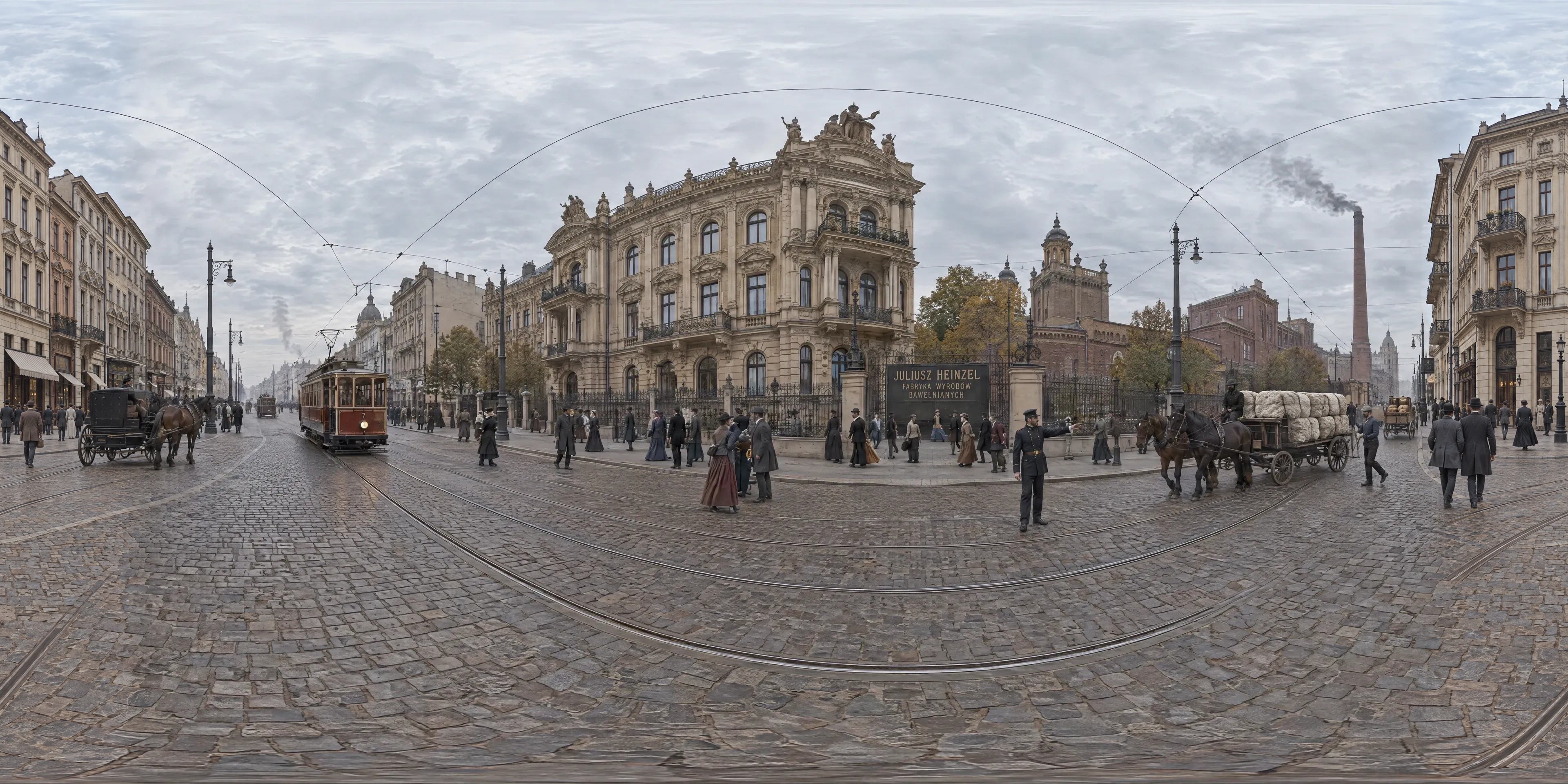
In 1899, the year Reymont's The Promised Land appears as a book, Łódź is the booming textile capital of the Russian partition, and its main street, Piotrkowska, has just got the first electric trams in Congress Poland, running since December 1898 past factory owners' palaces, new tenements and mill chimneys, while Warsaw still rides horse trams.
- Year
- 1899
- Where
- Łódź Land (Congress Poland) · PL
- Era
- Industrial
- Coordinates
- 51.765, 19.458
The moment
Łódź skipped the horse tram
Łódź never had horse trams. The city decided to build a line in 1883, then dropped the plan in 1893 on grounds of hygiene. When trams came, they were electric.
On 13 February 1897 the city signed a 35-year contract with the Łódź Electric Railway, a consortium of leading manufacturers: Juliusz Kunitzer, Zenon Anstadt, Alfred Biedermann, Emil Geyer, Juliusz Heinzel and Henryk Grohman. The German firm AEG built the lines and a power station, and on Friday 23 December 1898 the first cars ran on metre-gauge track.
Łódź was the first city in the Russian partition with electric trams, and the tenth in the Russian Empire. Warsaw kept its horse trams for another ten years. At first there were two short lines, one of them from Helenów Park to Piotrkowska Street; by February 1899 there were four.
The palace stood in front of the mill
Piotrkowska was the spine of the boom. It was laid out in 1821, when a factory settlement was planned along the old road from Piotrków to Zgierz, and it ran straight for about four kilometres. Thousands of droshkies, carriages and carts crowded the city centre, above all Piotrkowska, and tsarist policemen directed the traffic.
At No. 104 stood the palace of the wool manufacturer Juliusz Heinzel, finished in 1882 to a design by Hilary Majewski. It was built on the street line, directly in front of his mill, whose buildings stretched deep into the plot. Its three-storey front mixed styles, with a leaning to the Berlin Renaissance: oriels with balustrades on the first floor, lower side wings, two pavilions topped with towers behind an ornamental railing. On the roof stood a sculpted group of Freedom, Industry and Trade.
Around it the street was a jumble. New four-storey tenements rose beside one- and two-storey brick houses, the last wooden cottages and factory gates. Further north, at No. 72, stood the Hotel Grand of 1887.
A Pole, a German and a Jew
In 1899 Władysław Reymont's The Promised Land came out in two volumes in Warsaw, after running in the daily Kurier Codzienny in 1897 and 1898. Its three heroes, a Pole, Karol Borowiecki, a German, Max Baum, and a Jew, Moryc Welt, set out to make a fortune from a Łódź factory. Scenes play out on Piotrkowska and in the cafés of the Grand and the Victoria.
The trio mirrored the city. Łódź was Polish, Jewish and German, and its Jewish community was destroyed in the Holocaust.
The noon bugle sounds from Heinzel's balcony
Every Pole knows this Łódź of factory barons and workers from Reymont's novel and from Andrzej Wajda's film of it. It is the face of the industrial revolution in partitioned Poland.
Heinzel's palace now houses the city hall and the regional government office. Since 1998 the Łódź bugle call has sounded from its balcony every day at noon, and since 1999 a bronze of the poet Julian Tuwim has sat on a bench outside. After 1990 Piotrkowska itself was rebuilt as a pedestrian street, one of the longest shopping streets in Europe.
Sources
Further reading
Tagged
- poland
- lodz
- congress-poland
- industrial-revolution
- textiles
- trams
- 19th-century
- everyday-life
Published
See also

1897
Giant Ferris Wheel, Prater, Vienna
On 3 July 1897, a hot summer day, Vienna's Giant Ferris Wheel opens in the Prater, built by English engineers for the jubilee of Emperor Franz Joseph's 50 years on the throne. Its 30 cabins turn up to 64.75 m above the canals of the 'Venice in Vienna' pleasure park, making it one of the largest wheels in the world; a ride costs a gulden.

1869
Court Opera on the Ringstraße, Vienna
On the evening of 25 May 1869 Emperor Franz Joseph opens the new Court Opera, the first great public building on Vienna's Ringstraße, with Mozart's Don Giovanni sung in German. Neither of its architects lives to see the night: both died in 1868, after Viennese mockery of the 'sunken box'.

1881
National Theatre, Prague
On the afternoon of 12 August 1881, two months after its opening, the National Theatre, built over thirteen years from the pennies of a whole nation, catches fire and loses its copper dome, auditorium and stage. Within 47 days the Czechs collect a million gulden to rebuild it, and it reopens in 1883.