Rožmberk Pond Dam, Třeboň
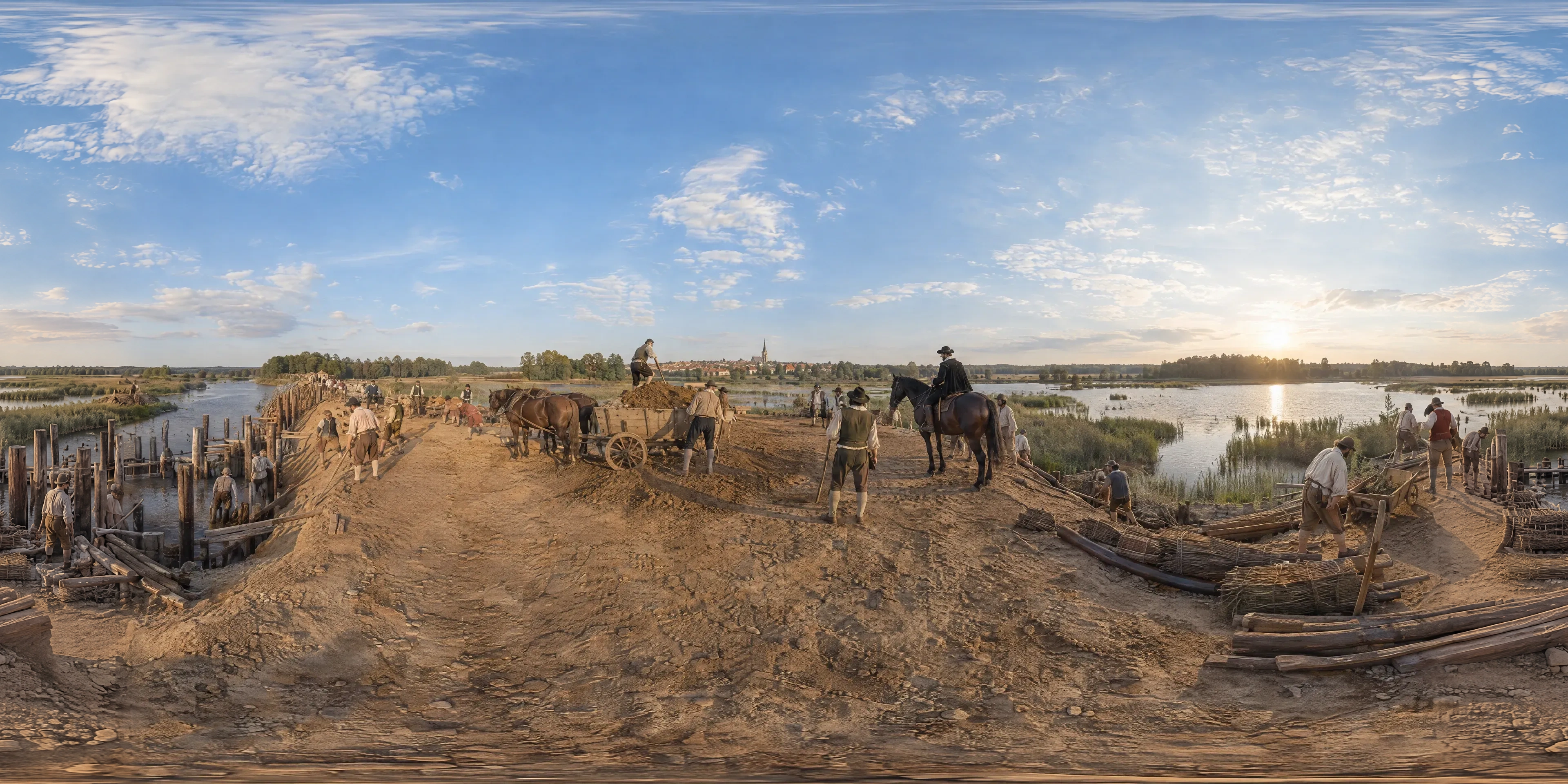
In 1590 the Rosenberg regent Jakub Krčín finishes a six-year project: hundreds of peasants have raised an earth dam over two kilometres long across the Lužnice floodplain near Třeboň. Behind it lies Rožmberk, still the largest fishpond in the world and the crown of the South Bohemian pond system.
- Year
- 1590
- Where
- Bohemia · CZ
- Era
- Renaissance
- Coordinates
- 49.048, 14.760
The moment
Six years and 2,355 metres of earth
In 1590 the dam of Rožmberk was finished. It had taken six seasons of work, from 1584, to raise an earth wall across the flat, wet floodplain of the Lužnice some six kilometres north of Třeboň.
The numbers still impress: 2,355 metres long, 11 metres high, 55 to 60 metres wide at the foot and up to 12 metres across the crown. In the last years, 400 to 500 men a day worked on it.
Most were subject peasants doing robota, the compulsory labour owed to their lord, alongside itinerant professional pond-diggers. They moved the soil with wooden spades, baskets, wheelbarrows and horse carts, faced the inner slope with driven oak piles, logs and bundles of fir and spruce brushwood, and laid outlet pipes of squared timber.
A new river to protect a pond
A dam that size across a living river needed a safety valve. Alongside the pond the builders dug the Nová řeka, the New River, a canal that carries the Lužnice's floodwater away into the neighbouring Nežárka.
The water behind the dam spread far wider than it does now. The original area is said to have been about 1,050 hectares; today's pond covers 489. Even so, Rožmberk is described as the largest fishpond in the world, in the precise sense of an artificial body of water made mainly for raising fish.
What visitors see on the dam today is mostly later. The stone arch bridges date from 1781 and 1799, the concrete outlet from 1916 to 1918, and in 1590 the crest was raw, trampled earth.
The regent said to have dealt with the devil
The project is tied to one man. Jakub Krčín, born in Kolín in 1535, ran the vast Rosenberg estates as regent for Vilém of Rožmberk from 1569 to 1589, and he began Rožmberk in 1584.
By the time the dam was finished he had stepped down as regent, though he went on managing the estate of Sedlčany until his death in 1604. He had built ponds before, among them the one on the edge of Třeboň finished in 1574 and first named Nevděk, "Ingratitude", now called Svět.
Local tradition was less admiring than the history books. His interest in alchemy fed rumours of a pact with the devil, and legend held that his body was never found in the tomb prepared for it.
Why the Czech Christmas passes through Třeboň
Krčín's ponds are the textbook image of the Rosenberg golden age. They are also a working landscape: the South Bohemian pond system they crowned still supplies the carp at the centre of the Czech Christmas table.
That landscape now looks natural, with reed beds, wet meadows and pine woods around broad sheets of water. It was made by spade, basket and cart.
The cost is part of the story. The dam was raised largely by compulsory peasant labour, and the pond that feeds a national tradition was built by people who had no choice about building it.
Sources
Further reading
Tagged
- czechia
- south-bohemia
- trebon
- rosenberg
- renaissance
- fishponds
- jakub-krcin
- everyday-life
Published
See also

1543
Cathedral Hill, Frombork
In late May 1543 Nicolaus Copernicus, a 70-year-old canon of the Warmian chapter, dies at Frombork; by tradition the first printed copy of his De revolutionibus, the book that sets the Earth moving around the Sun, reached him on his last day. The walled cathedral hill, beside which he lived and watched the sky for more than thirty years, looks out over the Vistula Lagoon.

1444
Florence Cathedral, Florence
In 1444, Brunelleschi's revolutionary double-shell brick dome over Santa Maria del Fiore in Florence approaches completion: the largest masonry dome in the world, raised without scaffolding.

960s
Malá Strana below Prague Castle
Around 965 the traveller Ibrahim ibn Yaqub finds Prague the richest trading place of the region: Rus and Slav merchants from Kraków and Muslim and Jewish traders from the east meet in the settlement below the Přemyslid castle, where saddles, bridles and shields are made and slaves, tin and furs are sold.