Beach of Scheveningen
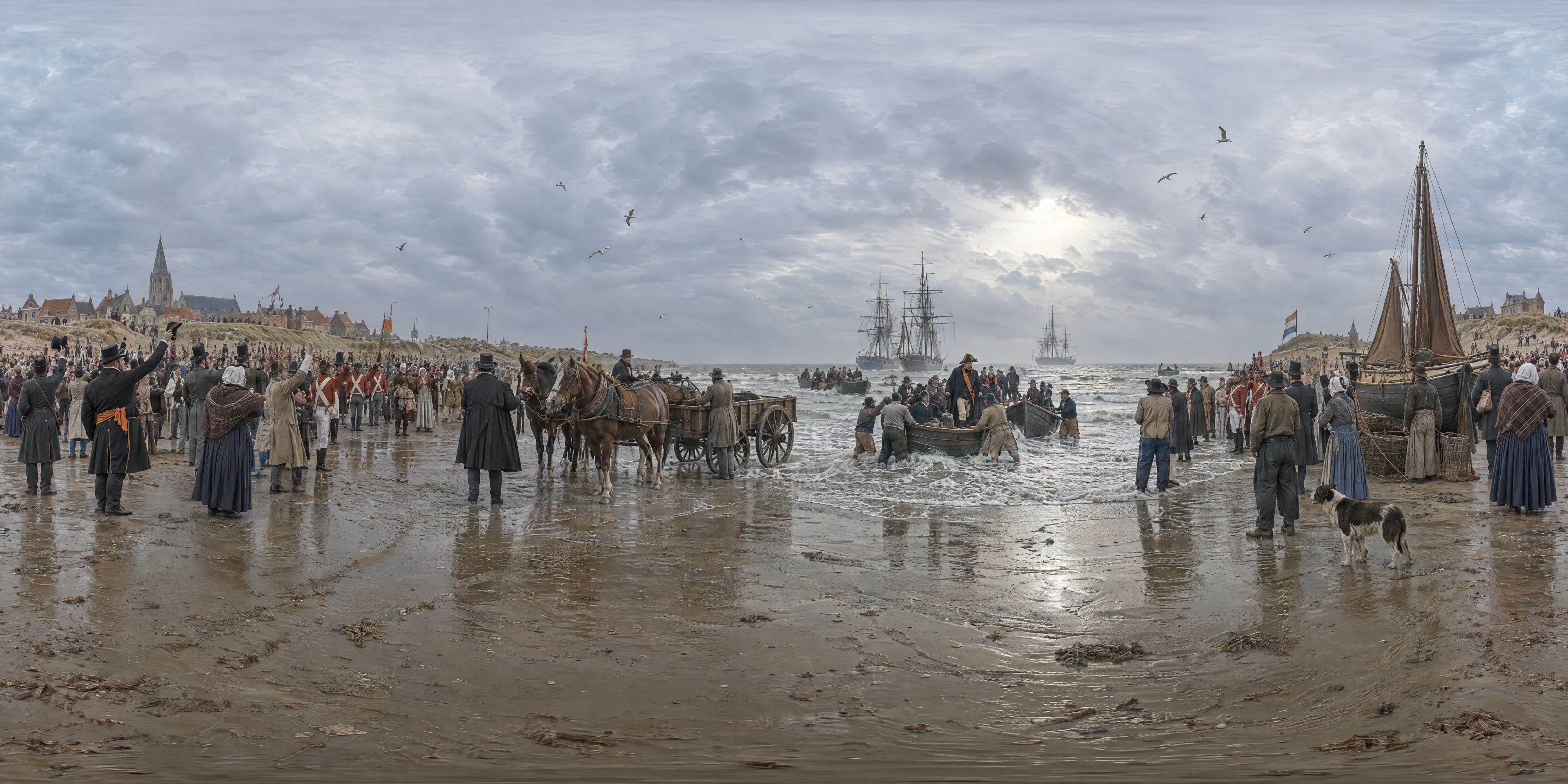
On the afternoon of 30 November 1813, as French rule in Holland collapses, Prince William Frederick of Orange, son of the last stadtholder, is rowed ashore from the British warship Warrior and lifted onto a farm wagon in the surf at Scheveningen. Two days later he is proclaimed sovereign prince in Amsterdam, the start of the Kingdom of the Netherlands.
- Year
- 1813
- Where
- Holland (South Holland) · NL
- Era
- Industrial
- Coordinates
- 52.107, 4.268
The moment
A prince carried ashore on a farm wagon
On the morning of Tuesday 30 November 1813, two warships appeared off Scheveningen, the fishing village by The Hague. On board the British Warrior was William Frederick, Prince of Orange, the son of the last stadtholder.
In the afternoon, by the traditional account, a ship's boat brought him in through the breakers. A high-wheeled wooden farm wagon drawn by three horses drove out into the surf to meet it, fishermen waded in to steady the boat, and many hands passed the prince across. The villager who took charge on the beach was Jacob Pronk.
The same beach, eighteen years earlier
The family had left from here. In January 1795, as French armies overran the country, the stadtholder William V fled to England from the frozen beach of Scheveningen, and Pronk had helped him get away.
For eighteen years the Netherlands had been a French client state, first a republic, then a kingdom under Louis Bonaparte, and from 1810 part of France itself. In November 1813, with Napoleon's power collapsing, a group of Orangist notables led by Gijsbert Karel van Hogendorp formed a provisional government, a triumvirate with Frans Adam van der Duyn van Maasdam and Leopold van Limburg Stirum, and invited the prince home. The British had prepared the way: on 29 November the warships Cumberland and Princess Caroline landed 240 marines on the same beach.
A welcome smaller than the legend
The patriotic legend that grew later puts a whole nation on the sand. Historians describe something plainer: a small, unspectacular reception, with a crowd in the hundreds rather than a multitude, later romanticised into a founding myth.
What followed is not in doubt. Three carriages took the prince to The Hague to meet Van Limburg Stirum. On 2 December 1813 he was proclaimed sovereign prince in Amsterdam, and in 1815 he took the title of king as William I.
Where the Kingdom of the Netherlands began
For the Dutch, the landing at Scheveningen marks the end of French rule and the start of the Kingdom of the Netherlands, and the House of Orange has reigned ever since.
The village has kept the date. A memorial obelisk, the Gedenknaald, was unveiled on 30 November 1865, and the landing is re-enacted every 25 years; at the bicentenary in 2013 the actor Huub Stapel played the prince.
Pronk did well out of the beach too. A few years after the landing he opened a bathing house there, one of the first steps in Scheveningen's change from fishing village to seaside resort, the resort of the Kurhaus and the pier.
Sources
Further reading
Tagged
- netherlands
- scheveningen
- the-hague
- house-of-orange
- kingdom
- napoleonic-era
- beach
- 1813
Published
See also

1869
Court Opera on the Ringstraße, Vienna
On the evening of 25 May 1869 Emperor Franz Joseph opens the new Court Opera, the first great public building on Vienna's Ringstraße, with Mozart's Don Giovanni sung in German. Neither of its architects lives to see the night: both died in 1868, after Viennese mockery of the 'sunken box'.

1897
Giant Ferris Wheel, Prater, Vienna
On 3 July 1897, a hot summer day, Vienna's Giant Ferris Wheel opens in the Prater, built by English engineers for the jubilee of Emperor Franz Joseph's 50 years on the throne. Its 30 cabins turn up to 64.75 m above the canals of the 'Venice in Vienna' pleasure park, making it one of the largest wheels in the world; a ride costs a gulden.

1804
Notre-Dame de Paris
On 2 December 1804, Napoleon Bonaparte crowns himself Emperor of the French inside Notre-Dame de Paris, taking the gold laurel wreath from Pope Pius VII's hands and placing it on his own head, the gesture David captured in the most famous coronation painting of the nineteenth century.