Spiš Castle
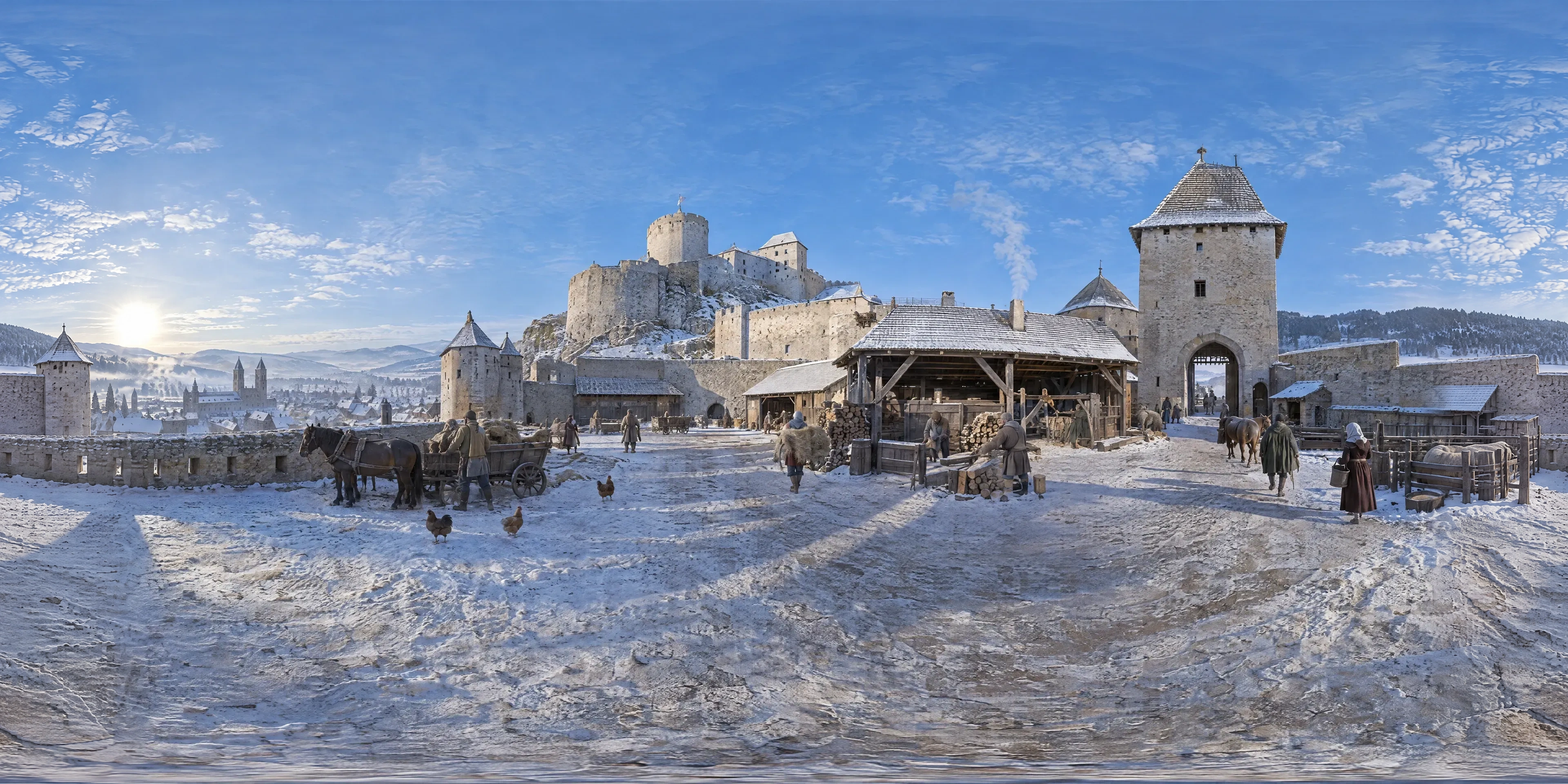
Candlemas, 2 February 1487: at Spiš Castle, seat of the Zápolya counts, the palatine Stephen Zápolya's wife Hedwig gives birth to John, the future king of Hungary, while the vast lower courtyard below the Gothic palace serves as the castle's farmyard. The castle, one of Slovakia's largest, is at its late-Gothic height, three centuries before the fire that ruined it.
- Year
- 1487
- Where
- Spiš (Szepes), Kingdom of Hungary · SK
- Era
- Renaissance
- Coordinates
- 48.998, 20.767
The moment
A king born at Candlemas
On 2 February 1487, the feast of Candlemas, Hedwig of Cieszyn, wife of the palatine Stephen Zápolya, gave birth to a son, John. Slovak tradition places the birth in Spiš Castle, the family's seat; other accounts give the town below it, Spišské Podhradie.
The boy became one of the most important men in Hungary. Appointed voivode of Transylvania in 1510, he was proclaimed King of Hungary at Székesfehérvár on 10 November 1526, after the disaster of Mohács, and crowned the next day.
His reign was a long contest with the Habsburg Ferdinand I, who claimed the same throne. In 1529 John accepted Ottoman overlordship in return for support, and he died on 22 July 1540, a week after the birth of his son, John Sigismund.
A farmyard inside the walls
In 1487 the castle was at its late-Gothic height, three centuries before the fire that ruined it. The Zápolyas had received it from King Matthias in 1465 and were adding new late-Gothic buildings and a chapel to the upper castle.
The huge lower courtyard had lost its military role. It had held the garrison of the Hussite captain Jiskra, whose troops built a round fort about seventeen metres across after 1442, and by the Zápolyas' time it served as the castle's farmyard.
How far the rebuilding had got by 1487, and whether Jiskra's fort still stood intact, is not documented. The farm buildings of the courtyard are known only in general terms.
Four hectares on a white hill
Spiš Castle covers about four hectares of a travertine hill, among the largest castle sites in Slovakia. It is first recorded in 1120, and its highest point was crowned by a round Romanesque keep.
From the walls, the view runs west to Spišská Kapitula, the church town on its own ridge. There the cathedral of St Martin, with its two Romanesque towers, had just been rebuilt as a Gothic hall church, consecrated in 1478; the Zápolya chapel was added from 1488.
The fire nobody explained
The Zápolyas held the castle until 1528, the Thurzó family from 1531 and the Csáky family from 1638. In 1780 a fire gutted it, and it was abandoned.
The cause is unknown. Theories range from deliberate burning to avoid taxes, to lightning, to soldiers distilling spirits illegally.
The ruin became Slovakia's most famous castle silhouette. It is part of the UNESCO World Heritage Site of Levoča, Spiš Castle and their surroundings, first inscribed in 1993 together with Spišská Kapitula and the church at Žehra.
It belongs to Hungarian history too, as Szepes vára, where John Zápolya is remembered first as a king of Hungary. For Slovakia it is the emblem of the whole Spiš region.
Sources
Further reading
Tagged
- slovakia
- spis
- castle
- medieval
- gothic
- zapolya
- unesco
- winter
Published
See also

1410
Grunwald Battlefield
On the hot morning of 15 July 1410 the armies of King Władysław Jagiełło and Grand Duke Vytautas wait at the edge of the woods facing the Teutonic Order across the fields of Grunwald, until two heralds ride over with two naked swords from Grand Master Ulrich von Jungingen, a taunt to come out and fight. By evening the Order's army is broken and its Grand Master dead.

1543
Cathedral Hill, Frombork
In late May 1543 Nicolaus Copernicus, a 70-year-old canon of the Warmian chapter, dies at Frombork; by tradition the first printed copy of his De revolutionibus, the book that sets the Earth moving around the Sun, reached him on his last day. The walled cathedral hill, beside which he lived and watched the sky for more than thirty years, looks out over the Vistula Lagoon.

1444
Florence Cathedral, Florence
In 1444, Brunelleschi's revolutionary double-shell brick dome over Santa Maria del Fiore in Florence approaches completion: the largest masonry dome in the world, raised without scaffolding.