Site 1 (Gagarin's Start), Baikonur
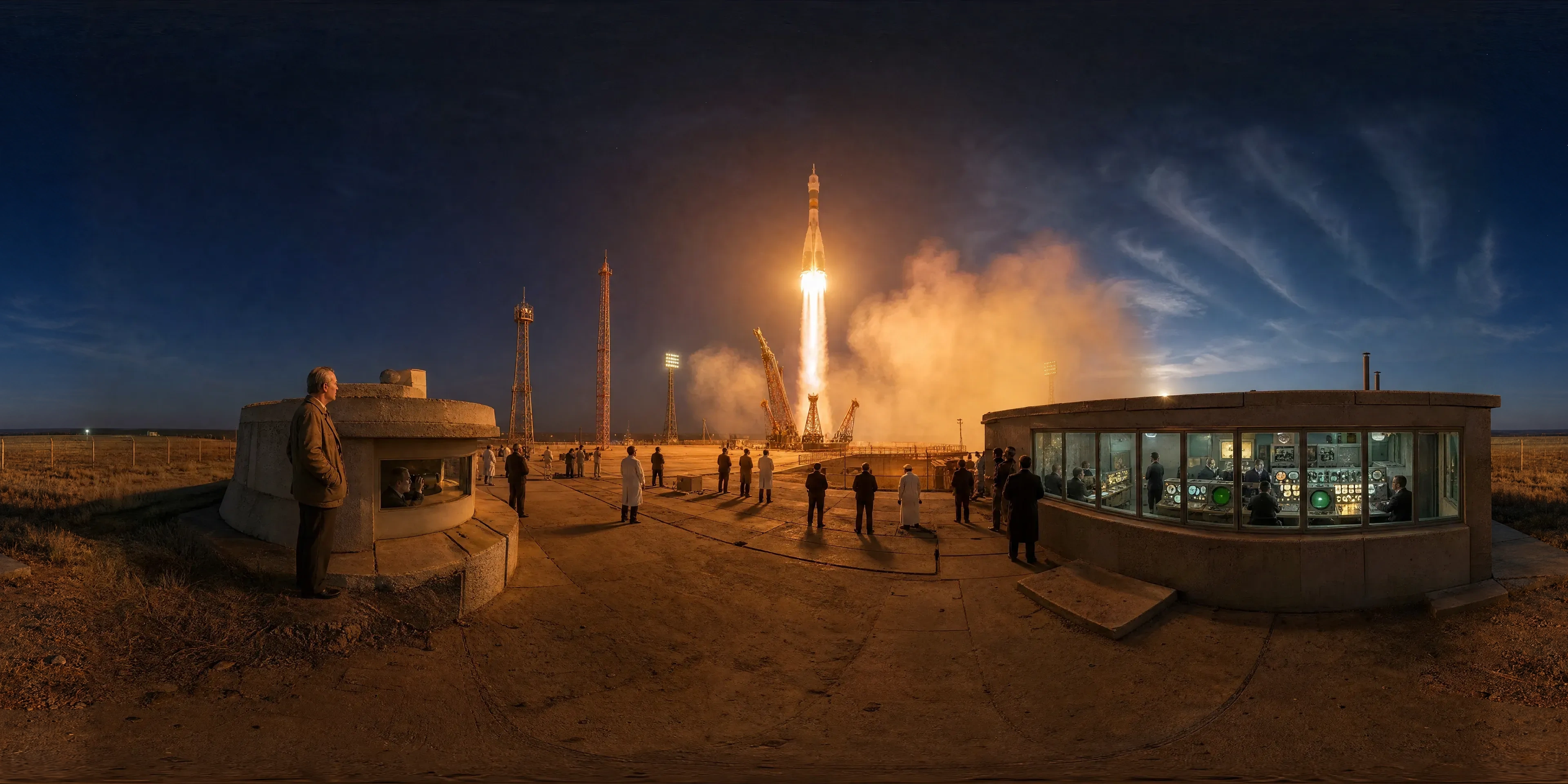
At 22:28 Moscow time on 4 October 1957, the Soviet Union launches *Sputnik 1*: an 84-kilogram polished aluminium sphere that becomes the first artificial satellite to orbit the Earth.
- Year
- 1957
- Where
- Baikonur Cosmodrome, Kazakh SSR · KZ
- Era
- modern_postwar
- Coordinates
- 45.965, 63.305
The moment
Twenty-three days late
The launch of Sputnik 1 on the night of 4 October 1957 was twenty- three days late.
The original launch plan had targeted 11 September 1957, to coincide with the closing of the International Geophysical Year preparatory meetings in Washington. Successive technical delays pushed the launch back through September. Sergei Korolev, the Chief Designer of the Soviet rocket programme, finally authorised launch on 4 October to avoid further postponement into the bad- weather Kazakh autumn.
The R-7 booster ignited at 22:28 Moscow time. Three hundred and fifteen seconds later, the third-stage core had cut off engines at 228 kilometres altitude and was travelling at 28 800 km/h: orbital velocity. The fairing separated. Sputnik 1 deployed its four whip antennae and began to broadcast.
The signal (a simple beep... beep... beep... on 20.005 MHz and 40.002 MHz, repeating roughly every second) was the first time a human-made transmission had originated from outside the Earth's atmosphere.
What Sputnik actually was
The satellite itself was simple by the engineering standards of the era. It was simple deliberately.
The Soviet Academy of Sciences had originally proposed a much more elaborate scientific payload: Object D, a 1 400-kg orbital laboratory carrying multiple instruments. Korolev abandoned the complex design in early 1957 when it became clear that Object D would not be ready before the Americans launched their planned Vanguard satellite later that year.
In its place, Korolev built PS-1: Prosteyshiy Sputnik 1, "Simplest Satellite 1". A polished aluminium sphere 58 centimetres in diameter, weighing 83.6 kilograms, containing four whip antennae, a radio transmitter, batteries, a temperature sensor, and nothing else.
The sphere was polished to a mirror finish for two reasons. The practical reason was thermal: a mirror surface reflects most incoming solar radiation and equalises temperature across the satellite. The public-relations reason was that a polished sphere would be visible from Earth as a moving point of reflected sunlight; astronomers worldwide would be able to verify the satellite's presence in orbit within hours of launch.
(In practice, observers with binoculars could see the discarded upper stage of the R-7 booster trailing Sputnik through the sky, more easily than the small satellite itself. Most "sighting reports" of Sputnik in October 1957 were actually observations of the booster.)
Three weeks of beeping
Sputnik 1 transmitted for 22 days, until its silver-zinc batteries ran out on 26 October 1957.
The orbital decay was slower. The satellite continued to orbit silently for another 92 days, gradually losing altitude as it dipped through the upper atmosphere on each orbit, until it burned up on re-entry on 4 January 1958.
Total orbits completed before re-entry: 1 440.
During those three months, the simple beep... beep... was received and re-broadcast by amateur radio operators across the planet. The frequency had been chosen by Korolev to be receivable by standard ham radio equipment: a deliberate decision to maximise public engagement with the achievement. The propaganda value of the launch was incalculable.
What the West thought
The American reaction to Sputnik was an order of magnitude larger than the Soviets had expected.
The launch coincided with one of the most embarrassing periods of Project Vanguard, the American attempt to launch the first satellite. Vanguard's first launch attempt on 6 December 1957, two months after Sputnik, exploded on the launch pad on national television. The press called it Kaputnik and Flopnik. The American public believed, for the first time since the Second World War, that the Soviet Union was technologically ahead of the United States.
The political consequences were enormous.
President Eisenhower's administration, criticised in Congress and the press for complacency, created two new agencies: NASA (the National Aeronautics and Space Administration) in October 1958, and DARPA (originally ARPA, the Defense Advanced Research Projects Agency) in February 1958. The 1958 National Defense Education Act poured federal funding into American science and engineering education at all levels. The American government essentially decided to remake American technical higher education in response to a 58-centimetre Soviet aluminium sphere.
The first American satellite, Explorer 1, launched on 31 January 1958, was a more sophisticated piece of equipment than Sputnik (it carried a Geiger counter that discovered the Van Allen radiation belts). It was also a year behind.
The Space Race had begun. Twelve years after Sputnik 1, on 20 July 1969, Americans walked on the Moon.
Further reading
Tagged
- ussr
- space-race
- sputnik
- baikonur
- 1957
- kazakhstan
- satellite
Published
See also

1989
Brandenburg Gate, Berlin
On the night of November 9–10, 1989, East and West Berliners climb the Berlin Wall in front of the Brandenburg Gate, chipping at the concrete with hammers and dancing on top: the symbolic collapse of the Iron Curtain.

1979
Victory Square, Warsaw
On the afternoon of Saturday 2 June 1979, on his first visit home as pope, John Paul II says Mass for about half a million people on Victory Square in communist Warsaw and prays that the Holy Spirit will renew the face of the earth, adding "this land". The words are remembered as the spark of the Solidarity movement.

1955
Upper Belvedere, Vienna
Around noon on Sunday 15 May 1955, just after the State Treaty is signed in the Marble Hall of the Upper Belvedere, Foreign Minister Leopold Figl steps onto the balcony with the Allied foreign ministers and holds up the signed treaty to the crowd waiting in the palace garden. After ten years of occupation, Austria is free.