Palace Square, Winter Palace
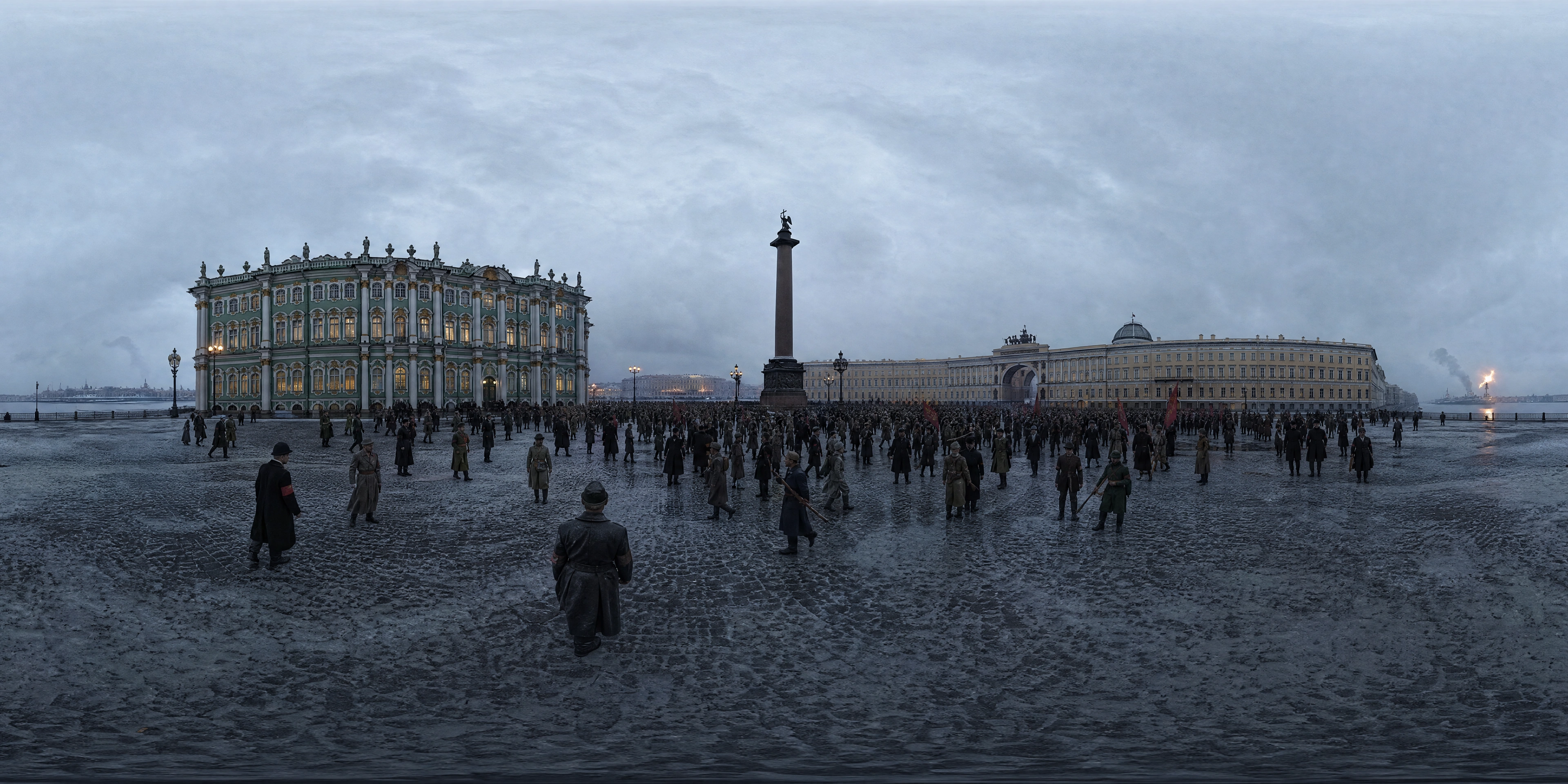
On the night of October 25, 1917 (November 7 New Style), Bolshevik forces cross Palace Square in Petrograd to arrest the Provisional Government inside the Winter Palace; Sergei Eisenstein's later film would mythologize this as a heroic charge.
- Year
- 1917
- Where
- Petrograd (St. Petersburg) · RU
- Era
- modern_early
- Coordinates
- 59.940, 30.315
The moment
A revolution that took six hours
The Bolshevik seizure of power in Petrograd on the night of 25–26 October 1917 (7–8 November New Style) was remarkably bloodless.
The combined Bolshevik forces (Red Guard factory militia plus pro-Bolshevik sailors from Kronstadt and soldiers from the Petrograd garrison) numbered perhaps 20 000. The defending Provisional Government had about 3 000 troops, mostly officer- cadets (junkers) from the military academies and one battalion of the Women's Death Battalion.
The actual fighting in the streets killed about six people. The capture of the Winter Palace, the seat of the Provisional Government, was completed by 02:00 on 26 October with about a dozen casualties.
The Aurora fires a blank
The cruiser Aurora, moored on the Neva River about a kilometre from the Winter Palace, fired a single blank from her forward six-inch gun at 21:40 as a signal for the assault to begin.
The gun made an enormous noise but caused no damage.
The cruiser had been ordered to fire live shells against the Palace if the Bolshevik infantry attack failed, but the infantry got into the building before the order was given.
The Aurora's blank shot remains one of the most famous signals in revolutionary history. Not for what it did but for what it represented: the moment the Russian Empire stopped existing.
The cinematic version is not what happened
The mass image of the storming (soldiers and sailors swarming into the Palace's huge gilded gates by the thousand) is from Sergei Eisenstein's 1928 silent film October: Ten Days That Shook the World, commissioned for the tenth anniversary of the revolution.
Eisenstein had access to thousands of extras, the actual Aurora, and the actual Palace gates. His footage looks real, and within a decade it had largely replaced the actual historical record in popular memory.
The real storming was small, chaotic, and partly opportunistic. Most of the defenders simply left their posts as the Bolshevik soldiers entered the building. Eisenstein himself joked, late in life, that more people had died filming October than had died in the real storming.
Lenin's hidden week
Vladimir Lenin had spent the days before the storming in hiding, in safe houses on the Vyborg side of Petrograd, with the Provisional Government's secret police actively searching for him.
He emerged from hiding around 18:00 on 25 October, walked into the Smolny Institute (the Bolshevik headquarters), and oversaw the night's operation from there. He did not personally enter the Winter Palace until early morning of 26 October, by which time the seizure was complete.
His first act as the head of the new government, that morning, was to issue the Decree on Peace (calling for an immediate armistice) and the Decree on Land (transferring all private agricultural land to peasant collectives without compensation).
Further reading
Tagged
- russia
- revolution
- bolshevik
- lenin
- 1917
- winter-palace
Published
See also

1944
Omaha Beach, Normandy
At 6:30 a.m. on June 6, 1944, the first waves of American soldiers from the 1st and 29th Infantry Divisions wade ashore at Omaha Beach under heavy German machine-gun fire in the bloodiest landing of D-Day.

1939
Lower Wenceslas Square, Prague
On the morning of 15 March 1939, in a heavy fall of wet snow, German columns roll down Wenceslas Square as Hitler's troops occupy what remains of Czechoslovakia. Thousands of Praguers watch from the pavements, weeping, booing and singing the national anthem; that evening Hitler reaches Prague Castle, and the next day he proclaims the Protectorate of Bohemia and Moravia.

1945
Mt. Suribachi, Iwo Jima
At midday on February 23, 1945, six United States Marines raise a larger replacement American flag on a length of iron pipe atop Mt. Suribachi on Iwo Jima, captured in Joe Rosenthal's photograph.