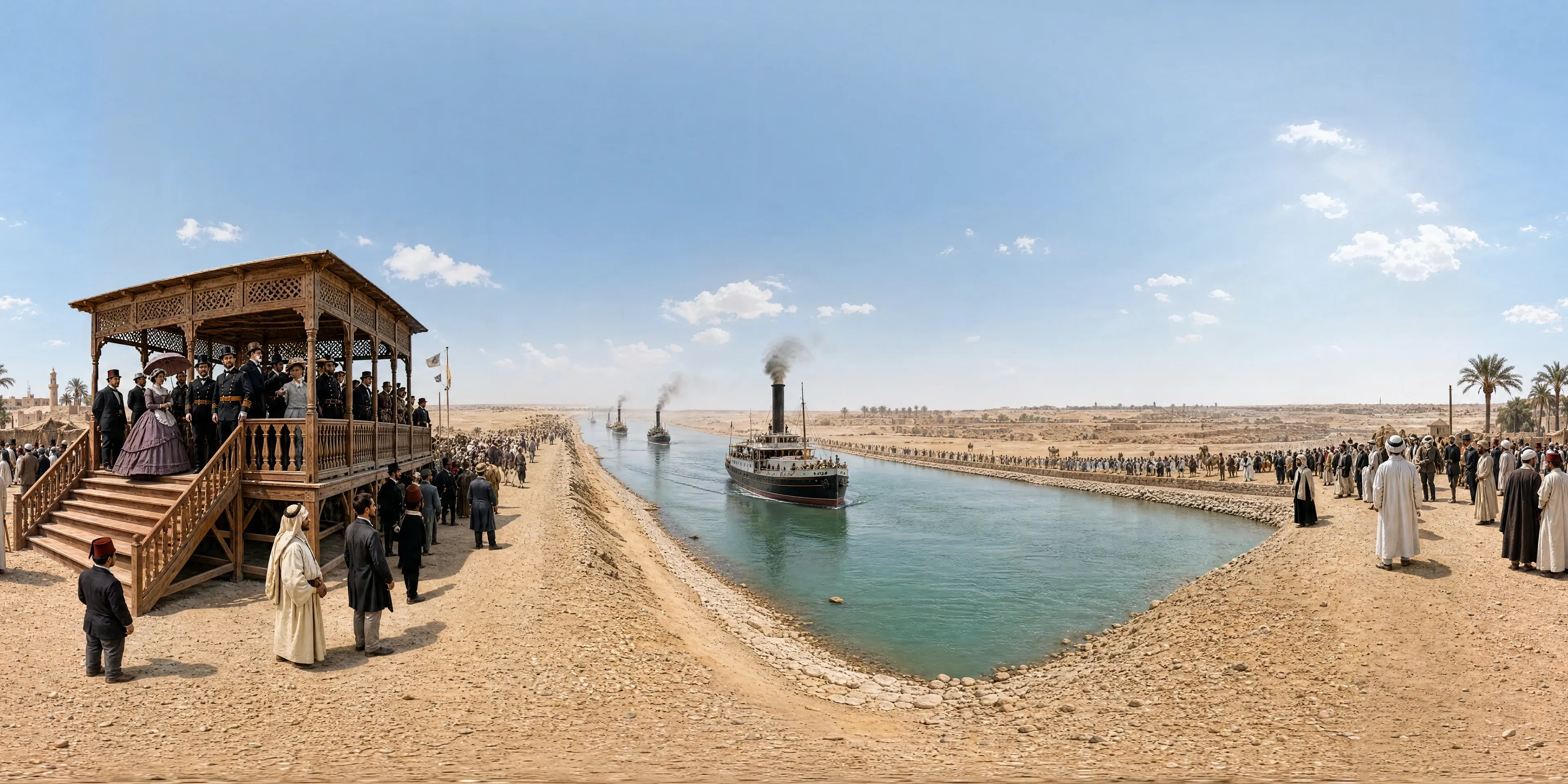
Suez Canal at Ismailia
On November 17, 1869, the Suez Canal opens with a procession of 68 ships led by the French Empress Eugénie's yacht L'Aigle: the first direct shipping link between the Mediterranean and the Red Sea.
- Year
- 1869
- Where
- Ismailia, Suez Canal · EG
- Era
- Industrial
- Coordinates
- 30.604, 32.272
The moment
A waterway between two seas
The Suez Canal opened on 17 November 1869 after eleven years of construction and the labour of perhaps 1.5 million Egyptian workers, of whom roughly 120 000 died of cholera, smallpox, and exhaustion.
The 193-kilometre canal connected the Mediterranean Sea at Port Said to the Red Sea at Suez, allowing ships to travel between Europe and South Asia without sailing 7 000 kilometres around the Cape of Good Hope.
The journey from London to Bombay was cut from roughly 100 days to 30.
Why no locks
The Suez Canal is unusual among major canals in that it has no locks.
The Mediterranean and Red Sea are at essentially the same level. Both are connected to the world ocean, so their levels equalise over geological time. This single geographic accident meant that Ferdinand de Lesseps's engineers could simply dig a sea-level trench between the two and let the water flow in.
The Panama Canal, completed 45 years later, faced the opposite problem: the Pacific and Atlantic are at different levels and the route crosses a continental divide. It required a system of three locks at each end.
Eugénie attends
The opening ceremony was attended by the Empress Eugénie of France (wife of Napoleon III, on board the imperial yacht L'Aigle), Emperor Franz Joseph of Austria-Hungary, Crown Prince Frederick of Prussia, and a procession of 68 ships flagged from all major maritime nations.
The Khedive Ismail Pasha of Egypt had organised six weeks of festivities and built a new opera house in Cairo specifically for the occasion. He commissioned Giuseppe Verdi to compose a new opera for the inauguration.
Verdi's contribution, Aida, was not finished in time. It premiered two years later, in December 1871. The Khedive received an earlier piece, Rigoletto, performed in his new opera house on opening night instead.
The canal that bankrupted Egypt
The Suez Canal cost Egypt the equivalent of seven years of state revenue.
Ismail Pasha, unable to service the debt, was forced in 1875 to sell Egypt's 44 per cent stake in the Suez Canal Company to the British government for £4 million. Prime Minister Benjamin Disraeli arranged the purchase personally, borrowing the money overnight from the Rothschild bank.
The sale gave Britain effective control over the canal: the strategic prize that shaped British imperial policy in Egypt for the next 80 years, and that triggered, in 1956, the Suez Crisis when Egyptian President Nasser nationalised the canal back into Egyptian ownership.
Further reading
Tagged
- egypt
- suez-canal
- lesseps
- eugenie
- 1869
- industrial
Published
See also

1869
Court Opera on the Ringstraße, Vienna
On the evening of 25 May 1869 Emperor Franz Joseph opens the new Court Opera, the first great public building on Vienna's Ringstraße, with Mozart's Don Giovanni sung in German. Neither of its architects lives to see the night: both died in 1868, after Viennese mockery of the 'sunken box'.

1897
Giant Ferris Wheel, Prater, Vienna
On 3 July 1897, a hot summer day, Vienna's Giant Ferris Wheel opens in the Prater, built by English engineers for the jubilee of Emperor Franz Joseph's 50 years on the throne. Its 30 cabins turn up to 64.75 m above the canals of the 'Venice in Vienna' pleasure park, making it one of the largest wheels in the world; a ride costs a gulden.

1804
Notre-Dame de Paris
On 2 December 1804, Napoleon Bonaparte crowns himself Emperor of the French inside Notre-Dame de Paris, taking the gold laurel wreath from Pope Pius VII's hands and placing it on his own head, the gesture David captured in the most famous coronation painting of the nineteenth century.