Sutton Hoo, Suffolk
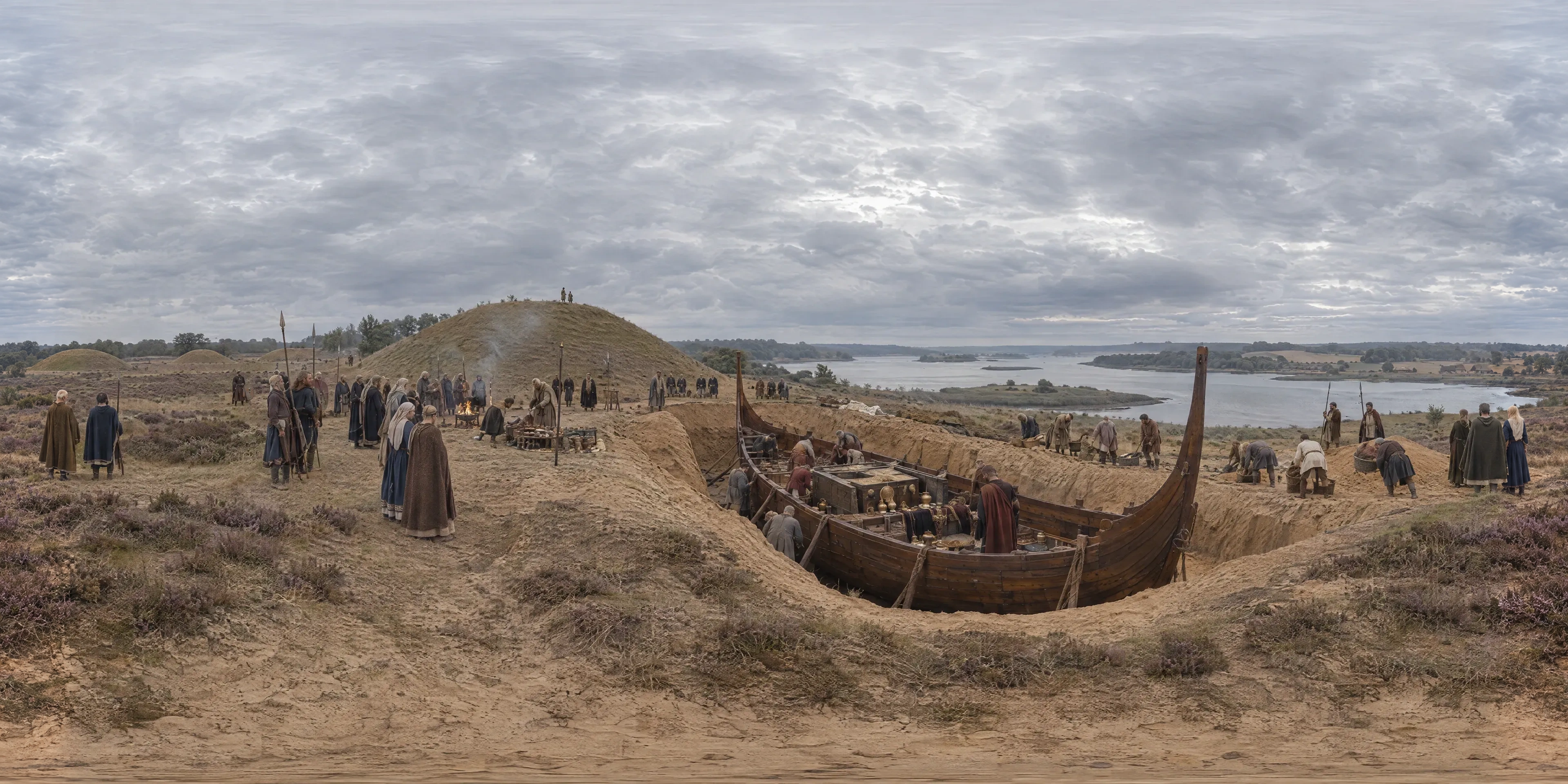
Around 625 the East Angles haul a 27-metre oak ship up from the River Deben onto the heath at Sutton Hoo and bury a king, most likely Rædwald, in a timber chamber amidships with his helmet, sword, shield, gold and silver. Found in 1939, the grave is one of the most spectacular discoveries in British archaeology.
- Year
- 620s
- Where
- East Anglia · GB
- Era
- Medieval
- Coordinates
- 52.089, 1.338
The moment
A ship dragged uphill to hold a king
Around 625 the East Angles hauled an oak ship 27 metres long up from the River Deben to the heath at Sutton Hoo, lowered it into a trench and built a timber burial chamber amidships. Then they heaped an oval mound over it, on the riverward side of the cemetery, where it rose above the horizon.
The ship was clinker-built, nine planks a side fastened with iron rivets. When archaeologists reached it in 1939, the wood had rotted away entirely. What survived was a ghost: stains in the sand holding the shape of the planks, and nearly all the rivets still in their places.
Long before, the chamber roof had collapsed under the weight of the mound, pressing its contents into a single seam of earth.
Gold from Francia, silver from Byzantium
The grave goods reach across the known world. A purse hung from the belt held 37 gold coins called tremisses, each from a different Frankish mint. A great silver dish made in the Eastern Roman Empire around 500 still bears the control stamps of the emperor Anastasius I. Two silver spoons, possibly Byzantine, belong to a type engraved with apostles' names, and one theory reads them as a baptismal gift.
Beside them lay the equipment of a warrior king: a helmet with a full face mask, a great round shield, a sword with gold-and-garnet fittings, drinking horns and a lyre.
The coins date the burial to between 610 and 635.
A king without a body
Nobody has proved who lay here. No bones survived in the sandy soil, and the grave was long suspected of being a cenotaph, until analysis detected phosphate, the chemical trace of a body.
Rædwald of East Anglia, who died around 624, remains the favourite. Rendlesham, a known residence of the East Anglian kings, is only four miles away, and the wealth suits an overking. But Eorpwald, who died in 627 or 628, fits the dates too, and the Oxford Dictionary of National Biography judges the case for Rædwald argued more strongly than convincingly. In 2025 the historian Helen Gittos proposed someone else entirely: a local warrior who had served in the Byzantine army.
Why the mask is the face of early England
The excavation began in 1938, when the landowner Edith Pretty set Basil Brown, a self-taught archaeologist, to open the mounds on her estate. He reached the ship under Mound 1 the following year, and national scholars soon took over.
In 1939 a treasure trove inquest held in the village of Sutton ruled that the finds belonged to Pretty rather than the Crown, because they had been buried with no intention of recovery. She then gave all of it to the British Museum, then the largest donation it had ever received from a living person.
The masked helmet is now the face of Anglo-Saxon England, in the museum and in the primary-school topic on Anglo-Saxon art and culture. The dig itself became a national story again through the film The Dig.
Sources
Further reading
Tagged
- united-kingdom
- england
- suffolk
- anglo-saxon
- east-anglia
- ship-burial
- early-medieval
- raedwald
Published
See also

2012
Olympic Stadium, London
At about 9.25 pm on 27 July 2012, in Danny Boyle's 'Isles of Wonder' ceremony, five glowing rings forged in a staged industrial revolution rise over the Olympic Stadium in Stratford and rain sparks. Watched by some 900 million people, it opens the Games many Britons remember as a high point of national pride.

1357
Charles Bridge, Prague
In 1357 Emperor Charles IV lays the foundation stone of a new stone bridge on the Old Town bank near St Clement's, fifteen years after ice and floodwater wrecked the Judith Bridge. Tradition sets the moment at 5:31 on 9 July, a palindrome of odd numbers; the bridge will take 45 years to finish.

537
Hagia Sophia, Constantinople
On December 27, 537 AD, Emperor Justinian I dedicates the newly built Hagia Sophia in Constantinople: its 32-meter dome rising on pendentives in a structural feat that defines Byzantine architecture.