Tilbury Camp, Essex
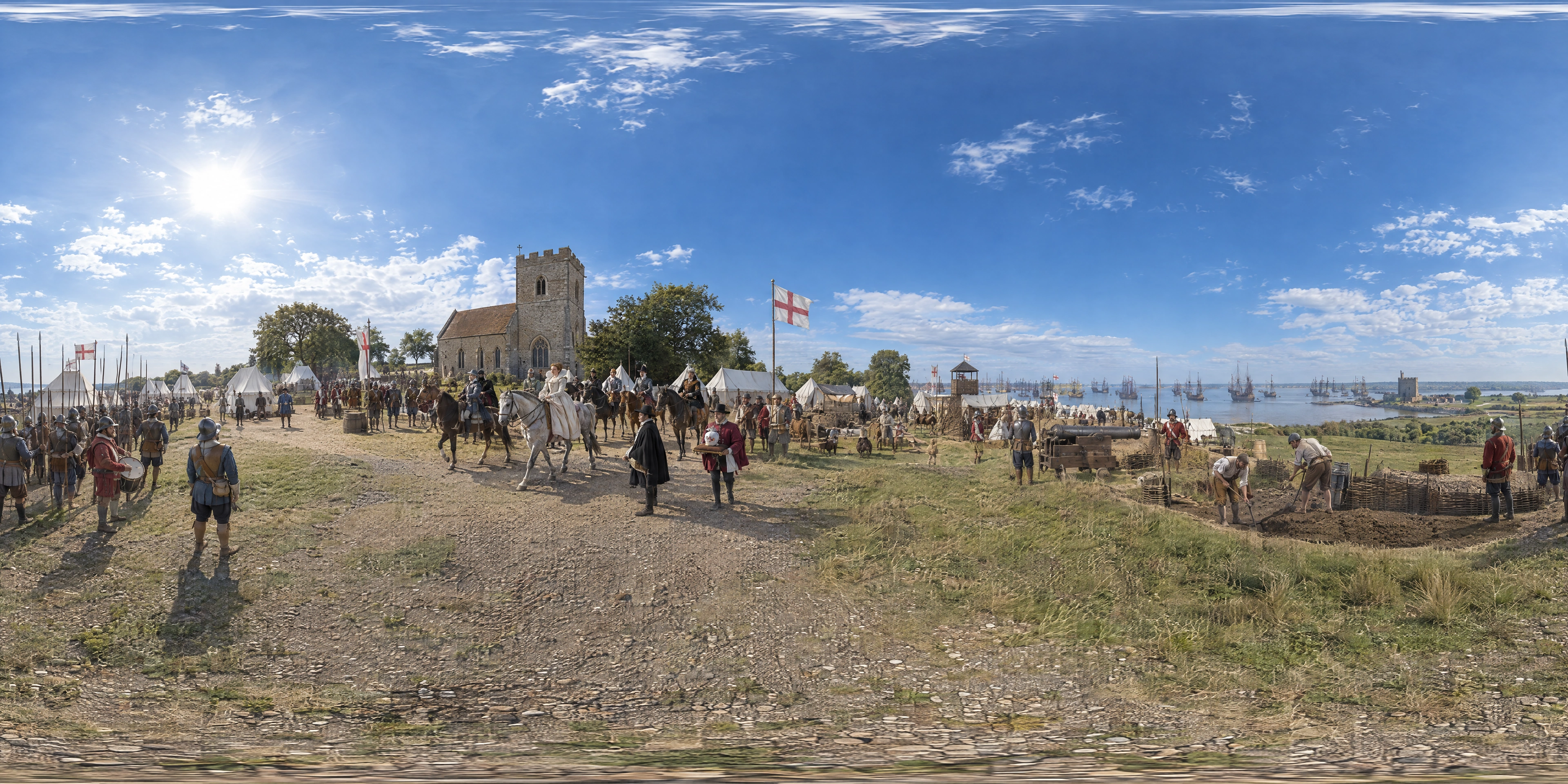
On 9 August 1588, with the Spanish Armada driven north round Scotland but Parma's invasion army still waiting in Flanders, Elizabeth I rides among her troops camped at West Tilbury in white with a silver breastplate and tells them she has 'the heart and stomach of a king'. It becomes the defining image of the Armada year.
- Year
- 1588
- Where
- Essex · GB
- Era
- Renaissance
- Coordinates
- 51.474, 0.391
The moment
The danger had already passed
By the time Elizabeth I rode among her army at West Tilbury, the Spanish Armada was gone. It had been driven from the Strait of Dover at the Battle of Gravelines eleven days earlier and was heading home round the north of Scotland.
What remained was the Duke of Parma's army, waiting in Flanders to cross from Dunkirk. So the troops guarding the Thames approach to London stayed in camp above the marshes under the Earl of Leicester, and on 9 August 1588, by the calendar England then used, the Queen reviewed them. Two days later they were discharged.
Six men, a grey gelding and a silver breastplate
She had come down the Thames on 8 August to the blockhouse at West Tilbury, Henry VIII's D-shaped artillery fort of 1539, which Leicester had just strengthened with earthworks. Some accounts put the speech on that day; most on the next.
At the review she left her bodyguard and went among her soldiers with an escort of six. The Earl of Ormonde walked ahead with the Sword of State; a page led her charger and another carried her silver helmet on a cushion. The Queen followed on a grey gelding, in white with a silver cuirass and a gold and silver baton, flanked by Leicester and the Earl of Essex. Sir John Norreys brought up the rear.
Dozens of descriptions of her survive, differing in detail. How the camp was laid out, and how large it was, nobody recorded.
The words survive in a later letter
The famous text comes from Leonel Sharp, a clergyman attached to Leicester at Tilbury, who sent it years later in a letter to the Duke of Buckingham; it was printed only in 1654. Sharp wrote that he was ordered to deliver the oration again to the whole army the day after she left.
It contains the line everyone remembers: "I know I have the body but of a weak, feeble woman; but I have the heart and stomach of a king, and of a king of England too." A copy in the British Library differs only slightly; two other versions, one in verse printed in 1588 and one recorded in 1612, read quite differently.
Most historians accept Sharp's text as a copy, at some remove, of a speech Elizabeth wrote herself, though sceptics have questioned it since 1919. That she spoke these exact sentences cannot be proved.
Why the line outlived the Armada
The defeat of the Armada is the climax of the Elizabethan story in England's curriculum, and the Tilbury speech is among the best-known royal words in English history. The news spread fast: a ballad on the visit by Thomas Deloney was registered in London the next day.
It has been quoted on screen from Fire Over England in 1937 to Elizabeth: The Golden Age in 2007. It also served a harder purpose: for centuries the Armada was told as a Protestant national myth against Catholic Spain.
Tilbury itself changed beyond recognition: from the 1670s the site became the star-shaped brick fort that still stands.
Sources
Further reading
Tagged
- united-kingdom
- england
- essex
- elizabeth-i
- spanish-armada
- tudor
- thames
- speech
Published
See also

1543
Cathedral Hill, Frombork
In late May 1543 Nicolaus Copernicus, a 70-year-old canon of the Warmian chapter, dies at Frombork; by tradition the first printed copy of his De revolutionibus, the book that sets the Earth moving around the Sun, reached him on his last day. The walled cathedral hill, beside which he lived and watched the sky for more than thirty years, looks out over the Vistula Lagoon.

1444
Florence Cathedral, Florence
In 1444, Brunelleschi's revolutionary double-shell brick dome over Santa Maria del Fiore in Florence approaches completion: the largest masonry dome in the world, raised without scaffolding.

15th century AD
Great Wall of China, Jinshanling
Around 1500, Ming China rebuilds the Great Wall in brick and stone across the mountain ridges north of Beijing: a battlemented rampart with watchtowers that climbs and plunges over the peaks as far as the eye can see, the most ambitious fortification ever built.