Stalin Monument, Budapest
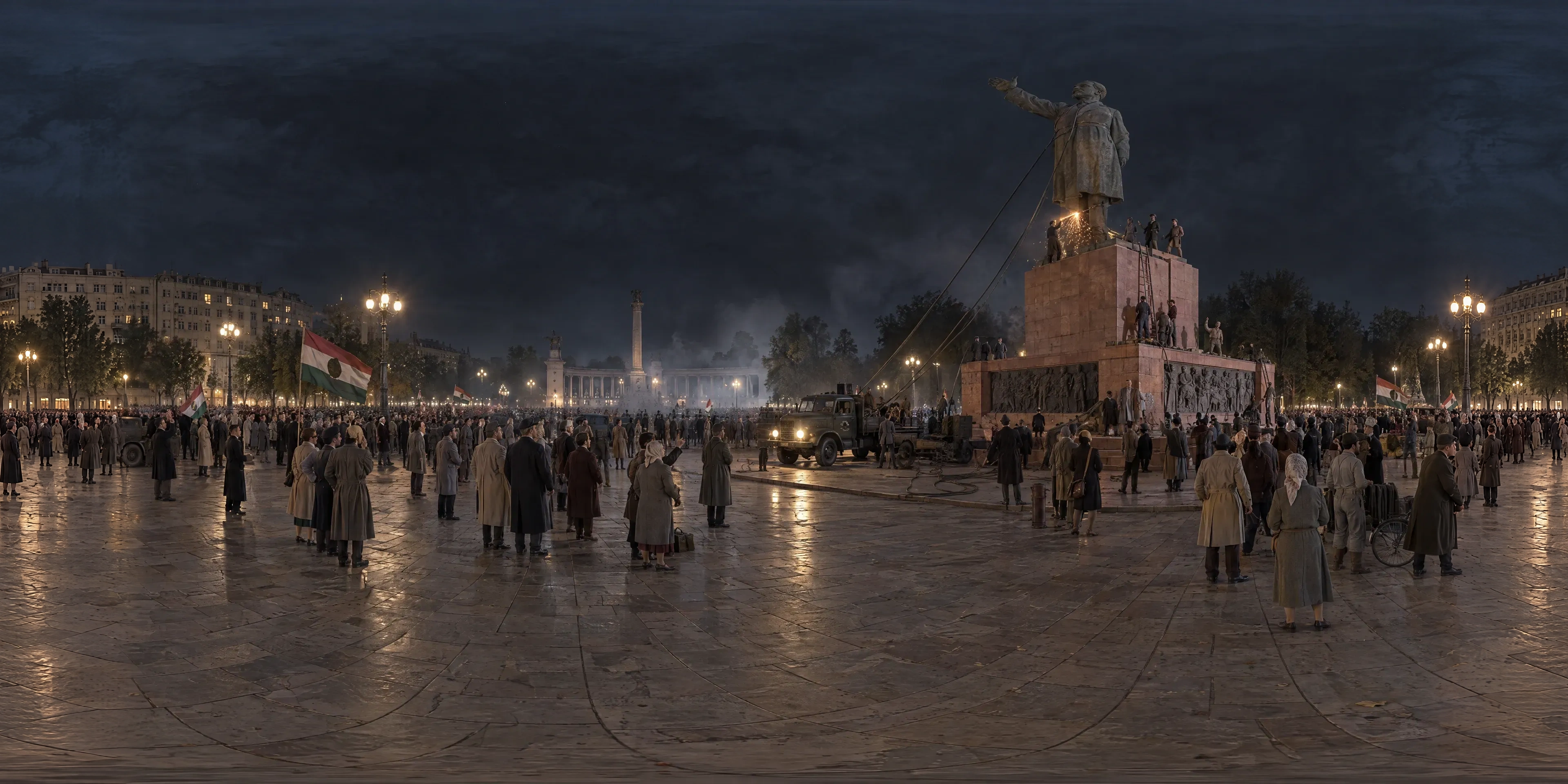
On the evening of 23 October 1956, the first day of the Hungarian Revolution, a huge crowd pulls down the eight-metre bronze Stalin on Stalin Square in Budapest: after hours of work with cables, lorries and cutting torches it falls at 21:37, leaving only the boots on the tribune. It is the revolution's first common act and becomes its emblem.
- Year
- 1956
- Where
- Budapest · HU
- Era
- modern_postwar
- Coordinates
- 47.511, 19.081
The moment
A gift for Stalin's seventieth birthday
The statue on Stalin Square stood for less than five years. It was dedicated on 16 December 1951, before a crowd of some 80,000, as the Hungarians' gift to Stalin for his seventieth birthday.
To make room at the edge of City Park, the Regnum Marianum church was demolished in 1951. On the new parade ground rose Sándor Mikus's bronze Stalin, eight metres tall, on a ten-metre pedestal of red Tata limestone that doubled as a tribune for the party leaders. Reliefs completed by 1953 showed departing Soviet soldiers, scenes of the war, sport, education, science and art.
It fell at 21:37
The students' sixteen-point manifesto had called the statue the symbol of Stalinist tyranny and political oppression and demanded its swift removal. On the evening of 23 October 1956, the first day of the revolution, the crowd did the job itself.
By the account of Sándor Kopácsi, the Budapest police chief, demonstrators looped a thick steel rope around the statue's neck, while others arrived in lorries with oxygen cylinders and cutting torches and set to work on the bronze boots. The torches cut through the thinnest point, just below the knees.
After hours of work, at 21:37, Stalin fell. Only the boots were left on the pedestal, and someone planted a Hungarian flag in them.
The head ended up on the Grand Boulevard
The fallen figure was dragged to Blaha Lujza Square and broken up. The damaged head was photographed lying on the Grand Boulevard, pieces were daubed with insults, and the bronze nameplate was pulled off the pedestal.
The revolution's other emblem belongs to the same days: the Hungarian tricolour with a hole in the middle, where the Soviet-style coat of arms had been cut out.
Twelve days later, from 4 November, Soviet forces crushed the revolution, and thousands were killed. The toppling itself had cost no lives.
The boots stand again, in Memento Park
23 October, the day the revolution broke out, is a Hungarian national holiday, and Stalin's boots on the empty tribune are its most famous image.
The parade ground has changed again. In 2006, on the fiftieth anniversary, it was renamed Ötvenhatosok tere, the Square of the Fifty-Sixers, and a memorial of rusted steel columns was completed there.
The same year a full-size recreation of the tribune with the broken boots, by the sculptor Ákos Eleőd, went up in Memento Park, the Budapest park of communist-era statues. The boots are back on their pedestal, this time as a monument to the night they were left behind.
Sources
Further reading
Tagged
- hungary
- budapest
- revolution-1956
- stalin
- cold-war
- communism
- 20th-century
- national-holiday
Published
See also

1979
Victory Square, Warsaw
On the afternoon of Saturday 2 June 1979, on his first visit home as pope, John Paul II says Mass for about half a million people on Victory Square in communist Warsaw and prays that the Holy Spirit will renew the face of the earth, adding "this land". The words are remembered as the spark of the Solidarity movement.

1955
Upper Belvedere, Vienna
Around noon on Sunday 15 May 1955, just after the State Treaty is signed in the Marble Hall of the Upper Belvedere, Foreign Minister Leopold Figl steps onto the balcony with the Allied foreign ministers and holds up the signed treaty to the crowd waiting in the palace garden. After ten years of occupation, Austria is free.

1968
National Museum, Wenceslas Square, Prague
On the morning of 21 August 1968, hours after Warsaw Pact armies invaded to crush the Prague Spring, Soviet tanks coming from Vinohradská rake the facade of the National Museum with machine-gun fire. Praguers fill the upper square, surround the tanks to argue with their crews and cover the statue of St Wenceslas with flags and slogans.