National Museum, Wenceslas Square, Prague
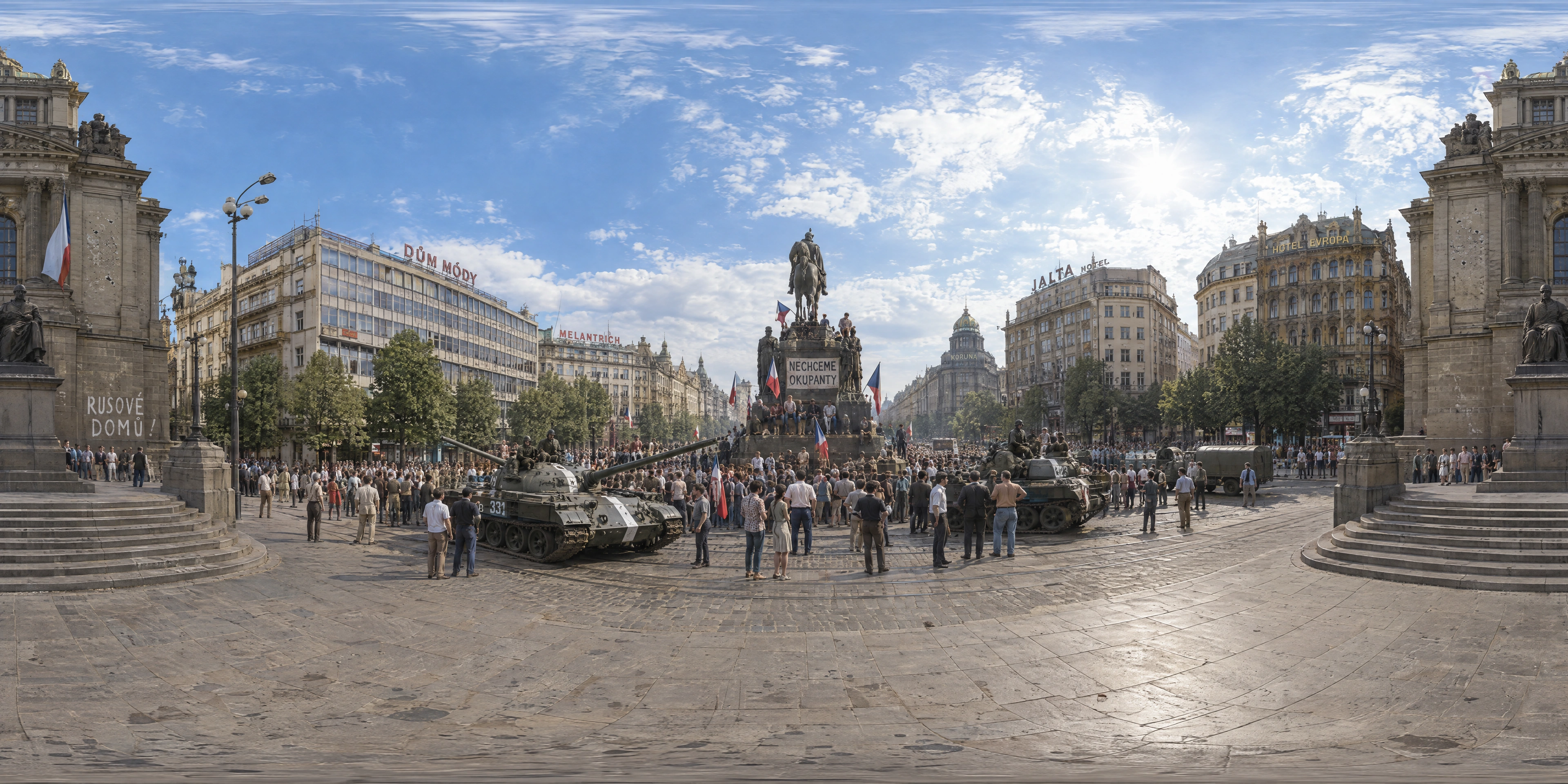
On the morning of 21 August 1968, hours after Warsaw Pact armies invaded to crush the Prague Spring, Soviet tanks coming from Vinohradská rake the facade of the National Museum with machine-gun fire. Praguers fill the upper square, surround the tanks to argue with their crews and cover the statue of St Wenceslas with flags and slogans.
- Year
- 1968
- Where
- Bohemia · CZ
- Era
- modern_postwar
- Coordinates
- 50.079, 14.430
The moment
The invasion came in the night
At about eleven at night on 20 August 1968, armies of the Warsaw Pact crossed into Czechoslovakia. Soviet, Polish, Bulgarian and Hungarian troops, some 250,000 men with 2,000 tanks in the first wave, came to put an end to the Prague Spring. East German troops were stood down hours before and gave only logistical support; Romania and Albania refused to take part.
Alexander Dubček, the Communist Party leader whose reforms had started it, was arrested and taken to Moscow. By morning Prague was occupied.
Machine-gun fire on the museum
On the morning of 21 August, Soviet tanks coming in from Vinohradská reached the top of Wenceslas Square and raked the facade of the National Museum with machine-gun fire. The sandstone columns and statues were chipped and pocked.
Praguers filled the upper square anyway. They surrounded the tanks, marked with broad white stripes, and argued with their crews, and they covered Myslbek's statue of St Wenceslas with Czechoslovak flags and hand-painted slogans against the occupation.
Below them ran the tram strip, with the 1950s Dům módy department store and the Melantrich building on one side and the Hotel Jalta of 1958 and the Art Nouveau Hotel Evropa on the other. The metro, the glass Federal Assembly building beside the museum and the pedestrian zone did not yet exist.
Seventy thousand left at once
Dozens of civilians were killed on the first day. By one count 137 Czechs and Slovaks died in the invasion, and some 500 were seriously wounded.
Dubček was brought back to Prague on 27 August and remained party leader until he was forced to resign in April 1969. About 70,000 people fled the country at once, and some 300,000 had emigrated by 1989.
What followed was called normalisation: purges, censorship and two decades of enforced conformity.
The scars left on purpose
The invasion is a defining national trauma, and Czechs remember it every 21 August as a significant day.
The museum carries the memory in its stone. When the building was restored, the marks of the machine-gun fire were deliberately left visible as a memento.
Eyewitnesses remember that morning as sunny. Nobody can say exactly how many tanks stood on the square at a given moment, but the image of unarmed Praguers arguing with tank crews under a statue draped in flags is the one that stayed.
Sources
Further reading
Tagged
- czechia
- prague
- wenceslas-square
- prague-spring
- invasion
- 1968
- cold-war
- 20th-century
Published
See also

1939
Lower Wenceslas Square, Prague
On the morning of 15 March 1939, in a heavy fall of wet snow, German columns roll down Wenceslas Square as Hitler's troops occupy what remains of Czechoslovakia. Thousands of Praguers watch from the pavements, weeping, booing and singing the national anthem; that evening Hitler reaches Prague Castle, and the next day he proclaims the Protectorate of Bohemia and Moravia.

1918
Wenceslas Square, Prague
Late in the morning of 28 October 1918, as news spreads that Austria-Hungary has accepted President Wilson's terms, crowds pour onto Wenceslas Square and the priest Isidor Zahradník proclaims an independent Czechoslovak state at the St Wenceslas monument. That evening the National Committee passes the new republic's first law.

1955
Upper Belvedere, Vienna
Around noon on Sunday 15 May 1955, just after the State Treaty is signed in the Marble Hall of the Upper Belvedere, Foreign Minister Leopold Figl steps onto the balcony with the Allied foreign ministers and holds up the signed treaty to the crowd waiting in the palace garden. After ten years of occupation, Austria is free.