The Vliet at the Walls of Leiden
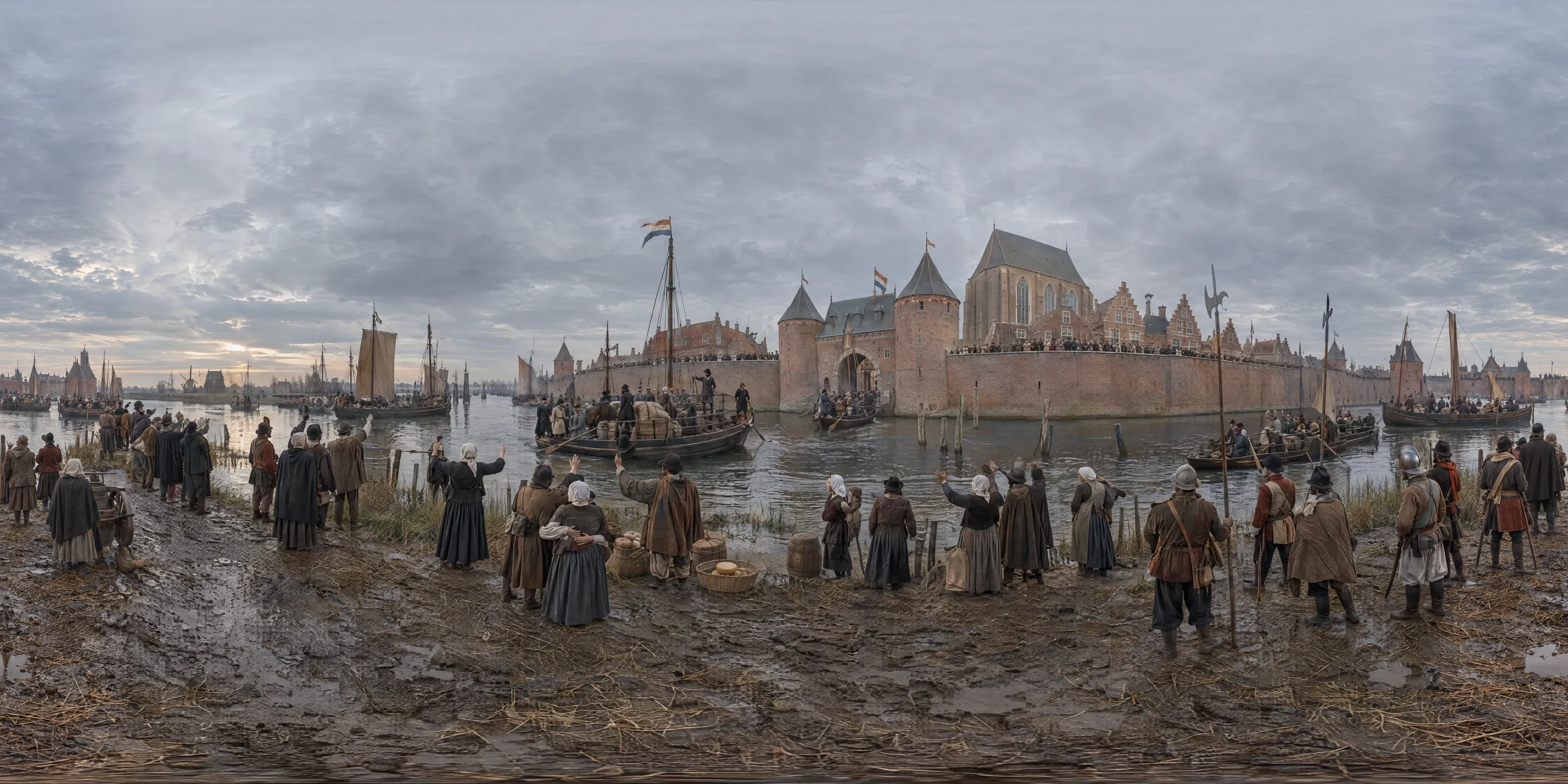
At daybreak on 3 October 1574, after a south-westerly storm drove the floodwaters high over the polders and the Spanish abandoned their forts, Admiral Boisot's Sea Beggar boats sail up the Vliet into starving Leiden with bread, cheese and herring. The relief ends a siege that cost thousands of lives and keeps the Dutch Revolt alive.
- Year
- 1574
- Where
- Holland (South Holland) · NL
- Era
- Renaissance
- Coordinates
- 52.154, 4.488
The moment
The Dutch let the sea in to save a city
From 26 May 1574 a Spanish army under Francisco de Valdez besieged Leiden, cutting it off with a ring of forts. The town refused to surrender.
Relief could not come by land, so William of Orange sent it by water. On 3 August his men began breaching the dikes to flood the polders between the sea and the town. A fleet of flat-bottomed boats under Admiral Louis de Boisot, crewed by Sea Beggars, waited for the water to rise high enough to carry them. Carrier pigeons took messages between the prince and the besieged town.
For weeks the water stayed too shallow. Then a storm from the south-west drove the sea over the drowned land, and the boats pushed forward from dike to dike.
A wall fell, and the Spanish left
The last obstacle was the Spanish fort at Lammen, on the Vliet just outside the town. In the night of 2 October part of Leiden's wall, undermined by the floodwater, collapsed. The Spanish did not attack. They abandoned Lammen instead.
At daybreak on Sunday 3 October the boats sailed up the Vliet into Leiden with bread, cheese and herring. Each person received half a loaf, some cheese and a herring.
The town they reached was still medieval: straight brick walls with half-round towers above a broad moat, and over the roofs the huge nave of the Pieterskerk, towerless since its tower collapsed in 1512.
A siege counted in thousands of dead
The relief came late. Thousands had died of hunger and plague during the siege, by some estimates up to a third of the people of Leiden.
The best-known story of those months belongs to the burgomaster, Pieter Adriaansz. van der Werff. Faced with a starving crowd demanding surrender, he is said to have offered them his own body to eat. Whether or not he said it, Leiden has kept the story for four and a half centuries.
Herring, white bread and hutspot, every 3 October
William of Orange rewarded the town with the first university in the northern Netherlands, founded in February 1575. Leiden University is still one of the country's leading universities.
The town rewards itself every year. On 3 October the municipality hands out herring and white bread, and families eat hutspot, a mash of carrots, onions and potatoes. Legend says an orphan boy found a pot of it in the abandoned camp at Lammen, although historians credit the find to another man, Gijsbert Cornelisz. Schaeck. The hutspot of 1574 had no potatoes, which were not yet eaten in Holland.
The Leidens Ontzet festival is now one of the largest in the Netherlands, and the Revolt it kept alive became, eighty years after it began, the independent Dutch Republic.
Sources
Further reading
Tagged
- netherlands
- leiden
- eighty-years-war
- siege
- relief
- sea-beggars
- inundation
- 16th-century
Published
See also

15th century AD
Great Wall of China, Jinshanling
Around 1500, Ming China rebuilds the Great Wall in brick and stone across the mountain ridges north of Beijing: a battlemented rampart with watchtowers that climbs and plunges over the peaks as far as the eye can see, the most ambitious fortification ever built.

1410
Grunwald Battlefield
On the hot morning of 15 July 1410 the armies of King Władysław Jagiełło and Grand Duke Vytautas wait at the edge of the woods facing the Teutonic Order across the fields of Grunwald, until two heralds ride over with two naked swords from Grand Master Ulrich von Jungingen, a taunt to come out and fight. By evening the Order's army is broken and its Grand Master dead.

1492
Guanahani (San Salvador Island), Bahamas
At dawn on 12 October 1492, Christopher Columbus and about 40 Spanish sailors land at a Lucayan-Taíno island in the Bahamas they will rename *San Salvador*: the encounter that begins five centuries of Atlantic exchange and the destruction of indigenous Caribbean populations.