White Mountain, Prague
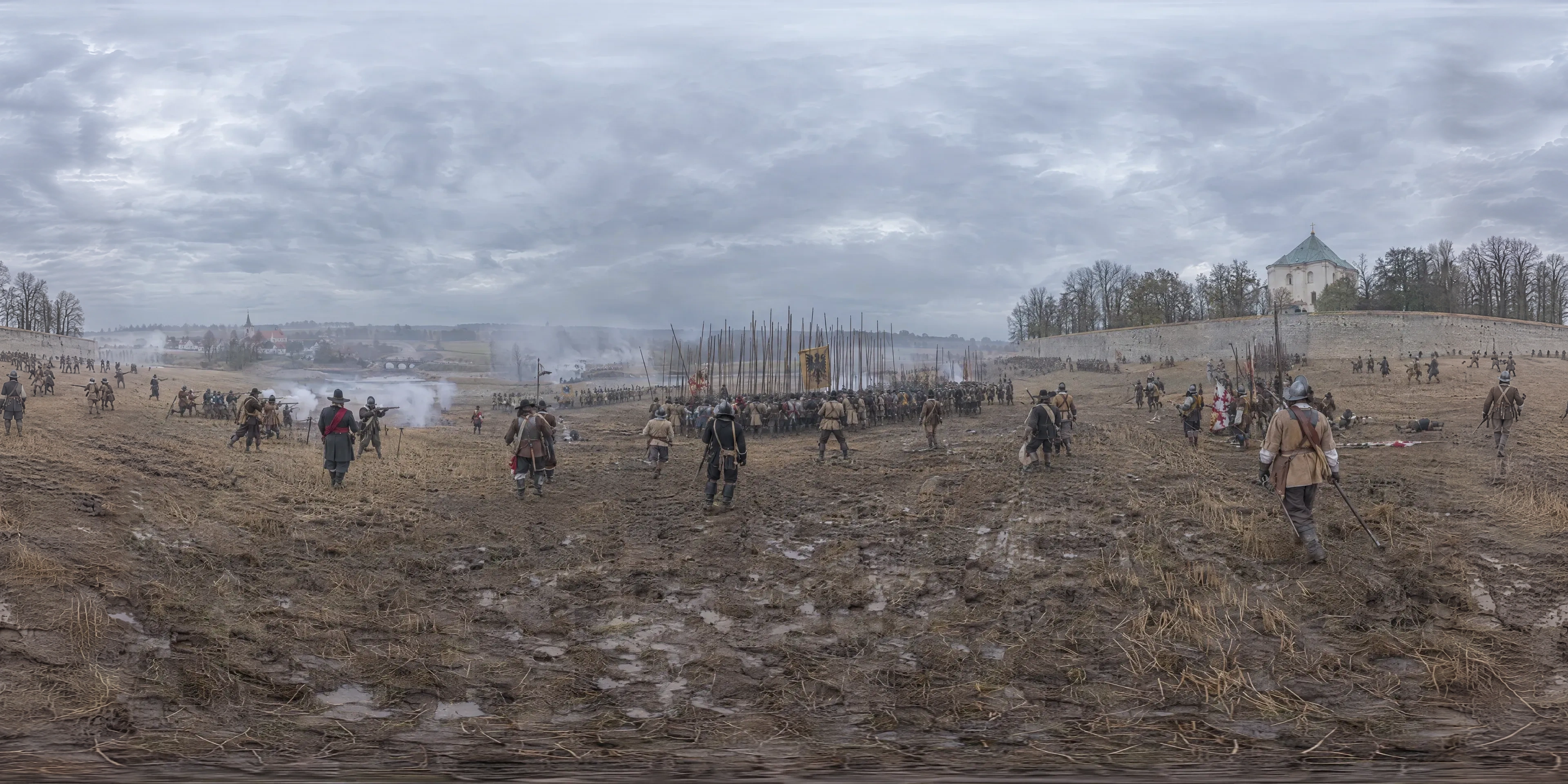
Around midday on Sunday 8 November 1620 the imperial and Catholic League armies storm the Bohemian Estates' position on White Mountain outside Prague; within about ninety minutes the rebel army breaks, and only the Moravian regiment fights on at the wall of the Hvězda game preserve. The defeat ends the Bohemian revolt and opens three centuries of Habsburg rule.
- Year
- 1620
- Where
- Bohemia · CZ
- Era
- Early modern
- Coordinates
- 50.080, 14.322
The moment
Over in about an hour
Around midday on Sunday 8 November 1620, the imperial army and the troops of the Catholic League climbed the gentle slope of White Mountain, a bare plateau a few kilometres west of Prague. On the crest waited the army of the Bohemian Estates, drawn up in two lines of squares.
The fight was short. Accounts give an hour, ninety minutes at most, before the Estates' army broke. Popular tradition adds a morning fog.
The sides were not badly matched on paper: about 23,000 men with 12 guns under Bucquoy and Tilly, against some 21,000 with 10 guns under Christian of Anhalt, reduced to perhaps 15,000 by the time the fighting began. The Estates lost about 2,800 killed or wounded and some 4,000 captured; the victors, about 650.
A king for one winter
The Estates had rebelled against the Habsburgs and chosen a Protestant king of their own, Frederick of the Palatinate. After White Mountain he fled Prague, and history remembers him as the Winter King, a ruler for barely a year.
Neither army looked like a modern one. There were no uniforms: soldiers wore broad hats or steel morions, buff coats, breastplates and coloured sashes, and fought as pikemen, musketeers with matchlocks and forked rests, and armoured cuirassiers.
The Moravians at the wall
On the Estates' northern wing stood the high stone wall of the royal game preserve. Inside it, above the trees, rose the copper roof of Hvězda, the star-shaped Renaissance summer palace built in 1555 and 1556, which still stands.
When the rest of the army broke, the Moravian regiment did not. Its men fought on at the preserve wall, the last of the Estates' troops still holding their ground.
The byword for catastrophe
In Czech, Bílá hora means more than a battle. In 1621, 47 leaders of the revolt were put on trial and 27 were executed on the Old Town Square.
What followed was forced re-Catholicisation. Thousands of Protestants went into exile, the educator Jan Amos Comenius among them, and the Habsburgs ruled Bohemia for three more centuries, until 1918.
Nineteenth-century nationalists read the defeat as the start of a dark age, a reading modern historians and Catholic tradition contest. The same era also left the Baroque churches and columns that fill Czech towns.
The plateau has changed. A pilgrimage church of Our Lady Victorious now stands near the field, and a memorial mound was raised there in 1920.
Sources
Further reading
Tagged
- czechia
- prague
- bohemia
- battle
- thirty-years-war
- habsburg
- bohemian-revolt
- early-modern
Published
See also

1357
Charles Bridge, Prague
In 1357 Emperor Charles IV lays the foundation stone of a new stone bridge on the Old Town bank near St Clement's, fifteen years after ice and floodwater wrecked the Judith Bridge. Tradition sets the moment at 5:31 on 9 July, a palindrome of odd numbers; the bridge will take 45 years to finish.

1410
Old Town Square, Prague
On 9 October 1410 the Old Town councillors reward the clockmaker Mikuláš of Kadaň for the astronomical dial he has built on the town hall tower, the heart of today's Prague orloj. Below it the market square trades as usual in the year Wycliffe's books are burned in Prague and Jan Hus is excommunicated.

1881
National Theatre, Prague
On the afternoon of 12 August 1881, two months after its opening, the National Theatre, built over thirteen years from the pennies of a whole nation, catches fire and loses its copper dome, auditorium and stage. Within 47 days the Czechs collect a million gulden to rebuild it, and it reopens in 1883.