Arc de Triomf and Saló de Sant Joan, Barcelona
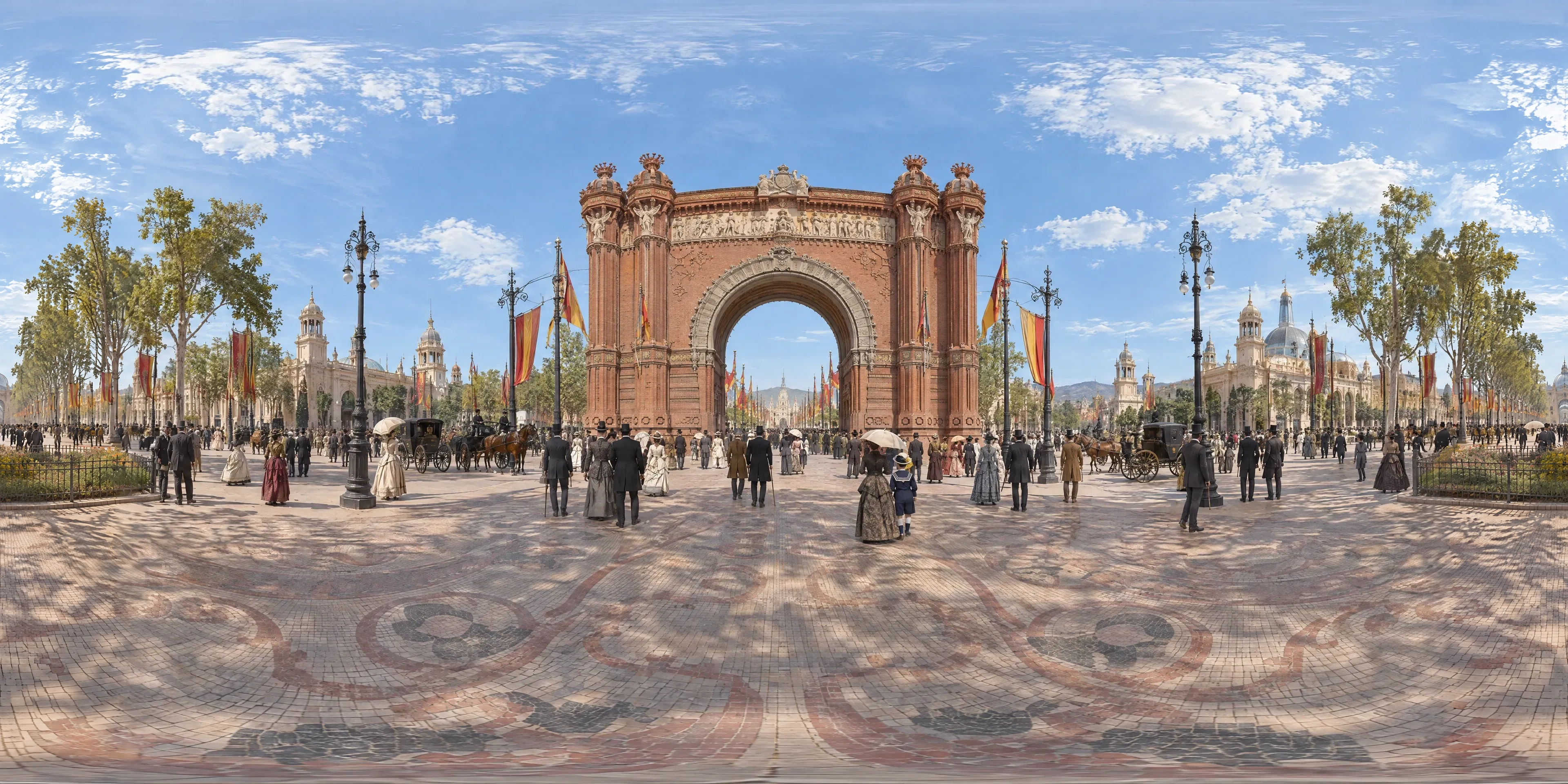
On 20 May 1888 the Queen Regent Maria Christina and the two-year-old King Alfonso XIII inaugurate Spain's first Universal Exposition in Barcelona. Crowds pour under Josep Vilaseca's brand-new red-brick Arc de Triomf and down the Saló de Sant Joan toward the Ciutadella park, where Domènech i Montaner's restaurant heralds modernisme.
- Year
- 1888
- Where
- Catalonia · ES
- Era
- Industrial
- Coordinates
- 41.390, 2.182
The moment
A king aged two opened the fair
On Sunday 20 May 1888 the Queen Regent Maria Christina and her son, King Alfonso XIII, aged two, inaugurated Spain's first Universal Exposition in Barcelona. The gates had opened to visitors on 8 April; the royal ceremony, held in the great hall of the Palace of Fine Arts, made it official.
The idea had come from a journalist and entrepreneur, Eugenio Serrano de Casanova, who tried to launch an exhibition in 1886. When his plan faltered, the mayor, Francesc Rius i Taulet, took it over. By the time the fair closed on 9 December it had drawn more than two million visitors, and 27 countries had taken part, among them China, Japan and the United States.
A triumphal arch with no victory to celebrate
The main entrance was Josep Vilaseca's Arc de Triomf, 30 metres high, built in red brick in a neo-Mudéjar style. It commemorates no battle. Its frieze by Josep Reynés shows Barcelona receiving the nations, and four female figures of Fame complete the decoration.
Beyond it ran the Saló de Sant Joan, a boulevard 50 metres wide, with wrought-iron balustrades, mosaic paving, tall ornate lampposts by Pere Falqués and bronze statues of figures from Catalan history. At its far end the Palace of Fine Arts, with a columned portico and domed corner towers, faced the Palace of Sciences.
A park where a fortress had stood
The fair filled the Ciutadella, the site of the citadel Philip V built after taking Barcelona in 1714 to hold the city down. Barcelonans had hated it for a century and a half, and after 1869 it was pulled down. On its ground Josep Fontserè laid out a park, with a Monumental Cascade crowned by a sculpted quadriga.
Near the park's edge Lluís Domènech i Montaner built the fair's café-restaurant: red brick, crenellations, iron and glass, a medieval castle made modern. Barcelona calls it the Castle of the Three Dragons, and it later housed the city's Zoology Museum. A young Antoni Gaudí designed the pavilion of the Compañía Transatlántica, and at the foot of the Rambla a 60-metre monument to Columbus went up for the occasion.
The fair taught Barcelona to remake itself
The 1888 Exposition put industrial Barcelona on the world map. It left the arch, the park and the Columbus column, and in Domènech i Montaner's castle it gave an early sign of modernisme, the style of Gaudí, Domènech and Puig i Cadafalch that would reshape the Eixample within a generation.
For Catalans the park still carries the old history too. The citadel's arsenal survived the demolition, and today it houses the Parliament of Catalonia.
The city would do it again: an exposition on Montjuïc in 1929, and in 1992 the Olympics.
Sources
Further reading
Tagged
- spain
- barcelona
- catalonia
- universal-exposition
- modernisme
- industrial
- belle-epoque
- 19th-century
Published
See also

1869
Court Opera on the Ringstraße, Vienna
On the evening of 25 May 1869 Emperor Franz Joseph opens the new Court Opera, the first great public building on Vienna's Ringstraße, with Mozart's Don Giovanni sung in German. Neither of its architects lives to see the night: both died in 1868, after Viennese mockery of the 'sunken box'.

1897
Giant Ferris Wheel, Prater, Vienna
On 3 July 1897, a hot summer day, Vienna's Giant Ferris Wheel opens in the Prater, built by English engineers for the jubilee of Emperor Franz Joseph's 50 years on the throne. Its 30 cabins turn up to 64.75 m above the canals of the 'Venice in Vienna' pleasure park, making it one of the largest wheels in the world; a ride costs a gulden.

1810
Theresienwiese, Munich
On 17 October 1810 a horse race on a meadow outside Munich crowns the celebrations for the wedding of Crown Prince Ludwig of Bavaria and Princess Therese of Saxe-Hildburghausen; 50,000 spectators watch from the hillside, and the field is named Theresienwiese after the bride. Repeated the next year, the race becomes the Oktoberfest.