Theresienwiese, Munich
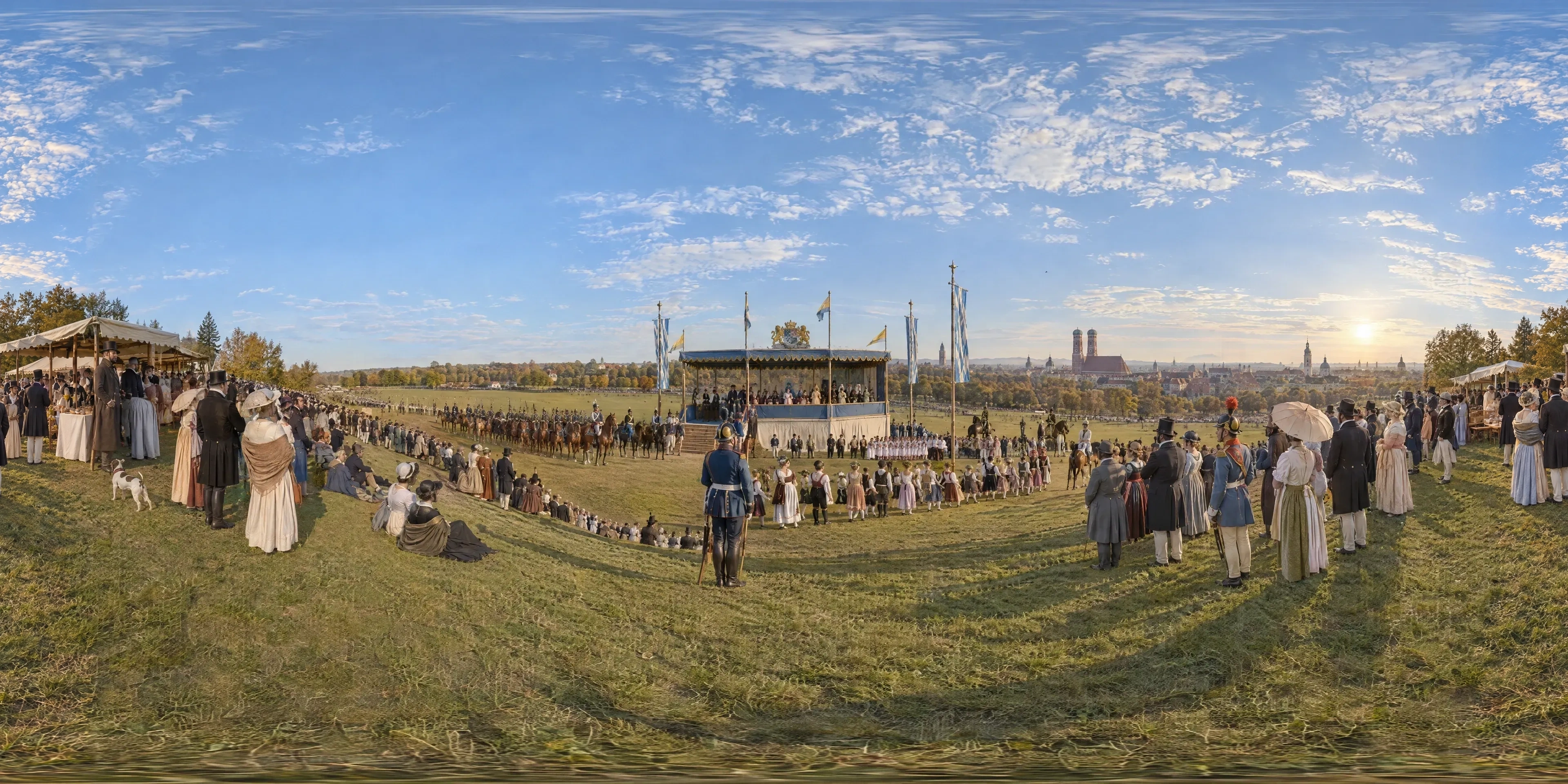
On 17 October 1810 a horse race on a meadow outside Munich crowns the celebrations for the wedding of Crown Prince Ludwig of Bavaria and Princess Therese of Saxe-Hildburghausen; 50,000 spectators watch from the hillside, and the field is named Theresienwiese after the bride. Repeated the next year, the race becomes the Oktoberfest.
- Year
- 1810
- Where
- Bavaria · DE
- Era
- Industrial
- Coordinates
- 48.132, 11.547
The moment
A royal wedding ended with a race
On 12 October 1810 Crown Prince Ludwig of Bavaria married Princess Therese of Saxe-Hildburghausen. Five days later, on 17 October, the celebrations ended with a horse race on a meadow outside Munich.
The idea is credited to Andreas Michael Dall'Armi, a major in the National Guard. A coachman named Franz Baumgartner later claimed it as his own, and it was Baumgartner's horse that won.
Thirty horses ran a course 3,270 metres long. About 50,000 spectators watched from the slope of the Sendlinger Berg, a natural grandstand along the west side of the field.
One tent, sixteen pairs of children
The meadow was bare except for a single royal pavilion, where the king and queen received homage together with the newly married couple. Sixteen pairs of children in the regional costumes of the kingdom's districts filed past, and a choir of pupils sang.
On the hilltop behind the crowd, caterers sold wine and beer from stalls and tables. Beyond the field rose the skyline of Munich, dominated by the two brick towers of the Frauenkirche under their rounded caps.
The meadow took the bride's name: Theresienwiese, Therese's meadow. Munich shortened it to the Wiesn.
Repeated, and rarely missed since
The race was held again in 1811, with an agricultural show added to promote Bavarian farming. Fairground booths and the first carousel arrived in 1818, and during the nineteenth century the start moved into late September for the warmer weather.
The festival has not always taken place. Cholera stopped it in 1854 and 1873, wars in 1866 and 1870, both world wars for years at a time, and the COVID-19 pandemic in 2020 and 2021.
Most of what defines it today came late. The bronze Bavaria statue on the hill above the field was completed in 1850, and the great beer halls replaced small booths only around 1900.
Why every German knows the date
The Oktoberfest is the largest folk festival in the world, with more than six million visitors a year and a record of 7.2 million in 2023. It is Bavaria's best-known tradition abroad.
For Germans the origin story is part of the fun. The most famous beer festival on earth began as a royal wedding party with a horse race, and the ground where millions now crowd into tents still carries the name of a young princess from Saxe-Hildburghausen.
Sources
Further reading
Tagged
- germany
- munich
- bavaria
- oktoberfest
- 19th-century
- royal-wedding
- horse-race
- everyday-life
Published
See also

1886
Neuschwanstein Castle
Before dawn on 10 June 1886 a government commission arrives at Neuschwanstein to take King Ludwig II, just declared unfit to rule, into custody; gendarmes loyal to the king bar the gate of his unfinished castle, and after half an hour in the rain the commissioners must turn back. Three days later Ludwig is dead in Lake Starnberg.

1897
Giant Ferris Wheel, Prater, Vienna
On 3 July 1897, a hot summer day, Vienna's Giant Ferris Wheel opens in the Prater, built by English engineers for the jubilee of Emperor Franz Joseph's 50 years on the throne. Its 30 cabins turn up to 64.75 m above the canals of the 'Venice in Vienna' pleasure park, making it one of the largest wheels in the world; a ride costs a gulden.

1842
Cologne Cathedral
On 4 September 1842 King Frederick William IV of Prussia and the coadjutor Johannes von Geissel lay the foundation stone for completing Cologne Cathedral, a torso for almost three centuries with a medieval crane on its unfinished south tower. Funded by donors across Germany, the work becomes a national project and is finished in 1880.