Bankside, Southwark
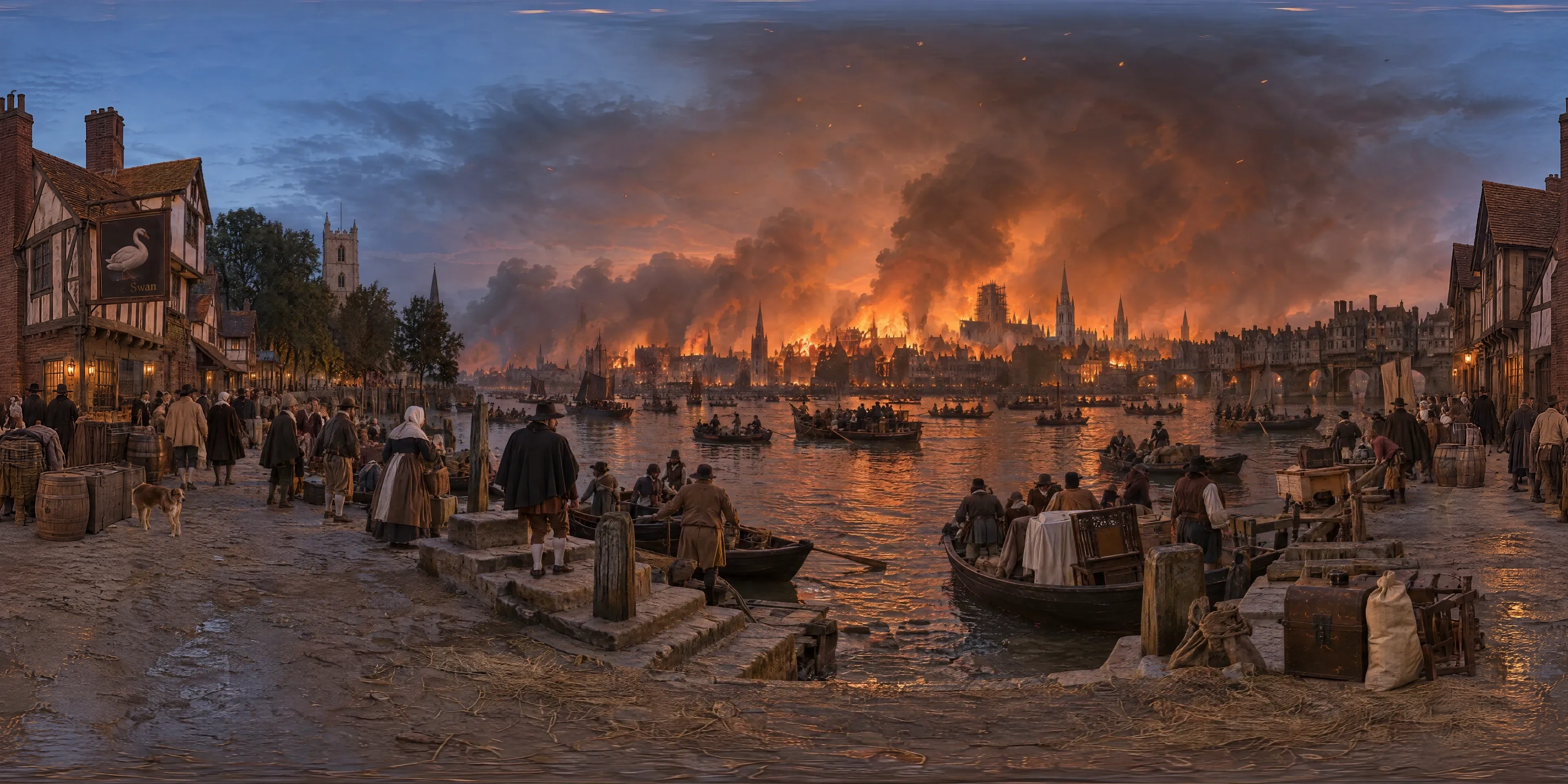
At dusk on Sunday 2 September 1666 Samuel Pepys sits in a little alehouse on Bankside and watches the City of London burn across the Thames, 'one entire arch of fire' from the Three Cranes opposite to beyond London Bridge and up the hill. Driven by an east wind, the Great Fire will destroy most of the medieval City and Old St Paul's in four days.
- Year
- 1666
- Where
- London · GB
- Era
- Early modern
- Coordinates
- 51.508, -0.094
The moment
The best view was from the wrong side of the river
At dusk on Sunday 2 September 1666, when they could bear no more of the smoke and sparks on the water, Samuel Pepys and his companions went to "a little ale-house on the Bankside, over against the Three Cranes," and stayed there until it was almost dark, watching the City of London burn across the Thames.
The fire had broken out shortly after midnight in Thomas Farriner's bakery in Pudding Lane. Driven by a strong east wind after a long, dry summer, by evening it ran along the riverfront from the Three Cranes, opposite Pepys, to beyond London Bridge. He saw it as "one entire arch of fire from this to the other side the bridge, and in a bow up the hill for an arch of above a mile long," and wrote that it made him weep.
A pair of virginals in every third boat
Pepys noticed what people saved. The river was crowded with lighters and small boats loaded with household goods, and hardly one in three, he wrote, was without a pair of virginals, a small keyboard instrument. He watched pigeons that would not leave their houses, hovering at windows and balconies until their wings burned. On the water, facing the wind, he was almost burned by a shower of firedrops.
The houses at the City end of London Bridge were alight, but Southwark was spared: an open space between the buildings on the bridge acted as a firebreak.
Four days that emptied the City
The fire burned until Wednesday 5 September. The Lord Mayor, Sir Thomas Bloodworth, hesitated to order houses pulled down while it was still small. By Tuesday it had leapt the River Fleet and reached Old St Paul's, which was wrapped in wooden scaffolding for repairs directed by Christopher Wren. The scaffolding caught, and within half an hour the lead roof was melting.
The wind dropped on Tuesday evening, and gunpowder firebreaks blown by the Tower garrison held on Wednesday. Between 13,200 and 13,500 houses were lost, with 86 or 87 parish churches, 44 livery company halls, the Royal Exchange, the Custom House and St Paul's. Only a handful of deaths were recorded. The real toll is unknown.
Why English children start their history here
The Great Fire is the first national event most English children study, named in the Key Stage 1 curriculum and told through Pepys's diary. It also made the London they know. Wren built a new St Paul's and 51 new City churches, and with Robert Hooke designed the Monument near Pudding Lane, 202 feet tall, built between 1671 and 1676.
The Monument also records a search for scapegoats. In 1681 an inscription blaming Catholics for the fire was added to it, and it stayed until after the Catholic Relief Act of 1829. A French watchmaker, Robert Hubert, had confessed to starting the fire despite doubts about his fitness to plead, and was hanged at Tyburn on 29 October 1666.
Sources
Further reading
Tagged
- united-kingdom
- england
- london
- great-fire
- samuel-pepys
- thames
- stuart
- 17th-century
Published
See also

2012
Olympic Stadium, London
At about 9.25 pm on 27 July 2012, in Danny Boyle's 'Isles of Wonder' ceremony, five glowing rings forged in a staged industrial revolution rise over the Olympic Stadium in Stratford and rain sparks. Watched by some 900 million people, it opens the Games many Britons remember as a high point of national pride.

1655
Dam Square and the New Town Hall, Amsterdam
On 29 July 1655 Amsterdam's burgomasters process from the Prinsenhof to the Dam to inaugurate Jacob van Campen's new Town Hall, a classical palace for a city of merchants, though it is still far from finished. Six companies of civic guards fire three volleys as the city at the height of its Golden Age celebrates.

1741
Coronation Hill, Pressburg (Bratislava)
Sunday, 25 June 1741: freshly crowned in St Martin's Cathedral, 24-year-old Maria Theresa rides up an earthen mound by the Danube and swings St Stephen's sword to the four corners of the world, vowing to defend Hungary. That September the Hungarian estates, gathered in this city, pledged her 'our life and blood' and saved her throne.