Dam Square and the New Town Hall, Amsterdam
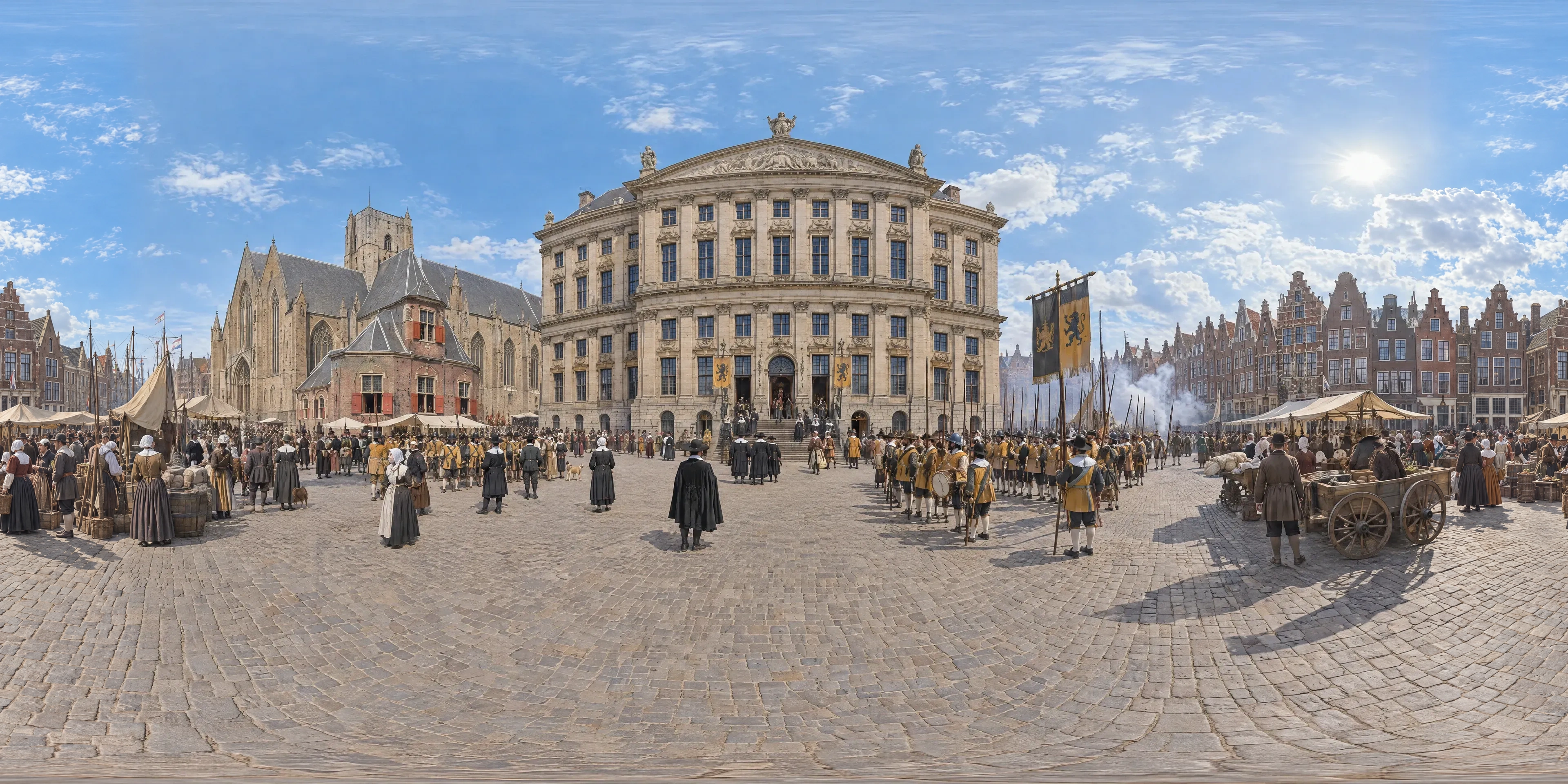
On 29 July 1655 Amsterdam's burgomasters process from the Prinsenhof to the Dam to inaugurate Jacob van Campen's new Town Hall, a classical palace for a city of merchants, though it is still far from finished. Six companies of civic guards fire three volleys as the city at the height of its Golden Age celebrates.
- Year
- 1655
- Where
- Holland (North Holland) · NL
- Era
- Early modern
- Coordinates
- 52.373, 4.893
The moment
Inaugurated half-built
On Thursday 29 July 1655, after thanksgiving services at half past seven in the morning in the Oude Kerk and the Nieuwe Kerk, Amsterdam's burgomasters and regents walked in procession from the Prinsenhof to the Dam to take possession of their new Town Hall. Six companies of the civic guard stood in battle order on the square and fired three volleys.
The city needed the building. The old medieval town hall on the Dam had burned down on 7 July 1652, while work on the new one was under way.
The new building was far from finished. Its upper storeys were still going up, and the cupola that crowns it today was only added when the work was completed, in 1665.
A palace for a city of merchants, on 13,659 piles
Jacob van Campen designed it as a classical palace in pale sandstone, a vast block on a heavy base, with tall windows between two orders of pilasters and a central section stepping slightly forward. Amsterdam's soft ground meant it had to stand on 13,659 wooden piles. The first stone was laid on 29 October 1648, the year the Peace of Münster ended the long war with Spain.
Daniël Stalpaert completed the work, and Artus Quellinus the Elder filled it with sculpture, including a six-metre Atlas carrying the globe. For the inauguration the poet Joost van den Vondel wrote a poem of 1,378 lines.
A square with a harbour in it
The Dam of 1655 was a working square. In front of the Town Hall stood the old Weigh House, where merchants' goods were weighed, and the open water of the Damrak still reached the square, crowded with the masts of barges unloading.
To the north rose the Gothic Nieuwe Kerk, restored after a fire in 1645, with the stump of a stone tower that had been abandoned in 1653. Tall brick gabled houses closed the other sides.
The wealth on display came from trade across the world. Part of it came from colonial trade and from the Atlantic slave trade, in which Amsterdam merchants took part.
The town hall that became a palace
In 1808 Louis Bonaparte, the king Napoleon had given Holland, moved his court into the Town Hall. The Weigh House was demolished the same year, to improve the view from the palace.
It has remained the Royal Palace ever since. The Dutch monarch uses it for state visits and official receptions, and its public rooms are open as a museum.
The square outside is the stage of national life. Dutch monarchs are inaugurated in the Nieuwe Kerk next door, and every 4 May the country's Remembrance of the Dead is held at the National Monument on the Dam.
Sources
Further reading
Tagged
- netherlands
- amsterdam
- dam-square
- golden-age
- town-hall
- jacob-van-campen
- dutch-republic
- 17th-century
Published
See also

1666
Bankside, Southwark
At dusk on Sunday 2 September 1666 Samuel Pepys sits in a little alehouse on Bankside and watches the City of London burn across the Thames, 'one entire arch of fire' from the Three Cranes opposite to beyond London Bridge and up the hill. Driven by an east wind, the Great Fire will destroy most of the medieval City and Old St Paul's in four days.

1741
Coronation Hill, Pressburg (Bratislava)
Sunday, 25 June 1741: freshly crowned in St Martin's Cathedral, 24-year-old Maria Theresa rides up an earthen mound by the Danube and swings St Stephen's sword to the four corners of the world, vowing to defend Hungary. That September the Hungarian estates, gathered in this city, pledged her 'our life and blood' and saved her throne.

1682
Place d'Armes, Versailles
On 6 May 1682 Louis XIV makes Versailles the permanent seat of his court and government, turning his father's hunting lodge, now wrapped in new wings, into the stage of absolute monarchy. The palace is still a vast building site: the Hall of Mirrors is being decorated, the Grand Commun is just begun and the north wing not yet started.