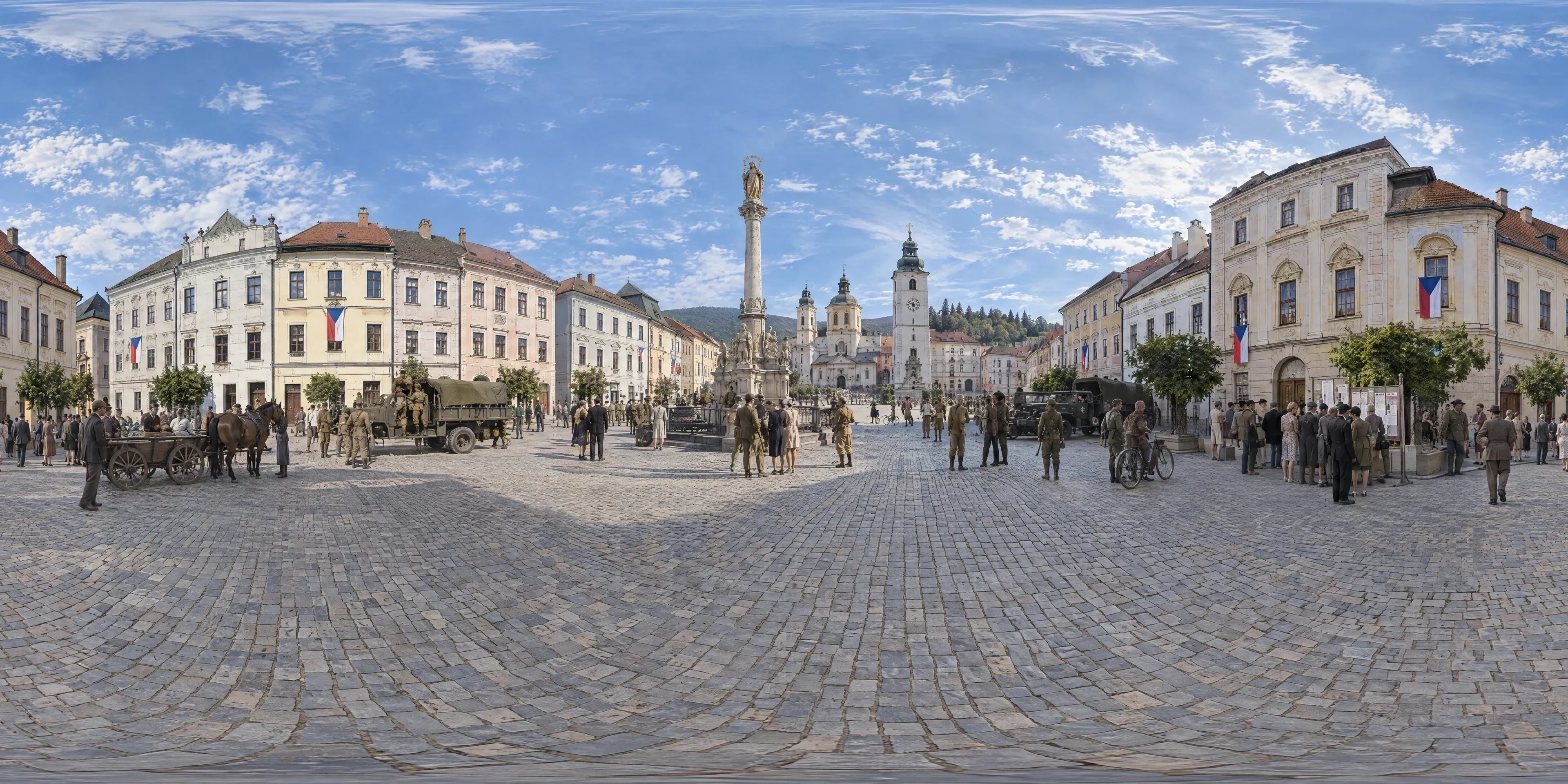
Main Square, Banská Bystrica
30 August 1944, the day after the Slovak National Uprising broke out against the German occupation: Banská Bystrica is in insurgent hands, partisans march in, and late in the morning the Free Slovak Radio goes on air from a building a few hundred metres away. For sixty days the town was the capital of free Slovakia.
- Year
- 1944
- Where
- Central Slovakia, insurgent territory · SK
- Era
- modern_early
- Coordinates
- 48.735, 19.145
The moment
The day after the uprising began
On 29 August 1944 German troops moved into Slovakia, and the Slovak National Uprising broke out against them. That day the defence minister, Ferdinand Čatloš, told the army over Bratislava radio not to resist; the military headquarters in Banská Bystrica ordered every garrison to fight.
By the next morning, Wednesday 30 August, Banská Bystrica was in insurgent hands. Partisans marched into the town, and late in the morning the Free Slovak Radio went on the air from a building a few hundred metres from the main square.
The square itself was the old heart of a mining town, laid out in the early sixteenth century: Gothic, Renaissance and Baroque burgher houses such as the Thurzo House and the Benický House, a Marian column of 1719, the slightly leaning clock tower rebuilt after the fire of 1761, and the Baroque church of St Francis Xavier, a cathedral since 1776.
A capital for sixty days
The uprising had been prepared for months. In December 1943 communists and non-communists had agreed to form the Slovak National Council, three from each camp, and in April 1944 it set up a military headquarters under Lieutenant Colonel Ján Golian.
The insurgent army began with about 18,000 men and grew to some 60,000 after mobilisation on 5 September, alongside 7,000 to 18,000 partisans. At first they held more than half of Slovakia, about 22,000 square kilometres with 1.7 million people, and Banská Bystrica was their capital.
The insurgents rose against the German occupation and against the regime of the wartime Slovak State, and for the Slovak army it meant turning its weapons on the occupiers.
Captured at Pohronský Bukovec
The insurgent capital held until late October. On 7 October Golian handed command to General Rudolf Viest, who had arrived from London; on 27 October Banská Bystrica fell, and Viest ordered the army to fight on as partisans in the mountains.
On 3 November both generals were captured by German special forces at Pohronský Bukovec. Golian was held in the Flossenbürg concentration camp, and it is widely believed that both men were murdered there.
Brutal German reprisals followed across the region. Crimes committed by partisans are part of the record too.
A holiday with more than one reading
The uprising is commemorated every 29 August as a Slovak state holiday, and it ranks among the events Slovaks are proudest of. Banská Bystrica, its centre, keeps the memory in its main square, now named after the uprising.
It is also contested. Admirers of the wartime Slovak State reject it, and after 1948 the Communists claimed it as their own.
The first days were simpler than the later arguments. On 30 August 1944 soldiers of the Slovak army, now an insurgent army, and newly arrived partisans filled the old square of a town that would be the capital of free Slovakia for sixty days.
Sources
Further reading
Tagged
- slovakia
- banska-bystrica
- snp
- uprising
- world-war-ii
- 1944
- resistance
- town-square
Published
See also

1944
PAST Building, Warsaw
On the morning of 20 August 1944, after a night assault that began at 2:30, Home Army soldiers of the Kiliński Battalion take the PAST telephone exchange, the German stronghold in central Warsaw, setting it ablaze with improvised flamethrowers from fire pumps and capturing over a hundred Germans. The white-and-red flag goes up over the burning tower.

1944
Omaha Beach, Normandy
At 6:30 a.m. on June 6, 1944, the first waves of American soldiers from the 1st and 29th Infantry Divisions wade ashore at Omaha Beach under heavy German machine-gun fire in the bloodiest landing of D-Day.

1939
Westerplatte, Gdańsk
At 4:45 on Friday 1 September 1939 the German training battleship Schleswig-Holstein, moored in the Gdańsk harbour channel, opens fire on the Polish Military Transit Depot at Westerplatte, the first shots of the Second World War in Europe. The 182 defenders, expected to hold for up to twelve hours, hold out for seven days.