PAST Building, Warsaw
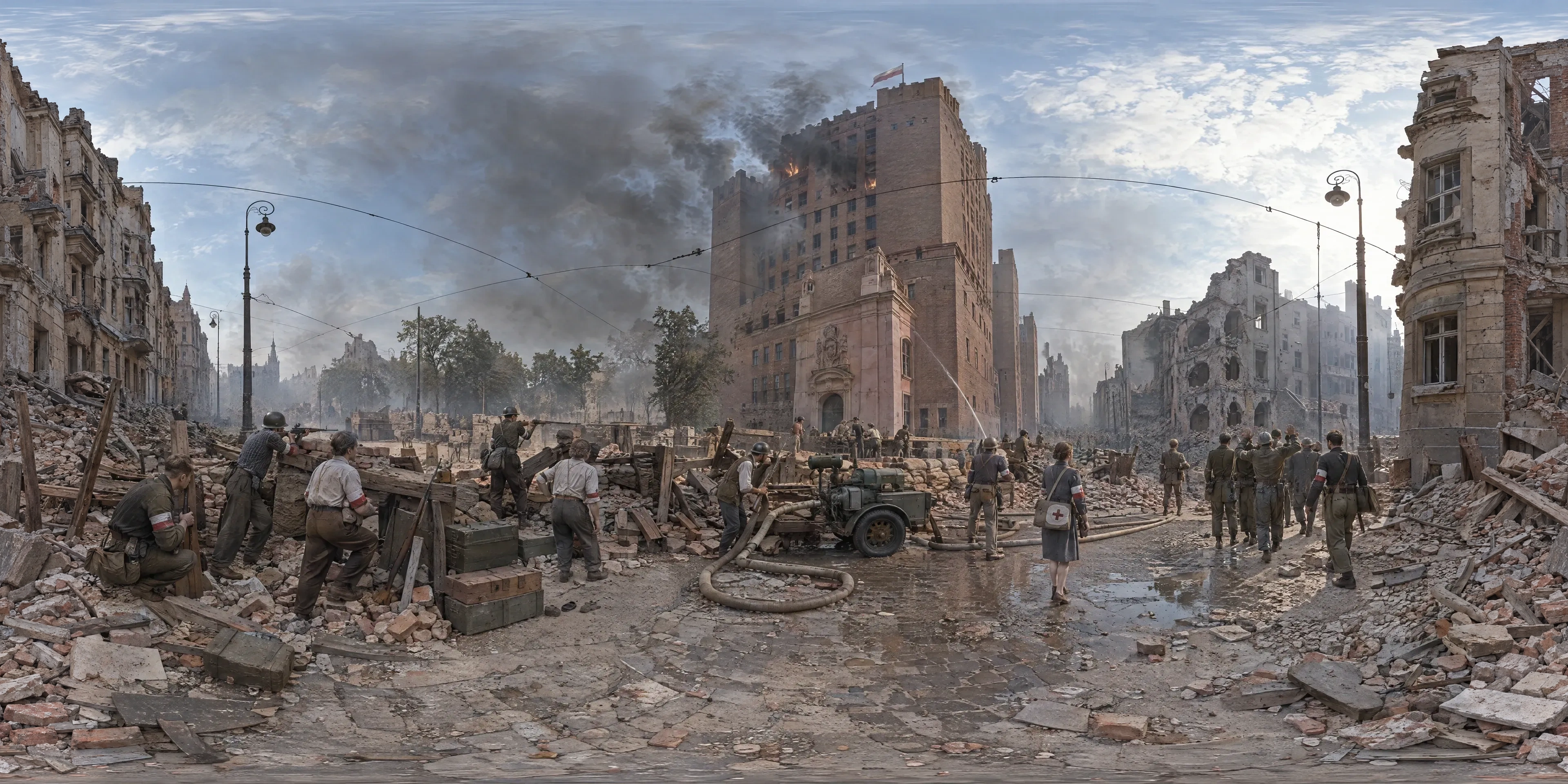
On the morning of 20 August 1944, after a night assault that began at 2:30, Home Army soldiers of the Kiliński Battalion take the PAST telephone exchange, the German stronghold in central Warsaw, setting it ablaze with improvised flamethrowers from fire pumps and capturing over a hundred Germans. The white-and-red flag goes up over the burning tower.
- Year
- 1944
- Where
- Masovia · PL
- Era
- modern_early
- Coordinates
- 52.236, 21.007
The moment
Europe's tallest high-rise, for about a year
The tower at Zielna Street 39 was built in 1908 to 1910 for the Swedish Cedergren telephone company, designed by Isak Gustaf Clason with Bronisław Brochwicz-Rogoyski. It rose 51.5 metres in eight storeys, shaped like a medieval castle keep, and was the first European high-rise modelled on Chicago School skyscrapers. Its only stone feature was a baroque-style portal of pink sandstone.
For about a year it was the tallest high-rise in Europe, until Liverpool's Royal Liver Building opened in 1911, and it stayed the tallest in Poland until 1934. Its later owner, the Polish Telephone Joint-Stock Company, gave it the name Varsovians still use: PAST, or Pasta.
In October 1939 the Germans took it over. The exchange carried telephone traffic between occupied Poland and Berlin.
Five attacks failed first
When the Warsaw Uprising broke out on 1 August 1944, more than 150 well-armed Germans held the building, firing through loopholes on several floors. The 6th company of the Home Army's Kiliński Battalion attacked that first day and failed. Attacks on 3, 4, 5 and 6 August failed too, at a heavy cost.
Until 13 August the garrison was supplied, and its wounded taken out by tank, from the Saxon Garden. On 15 August the building lost electricity and water, and on 19 August its telephone lines were cut.
A fire pump decided it
At 2:30 in the night of 19 to 20 August about 250 insurgents attacked from three sides: assault teams from nine companies of the Kiliński Battalion under Henryk Leliwa-Roycewicz, a platoon of the Koszta company, Home Army sappers and a women's sapper squad led by Zofia Franio. Blowing holes in the walls did not get them inside.
Fire did. With a motorised fire pump they forced thousands of litres of crude oil and petrol into the building and set it alight.
Around ten in the morning the garrison tried to break out; those who ran for the Saxon Garden were shot, and most of the rest took refuge in the cellars. They came out in groups of ten or twelve, and the last left in the afternoon.
A white-and-red flag went up over the burning tower, and German artillery in the Saxon Garden opened fire on it. The insurgents took 115 prisoners and six wounded; their own dead numbered between six and about twenty. The SS men among the prisoners were separated from the rest and shot.
Why Warsaw stops at five o'clock
Every 1 August at 17:00, the hour the Uprising began, the whole city stops. The rising lasted 63 days and ended in surrender on 2 October; about 16,000 insurgents and between 150,000 and 200,000 civilians died, and the Germans then razed the city. Its human cost and political wisdom are still debated.
The capture of PAST is one of the Uprising's best-remembered victories, and the building stayed in Polish hands until the surrender. Rebuilt as offices around 1960, it lost its battlements and gained a glazed extra storey, so today's tower is not the one the flag flew over.
Sources
Further reading
Tagged
- poland
- warsaw
- warsaw-uprising
- world-war-ii
- home-army
- 1944
- flag
- 20th-century
Published
See also

1939
Westerplatte, Gdańsk
At 4:45 on Friday 1 September 1939 the German training battleship Schleswig-Holstein, moored in the Gdańsk harbour channel, opens fire on the Polish Military Transit Depot at Westerplatte, the first shots of the Second World War in Europe. The 182 defenders, expected to hold for up to twelve hours, hold out for seven days.

1979
Victory Square, Warsaw
On the afternoon of Saturday 2 June 1979, on his first visit home as pope, John Paul II says Mass for about half a million people on Victory Square in communist Warsaw and prays that the Holy Spirit will renew the face of the earth, adding "this land". The words are remembered as the spark of the Solidarity movement.

1944
Omaha Beach, Normandy
At 6:30 a.m. on June 6, 1944, the first waves of American soldiers from the 1st and 29th Infantry Divisions wade ashore at Omaha Beach under heavy German machine-gun fire in the bloodiest landing of D-Day.