Westerplatte, Gdańsk
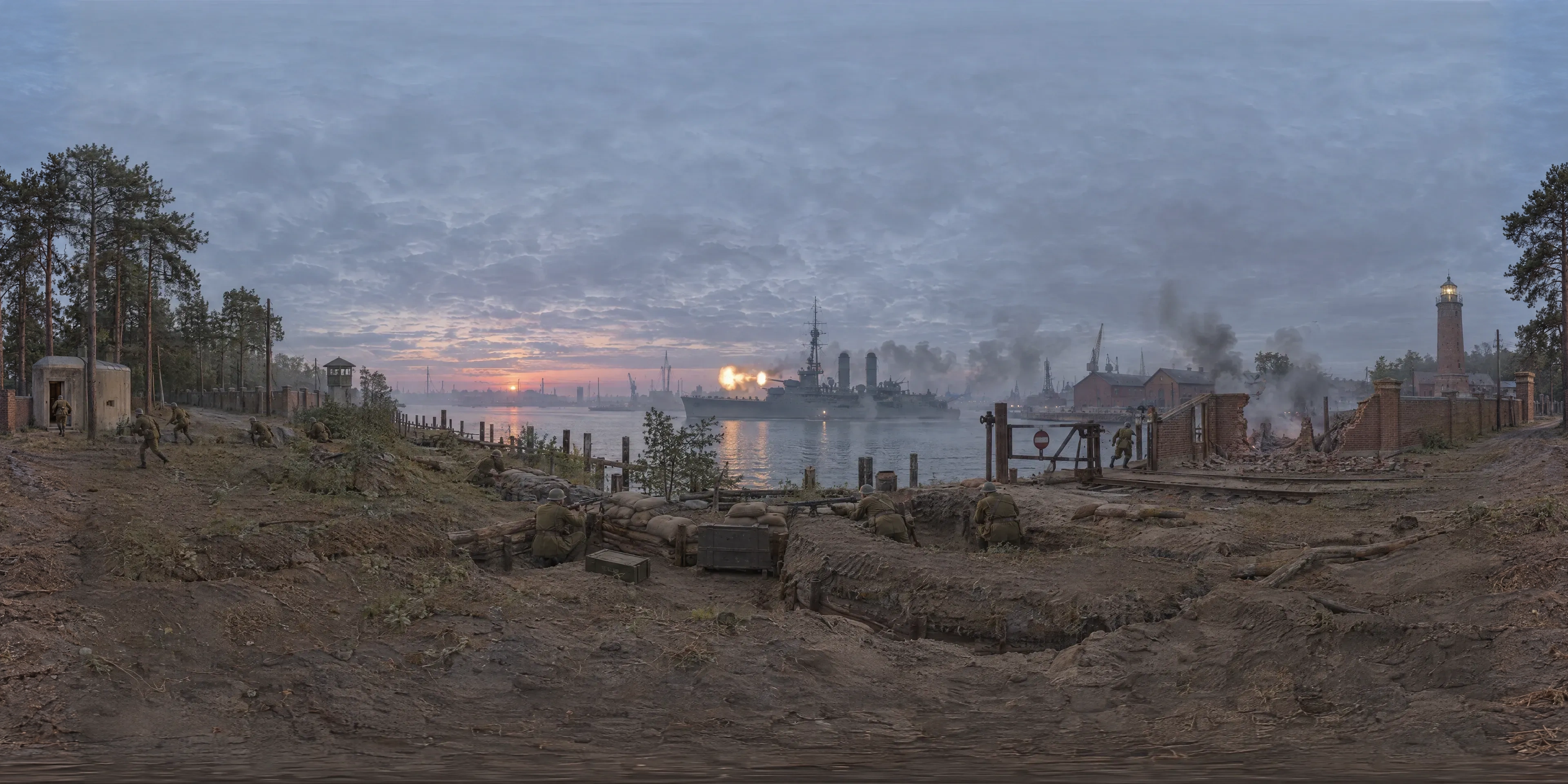
At 4:45 on Friday 1 September 1939 the German training battleship Schleswig-Holstein, moored in the Gdańsk harbour channel, opens fire on the Polish Military Transit Depot at Westerplatte, the first shots of the Second World War in Europe. The 182 defenders, expected to hold for up to twelve hours, hold out for seven days.
- Year
- 1939
- Where
- Pomerania (Free City of Danzig) · PL
- Era
- modern_early
- Coordinates
- 54.406, 18.674
The moment
The battleship came on a courtesy visit
The Schleswig-Holstein, an old German training battleship, left Kiel on 18 August 1939 and entered Gdańsk on 25 August on what was billed as a courtesy visit. It moored in the harbour channel about 150 metres from Westerplatte. It was meant to be in place for an attack on 26 August; when the invasion was put off, the ship waited six more days.
At four in the morning on Friday 1 September it moved to the channel bend known as the Five Whistles, for a better field of fire. A Kriegsmarine assault company of 229 men had landed in the night near the old Wisłoujście fortress.
At 4:45 the forward turret opened fire; the ship's log gives 4:48. Shells weighing 330 kilograms blew in the depot's railway gate and stretches of its brick wall. These were the first shots of the Second World War in Europe.
A depot meant for 88 soldiers
Westerplatte, a wooded spit at the mouth of the port, lay in the Free City of Danzig. In 1924 the League of Nations agreed to hand it to Poland, and in 1925 the city leased it to Poland free of charge as a Military Transit Depot. The League's Council limited its garrison to 88 men.
By September 1939 the depot held 182 soldiers, including five officers and a doctor, under Major Henryk Sucharski; some sources give over 200. They had five reinforced concrete guardhouses, modern barracks and field positions dug that August. The plan assumed they would hold for twelve hours.
Seven days and thirteen assaults
The first German assault was beaten back after about ninety minutes. On the evening of 2 September nearly sixty Stuka dive bombers attacked, and at least six defenders died when Guardhouse No. 5 was hit.
At 10:15 on 7 September Sucharski ordered the surrender, citing the losses, the exhaustion of his men, the condition of the wounded and an enemy almost twenty times stronger. The defenders had repelled thirteen assaults. Between fifteen and twenty of them had been killed and some fifty wounded. German losses, once put at 300 dead, are now estimated at 30 to 50.
What happened inside the depot is still argued over. Some accounts say Sucharski broke down after the air raid and that his deputy, Captain Franciszek Dąbrowski, quietly took over; a disputed thesis speaks of a mutiny among officers.
Why Poland marks 4:45
Westerplatte is the Polish symbol of the start of the Second World War, and the anniversary is marked there every 1 September at 4:45. The 25-metre Monument to the Coast Defenders, unveiled in 1966, carries the words "Never again war".
It is not exactly the ground of 1939. When the harbour channel was widened in 1967, Guardhouse No. 1 was moved on rails in one piece. Remembrance here has been politically contested too: in 2020 the state took over the city-owned land around the monument, a step the Supreme Administrative Court ruled unlawful in 2021. In November 2022 ten of the defenders were buried in a new military cemetery on the peninsula.
Sources
Further reading
Tagged
- poland
- gdansk
- westerplatte
- world-war-ii
- 1939
- battleship
- defence
- 20th-century
Published
See also

1944
PAST Building, Warsaw
On the morning of 20 August 1944, after a night assault that began at 2:30, Home Army soldiers of the Kiliński Battalion take the PAST telephone exchange, the German stronghold in central Warsaw, setting it ablaze with improvised flamethrowers from fire pumps and capturing over a hundred Germans. The white-and-red flag goes up over the burning tower.

1939
Lower Wenceslas Square, Prague
On the morning of 15 March 1939, in a heavy fall of wet snow, German columns roll down Wenceslas Square as Hitler's troops occupy what remains of Czechoslovakia. Thousands of Praguers watch from the pavements, weeping, booing and singing the national anthem; that evening Hitler reaches Prague Castle, and the next day he proclaims the Protectorate of Bohemia and Moravia.

1918
Wenceslas Square, Prague
Late in the morning of 28 October 1918, as news spreads that Austria-Hungary has accepted President Wilson's terms, crowds pour onto Wenceslas Square and the priest Isidor Zahradník proclaims an independent Czechoslovak state at the St Wenceslas monument. That evening the National Committee passes the new republic's first law.