Holy Trinity Square, Banská Štiavnica
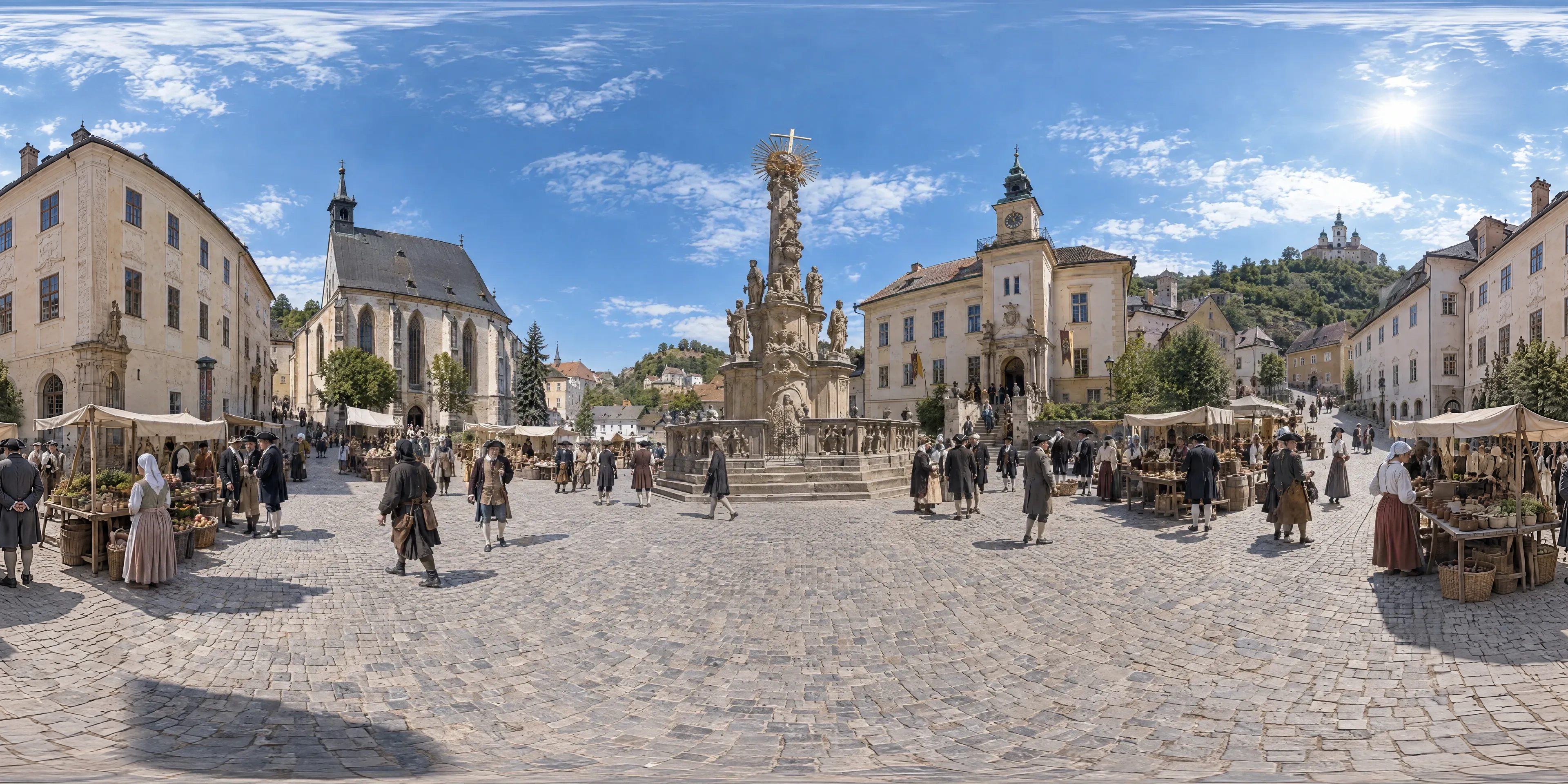
1782: counted at more than 23,000 people, silver-rich Banská Štiavnica is the third-largest town in the Kingdom of Hungary after Pressburg and Debrecen and home of the pioneering Mining Academy. On market day its steep main square, built on a heap of mine waste, crowds around the tall Baroque Holy Trinity column.
- Year
- 1782
- Where
- Central Slovak mining towns, Kingdom of Hungary · SK
- Era
- Early modern
- Coordinates
- 48.460, 18.892
The moment
The third-largest town in Hungary
In 1782 Banská Štiavnica counted 23,192 inhabitants, around 40,000 with its suburbs. Only Pressburg and Debrecen were bigger in the whole Kingdom of Hungary.
It was a silver town, rich from the mines under its steep hills, and home to a pioneering Mining Academy. No single event is attached to the year; 1782 is simply a snapshot of the town near its peak.
A square built on mine waste
The main square, Holy Trinity Square, is long and sloping for a reason: it was laid out in the early sixteenth century on a heap of mine waste more than ten metres high.
In the middle of the slope stands the Holy Trinity plague column, built between 1759 and 1764 to a design by Dionýz Stanetti, the tallest of its kind in the country. Its saints include protectors against plague and the patrons of miners.
Downhill, the late-Gothic St Catherine's Church of 1488 to 1491 has heard sermons in Slovak since 1658. Above the roofs looms the Old Castle, a parish basilica turned into a fortress against the Ottomans between 1546 and 1559, and the square is lined with the houses of mining entrepreneurs, coats of arms over their gateways.
Where mining became a science
Samuel Mikovíny founded a mining school here in 1735, the first in Hungary. In 1763 the imperial treasury in Vienna turned it into an Academy of Mining, and in 1848 it became the Academy of Mining and Forestry, often called the first technical university in the world.
It had innovated long before. In 1627 gunpowder was used in a mine here, one of the first times anywhere, after Le Thillot in France.
Mining also reshaped the landscape. The tajchy, some sixty reservoirs linked by more than a hundred kilometres of channels, were built between the fifteenth and eighteenth centuries to serve the mines; Jozef Karol Hell, Maximilian Hell and Mikovíny designed the eighteenth-century system.
Why Slovaks call it the silver town
Banská Štiavnica and its academy are Slovakia's proudest contribution to the history of science and industry. On 11 December 1993 the town and its technical monuments became one of the country's first UNESCO World Heritage Sites.
The academy itself left after 1919, moving to Sopron in Hungary.
Its square still carries the shape of its history. On a market morning of the 1780s the slope filled with stalls, miners, academy students and village traders, around the Trinity column.
Sources
Further reading
Tagged
- slovakia
- banska-stiavnica
- mining
- silver
- baroque
- 18th-century
- unesco
- market
Published
See also

1741
Coronation Hill, Pressburg (Bratislava)
Sunday, 25 June 1741: freshly crowned in St Martin's Cathedral, 24-year-old Maria Theresa rides up an earthen mound by the Danube and swings St Stephen's sword to the four corners of the world, vowing to defend Hungary. That September the Hungarian estates, gathered in this city, pledged her 'our life and blood' and saved her throne.

1618
Prague Castle (Ludwig Wing)
On May 23, 1618, Bohemian Protestant nobles throw two imperial Catholic regents out of the upper window of the Ludwig Wing of Prague Castle, triggering the Thirty Years' War.

1650s
Tōkaidō road, Mt. Fuji
Around 1650 AD, a daimyō and his retinue of 2,000 retainers march along the Tōkaidō road past Mt. Fuji on the mandatory alternate-year residence journey to Edo: the Tokugawa shogunate's masterstroke of social control.