Tōkaidō road, Mt. Fuji
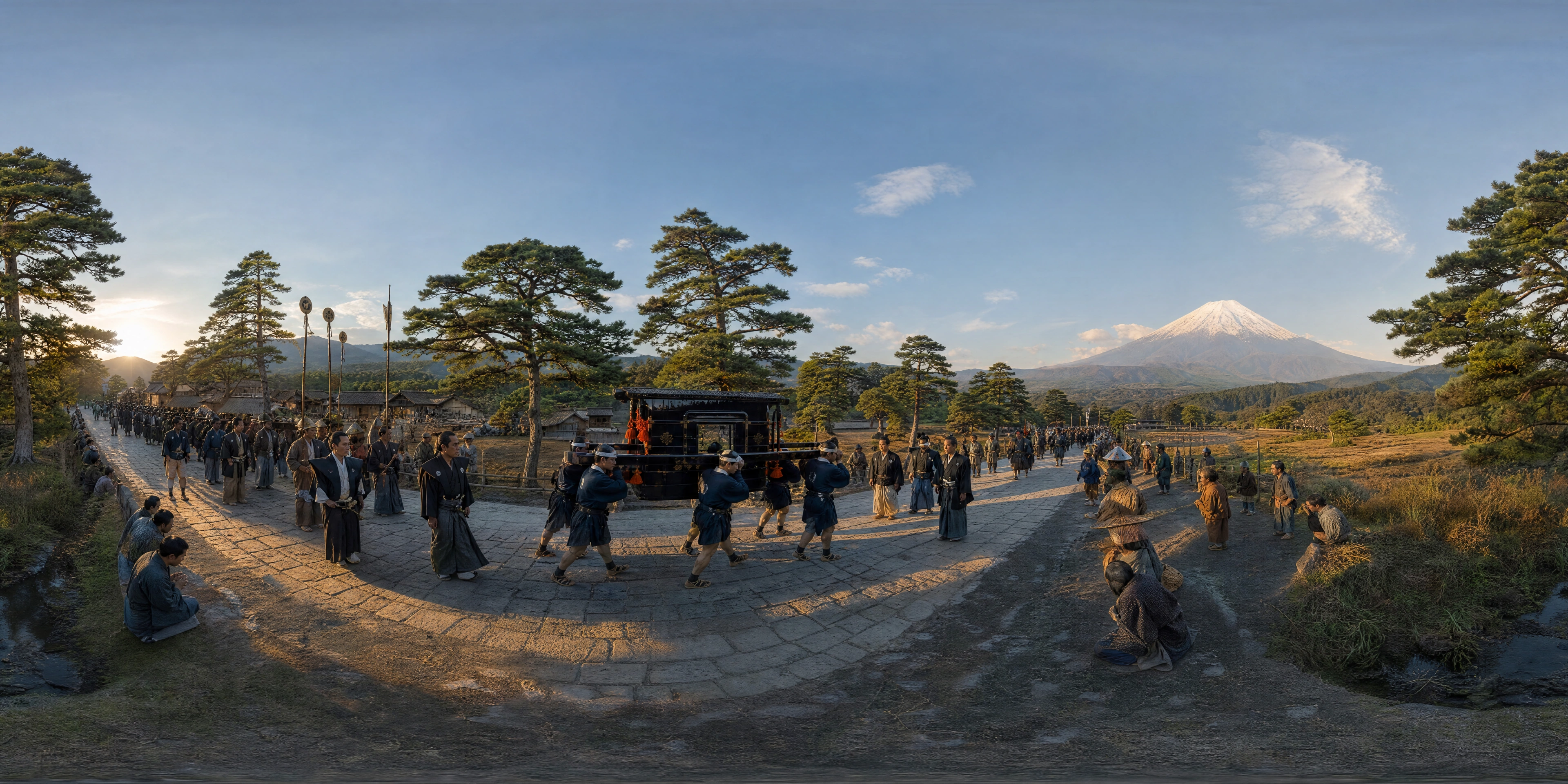
Around 1650 AD, a daimyō and his retinue of 2,000 retainers march along the Tōkaidō road past Mt. Fuji on the mandatory alternate-year residence journey to Edo: the Tokugawa shogunate's masterstroke of social control.
- Year
- 1650s
- Where
- Edo period, Tōkaidō · JP
- Era
- Early modern
- Coordinates
- 35.361, 138.727
The moment
A bureaucratic invention that bankrupted the samurai
The sankin-kōtai system ("alternate attendance") was the masterstroke of Tokugawa Iemitsu, third shogun of the Tokugawa shogunate.
From 1635 onward, every one of Japan's roughly 260 daimyō (feudal lords) was required to spend alternating years in his home domain and in the shogunal capital of Edo. His wife and heir lived permanently in Edo as effective hostages.
The cost of maintaining two households and travelling annually with a full retinue absorbed 50 to 75 per cent of a typical daimyō's income, leaving him no budget for military expansion.
The Tokugawa peace held for 250 years.
Processions visible from Mt. Fuji
The annual journeys followed the five major highways (the Gokaidō) that converged on Edo. The largest of these was the Tōkaidō, running 514 kilometres from Kyoto along the Pacific coast.
Major daimyō travelled with retinues of 2 000 to 4 000 men. Armed samurai in formal kamishimo. Foot-soldiers carrying lacquered storage chests. Bearers shouldering the lord's palanquin (norimono). Spearmen carrying the family banner-spears. Gunmen with matchlock muskets in red lacquered cases. Packhorses with red leather panniers. The procession could stretch for two kilometres along the road.
At the Tōkaidō's most famous viewpoint, the long stretch through Suruga province where Mount Fuji's 3 776-metre cone dominates the horizon, the processions formed an unforgettable visual. A slow ribbon of lacquered armour and banners moving past the mountain.
A road economy
The sankin-kōtai system created a peculiar service economy along the highways.
The 53 post-stations of the Tōkaidō each had to supply specific services: relays of horses and porters, designated honjin (official lord-hostelries) for the daimyō, wakihonjin (backup hostelries), hatago (inns for retainers), tea-houses, money- changers, courier services.
Hiroshige's woodblock series Fifty-three Stations of the Tōkaidō (1833) catalogued the visual character of each post-station: packed inn courtyards, river crossings by porter chair-ride, mountain passes, fishermen's villages. The series became the most popular ukiyo-e prints of the late Edo period and remains the standard image of the road today.
Why it ended
The sankin-kōtai system was abolished in 1862 as part of the late-Tokugawa political reforms, six years before the regime itself collapsed.
The reform was a desperate attempt to save the shogunate by lessening the daimyō burden and freeing the domains to modernise their militaries against the perceived threat of Western intervention. It came too late.
The lords had spent two hundred and fifty years building a culture of urbane Edo sophistication around the bi-annual journeys. When the system was abolished, the road economies of the Gokaidō collapsed within a decade.
The Tōkaidō survived because the new Meiji government built a railway along its line in the 1880s. The post-stations became the modern stations of the Tokaido Main Line, which today carries the Shinkansen bullet trains.
Further reading
Tagged
- japan
- edo
- tokugawa
- sankin-kotai
- samurai
- mt-fuji
Published
See also

1741
Coronation Hill, Pressburg (Bratislava)
Sunday, 25 June 1741: freshly crowned in St Martin's Cathedral, 24-year-old Maria Theresa rides up an earthen mound by the Danube and swings St Stephen's sword to the four corners of the world, vowing to defend Hungary. That September the Hungarian estates, gathered in this city, pledged her 'our life and blood' and saved her throne.

1655
Dam Square and the New Town Hall, Amsterdam
On 29 July 1655 Amsterdam's burgomasters process from the Prinsenhof to the Dam to inaugurate Jacob van Campen's new Town Hall, a classical palace for a city of merchants, though it is still far from finished. Six companies of civic guards fire three volleys as the city at the height of its Golden Age celebrates.

1682
Place d'Armes, Versailles
On 6 May 1682 Louis XIV makes Versailles the permanent seat of his court and government, turning his father's hunting lodge, now wrapped in new wings, into the stage of absolute monarchy. The palace is still a vast building site: the Hall of Mirrors is being decorated, the Grand Commun is just begun and the north wing not yet started.