Štefánik's Tomb, Bradlo
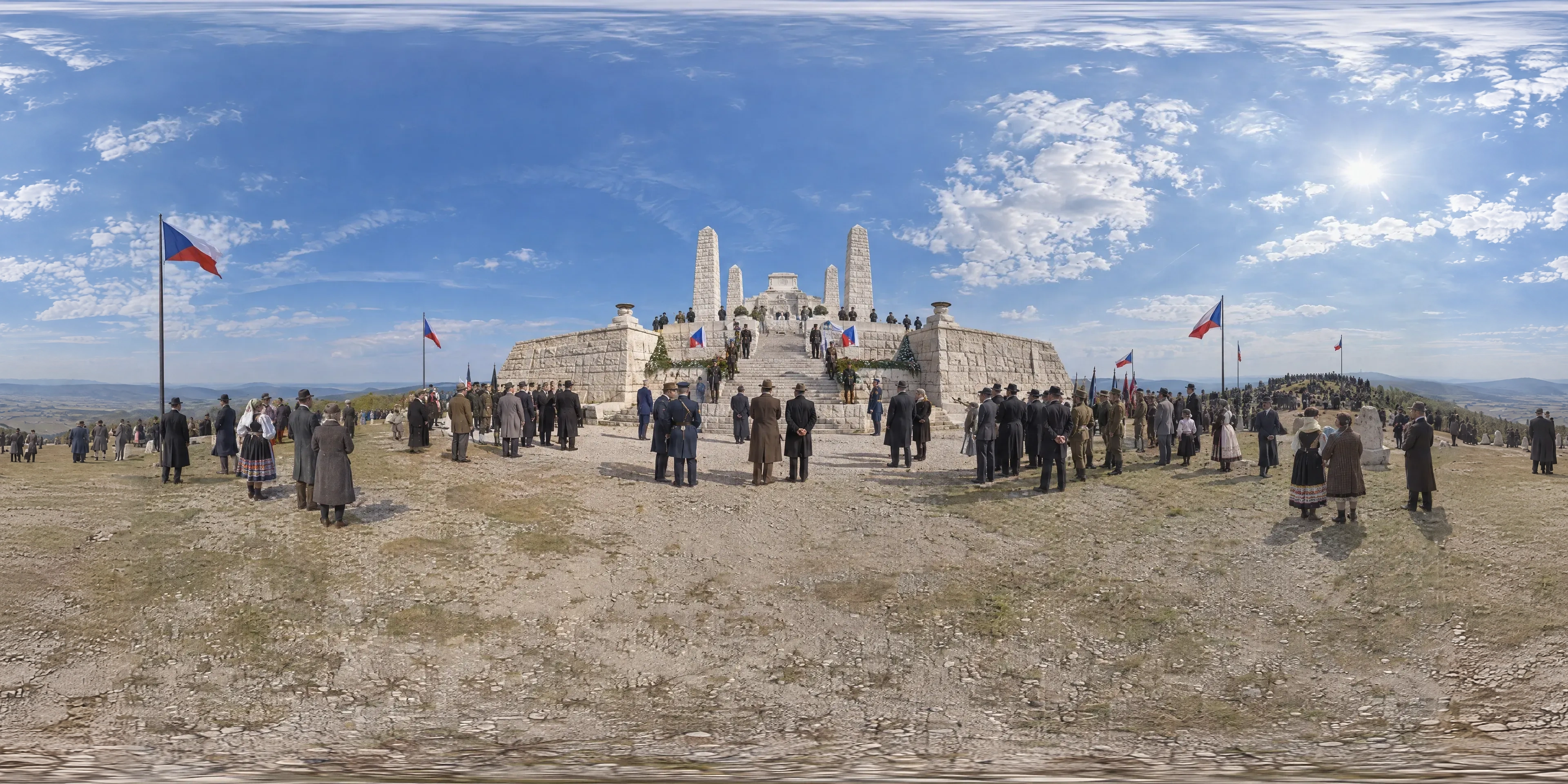
Sunday, 23 September 1928: on the tenth anniversary of Czechoslovakia, state officials and diplomats unveil Dušan Jurkovič's gleaming travertine tomb for General Milan Rastislav Štefánik on Bradlo hill above his native village. Built in 280 working days, it holds the astronomer, aviator and diplomat who co-founded the republic and died in a plane crash in 1919.
- Year
- 1928
- Where
- Myjava Hills (kopanice), First Czechoslovak Republic · SK
- Era
- modern_early
- Coordinates
- 48.679, 17.560
The moment
An astronomer who became a general
Milan Rastislav Štefánik was born on 21 July 1880 in Košariská, a village in the Myjava Hills, the son of a Lutheran pastor. He went to Prague to study engineering in 1898, switched to astronomy, physics and mathematics at Charles University, and took his doctorate in 1904.
In Paris he joined the Meudon Observatory under Pierre Janssen, observed the Moon and Mars from Mont Blanc in 1905 and 1906, and in 1907 won the Prix Jules Janssen of the French astronomical society. In 1912 he became a French citizen.
The First World War turned the scientist into an aviator, a diplomat and a general of the French army. With Tomáš Masaryk and Edvard Beneš he worked in the Czechoslovak National Council in exile, helped build the Czechoslovak Legions, and he became the new state's minister of war.
The crash at Ivanka
On 4 May 1919 Štefánik's plane crashed near Ivanka pri Dunaji, close to Bratislava, as it tried to land. He was killed at the age of 38.
The crash has attracted conspiracy theories ever since. What is not in doubt is the loss: one of the three founders of the republic was dead, barely six months after it was born.
He lies on Bradlo, a hill of 543 metres above his native village.
A tomb built in 280 working days
The architect Dušan Jurkovič designed the permanent tomb, and it was built in 280 working days. It was finished on 20 September 1928, in cream-white travertine from Spišské Vlachy laid in massive blocks.
It rises in stages. A lower terrace of about 93 by 62 metres, with sloping walls, stairs and stone vessels for an eternal flame at its corners, carries an upper terrace of 45 by 32 metres with a 12-metre obelisk at each corner, and on top a stepped pyramid holds the tomb itself.
On Sunday 23 September 1928, the tenth anniversary year of the republic, state officials and diplomats unveiled it on the bare crown of the hill.
Why Slovaks climb Bradlo
In 2019 Slovaks voted Štefánik the Greatest Slovak. His tomb on Bradlo, which carries the European Heritage Label, is the country's best-known national memorial.
The monument has changed a little since 1928. Trees have grown up around the mound, and the original wreaths were replaced with marble ones during a restoration in the 1990s.
The landscape around it has not. From the top the view still runs over the scattered farmsteads and strip fields of the Myjava Hills to the White and Little Carpathians, the country Štefánik left as a pastor's son and where he now lies as a general.
Sources
Further reading
Tagged
- slovakia
- bradlo
- stefanik
- czechoslovakia
- interwar
- memorial
- jurkovic
- first-republic
Published
See also

1918
Wenceslas Square, Prague
Late in the morning of 28 October 1918, as news spreads that Austria-Hungary has accepted President Wilson's terms, crowds pour onto Wenceslas Square and the priest Isidor Zahradník proclaims an independent Czechoslovak state at the St Wenceslas monument. That evening the National Committee passes the new republic's first law.

1939
Lower Wenceslas Square, Prague
On the morning of 15 March 1939, in a heavy fall of wet snow, German columns roll down Wenceslas Square as Hitler's troops occupy what remains of Czechoslovakia. Thousands of Praguers watch from the pavements, weeping, booing and singing the national anthem; that evening Hitler reaches Prague Castle, and the next day he proclaims the Protectorate of Bohemia and Moravia.

1944
Omaha Beach, Normandy
At 6:30 a.m. on June 6, 1944, the first waves of American soldiers from the 1st and 29th Infantry Divisions wade ashore at Omaha Beach under heavy German machine-gun fire in the bloodiest landing of D-Day.