Wenceslas Square, Prague
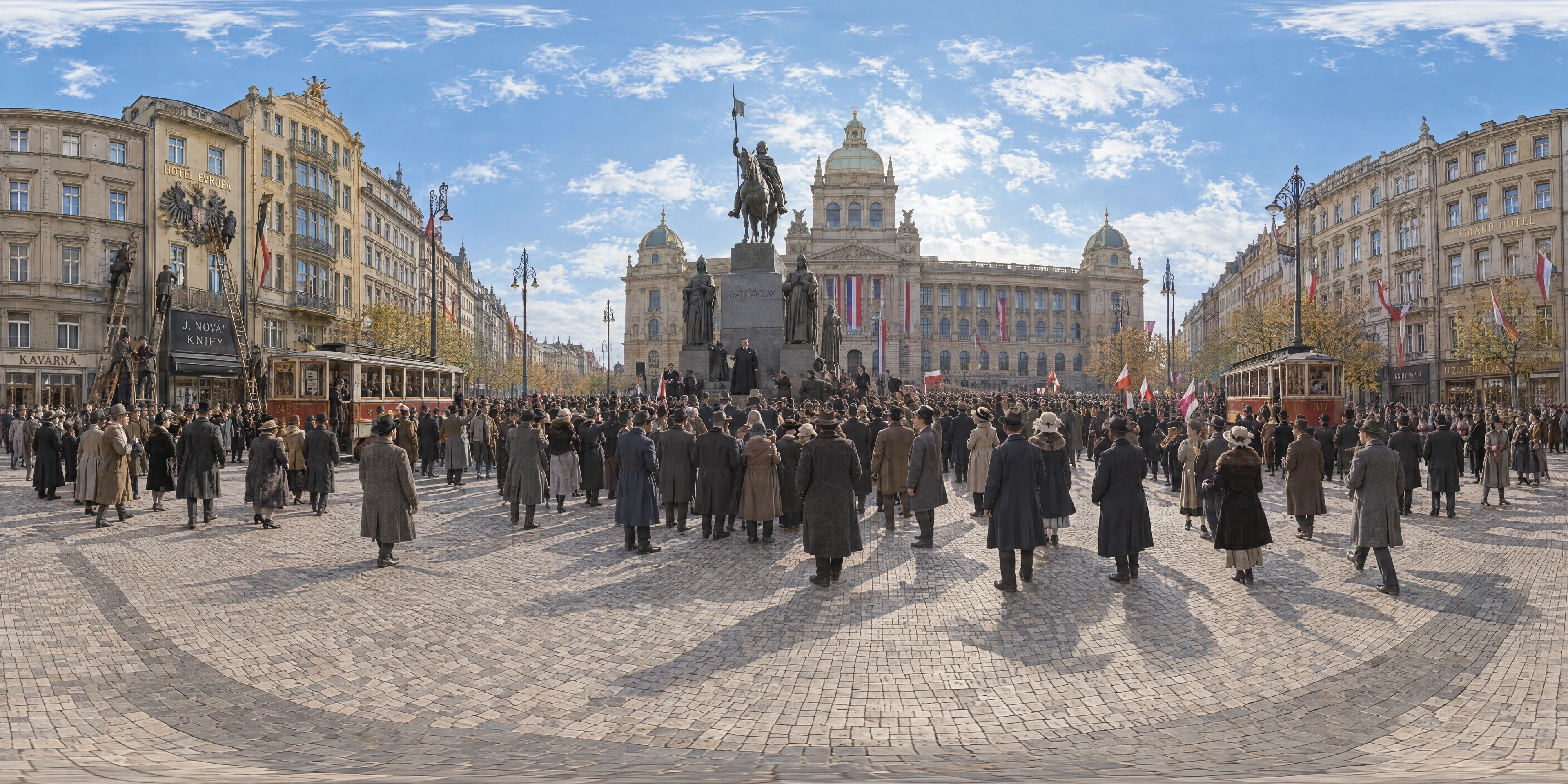
Late in the morning of 28 October 1918, as news spreads that Austria-Hungary has accepted President Wilson's terms, crowds pour onto Wenceslas Square and the priest Isidor Zahradník proclaims an independent Czechoslovak state at the St Wenceslas monument. That evening the National Committee passes the new republic's first law.
- Year
- 1918
- Where
- Bohemia · CZ
- Era
- modern_early
- Coordinates
- 50.080, 14.429
The moment
A diplomatic note, read as independence
On 27 October 1918 Austria-Hungary accepted President Wilson's peace conditions, in a diplomatic message known as the Andrássy note. When the news reached Prague on the morning of Monday 28 October, people read it as recognition of their independence.
Crowds poured into the streets and onto Wenceslas Square. Imperial eagles and signs came down from the shopfronts, and red-and-white Bohemian flags went up everywhere.
The flag with the blue wedge did not yet exist; it was adopted in 1920. On 28 October the colours of independence were simply red and white.
Grain first, then a state
The politicians moved faster than the crowd. At about nine in the morning Antonín Švehla and František Soukup took control of the War Grain Institute, to stop grain being shipped to the front, and made its staff swear loyalty to the new state.
Late in the morning, at the upper end of the square, the priest Isidor Zahradník proclaimed an independent Czechoslovak state from the St Wenceslas monument. Some English-language accounts credit the reading to the writer Alois Jirásek; Czech sources name Zahradník.
That evening the National Committee passed the new republic's first law, the act establishing the independent Czechoslovak state. It was issued by five men remembered as the Men of 28 October: Švehla, Soukup, Alois Rašín, Jiří Stříbrný and Vavro Šrobár.
St Adalbert had not arrived yet
Myslbek's bronze horseman had been unveiled on its granite pedestal only in 1913. Three of the four saints stood around it; St Adalbert, at the rear, arrived in 1925.
Behind the monument rose the long neo-Renaissance National Museum, finished in 1891. Electric trams ran along both sides of the square, since there was no central tram strip yet, below six-storey blocks and hotels such as the Art Nouveau Evropa.
The future president was not there. Tomáš Garrigue Masaryk was abroad; the National Assembly elected him by acclamation on 14 November, and he returned to Prague on 21 December.
Why 28 October is the Czech national day
28 October is the main Czech state holiday, the founding day of Czechoslovakia. The First Republic that began on the square that morning is ranked by Czechs as the second-greatest era of their history, after the age of Charles IV.
Not everyone in the new state had chosen it. For the Sudeten Germans, and for some Slovak and Hungarian communities, it was imposed rather than wanted.
The Slovaks' own voice came two days later. On 30 October Slovak politicians meeting in Turčiansky Svätý Martin adopted the Martin Declaration and joined the common state, which is why the story of 1918 is told in two towns, not one.
Sources
Further reading
Tagged
- czechia
- prague
- czechoslovakia
- independence
- 1918
- wenceslas-square
- first-republic
- 20th-century
Published
See also

1939
Lower Wenceslas Square, Prague
On the morning of 15 March 1939, in a heavy fall of wet snow, German columns roll down Wenceslas Square as Hitler's troops occupy what remains of Czechoslovakia. Thousands of Praguers watch from the pavements, weeping, booing and singing the national anthem; that evening Hitler reaches Prague Castle, and the next day he proclaims the Protectorate of Bohemia and Moravia.

1968
National Museum, Wenceslas Square, Prague
On the morning of 21 August 1968, hours after Warsaw Pact armies invaded to crush the Prague Spring, Soviet tanks coming from Vinohradská rake the facade of the National Museum with machine-gun fire. Praguers fill the upper square, surround the tanks to argue with their crews and cover the statue of St Wenceslas with flags and slogans.

1357
Charles Bridge, Prague
In 1357 Emperor Charles IV lays the foundation stone of a new stone bridge on the Old Town bank near St Clement's, fifteen years after ice and floodwater wrecked the Judith Bridge. Tradition sets the moment at 5:31 on 9 July, a palindrome of odd numbers; the bridge will take 45 years to finish.