Sanssouci Palace, Potsdam
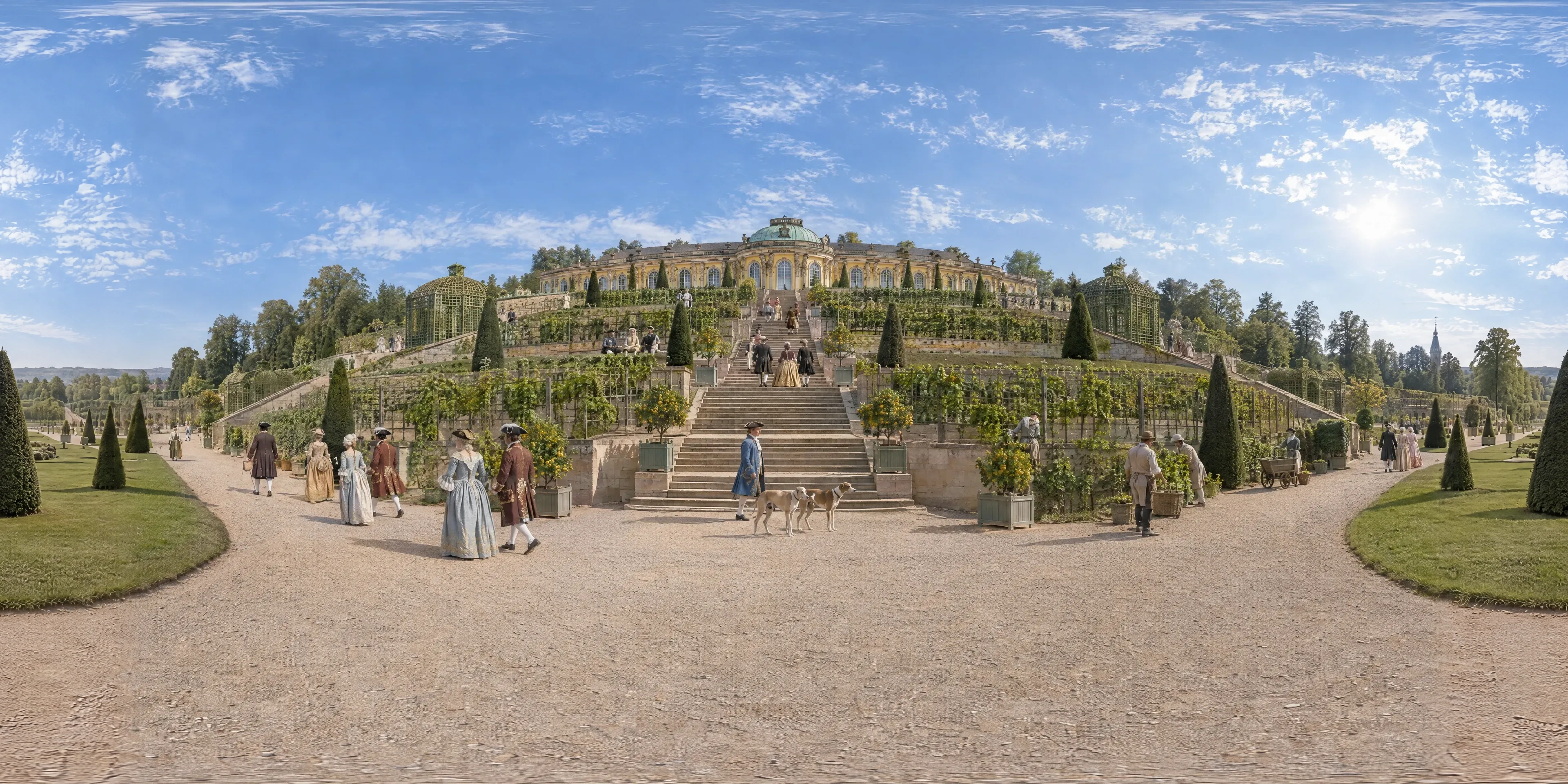
On 1 May 1747 Frederick II of Prussia inaugurates Sanssouci, the small summer palace built to his own sketches on top of six curved vineyard terraces outside Potsdam, though not all its rooms are finished. Here the philosopher king will spend every summer, playing the flute and gathering Voltaire and other guests at his table.
- Year
- 1747
- Where
- Brandenburg (Prussia) · DE
- Era
- Early modern
- Coordinates
- 52.403, 13.038
The moment
A king drew his own palace
On 1 May 1747 Frederick II of Prussia inaugurated his new summer palace on a vineyard hill outside Potsdam, although not all its rooms were finished. He called it Sanssouci, without worry.
The design began with the king. His own sketch of 1745 set out the plan, and his architect, Georg Wenzeslaus von Knobelsdorff, worked it up into a small, single-storey palace with an oval central pavilion under a low dome. On the central pavilion the name appears in gilded letters, with a puzzling comma and a full stop: SANS, SOUCI.
On the garden front, paired sandstone atlantes, bacchants and bacchantes, stand between tall arched windows.
Six terraces of vines and figs
Below the palace the hill was cut into six broad terraces whose retaining walls curve inward toward the middle. Stretches of wall trained with vines and fruit espaliers alternate with 168 glazed niches for figs and other tender plants.
A straight flight of 120 steps, broken into six runs, climbs the centre. Clipped yew pyramids and orange trees in tubs stood along the edges.
Much of the park now famous was still to come in May 1747. The Great Fountain basin at the foot of the hill dates from 1748 and its ring of marble statues from 1750 onward, the Picture Gallery from 1755 to 1764, and the marble balustrades and vases on the terraces from 1845.
The philosopher of Sanssouci
Frederick was 35. From then on he spent every summer here, played the flute and gathered guests at his table. Voltaire, the most famous of them, lived at his court in Potsdam from 1750 to 1753.
The king meant to stay for good. He asked to be buried on the top terrace, at night and without pomp, near the graves of his dogs. When he died in 1786 the wish was ignored.
It was fulfilled only on 17 August 1991, exactly 205 years after his death. After German reunification his coffin was laid in the terrace at midnight, with Chancellor Helmut Kohl among those present.
Why Germans bring him potatoes
Frederick the Great remains one of the most debated figures in German history. He is admired as an enlightened monarch and remembered as a symbol of Prussian militarism, a legacy the Nazis later exploited.
Sanssouci is the heart of the palaces and parks of Potsdam and Berlin, a UNESCO World Heritage Site since 1990. On the plain slab over the king's grave, visitors leave flowers and potatoes, in thanks for his efforts to make the potato a Prussian crop. Beside it, small stone plaques carry the names of his dogs.
Sources
Further reading
Tagged
- germany
- potsdam
- prussia
- frederick-the-great
- rococo
- sanssouci
- early-modern
- unesco
Published
See also

1618
Prague Castle (Ludwig Wing)
On May 23, 1618, Bohemian Protestant nobles throw two imperial Catholic regents out of the upper window of the Ludwig Wing of Prague Castle, triggering the Thirty Years' War.

1650s
Tōkaidō road, Mt. Fuji
Around 1650 AD, a daimyō and his retinue of 2,000 retainers march along the Tōkaidō road past Mt. Fuji on the mandatory alternate-year residence journey to Edo: the Tokugawa shogunate's masterstroke of social control.

1640s
Taj Mahal under construction, Agra
Around 1640, the white marble dome of the Taj Mahal rises on its riverside platform at Agra: some twenty thousand workers and a thousand elephants raising Shah Jahan's tomb for his wife Mumtaz Mahal, partway through a project that will take more than twenty years.