SNP Square, Bratislava
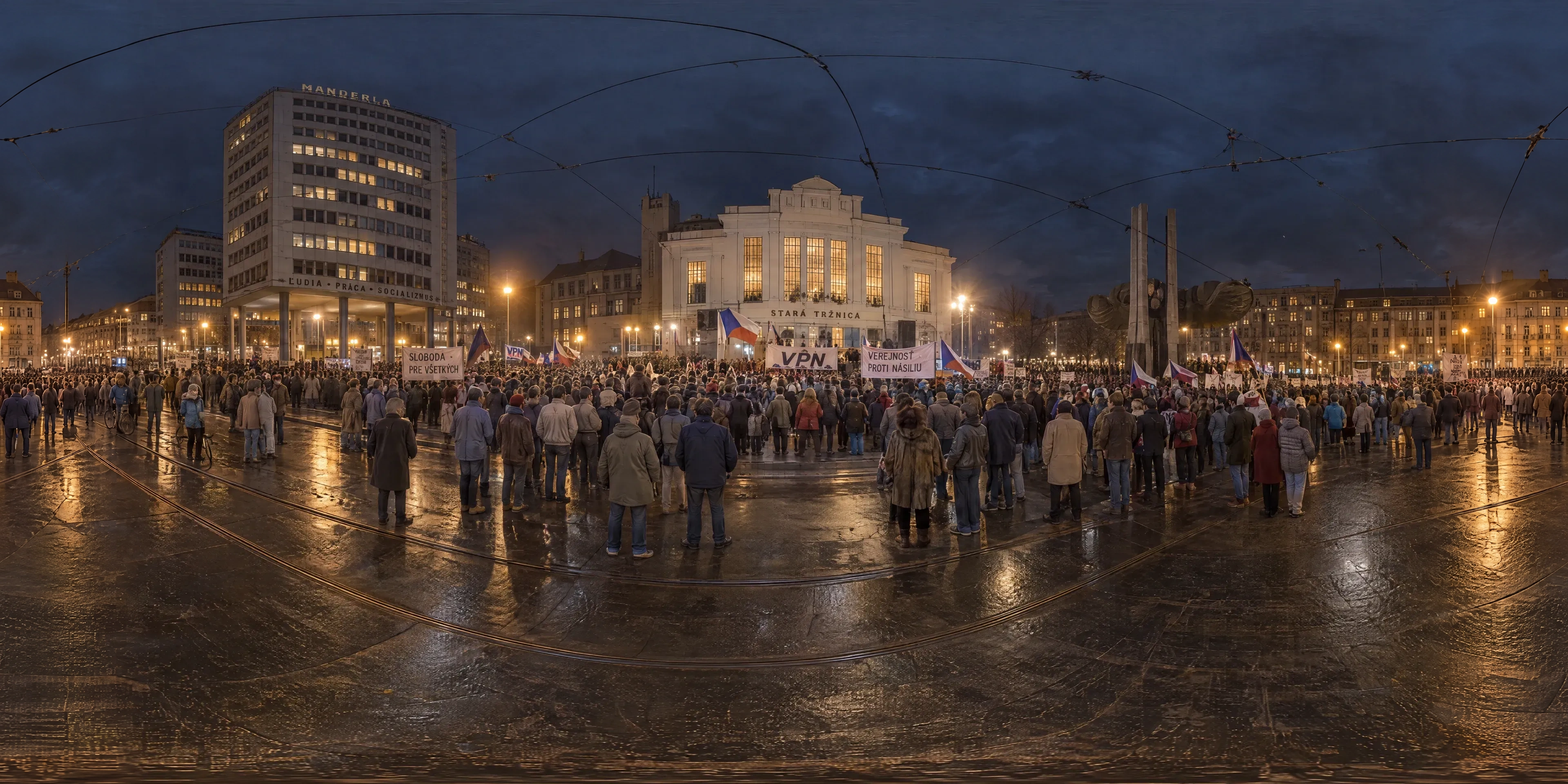
Thursday evening, 23 November 1989: a crowd fills Bratislava's SNP Square, where rallies now gather every day, and hears Alexander Dubček, the face of the 1968 Prague Spring, call for the renewal of society. Five weeks later Václav Havel was president and Dubček chaired the federal parliament.
- Year
- 1989
- Where
- Bratislava, Czechoslovakia · SK
- Era
- Contemporary
- Coordinates
- 48.145, 17.111
The moment
A march nobody authorised
On 16 November 1989, around five in the afternoon, some 150 to 300 secondary-school and university students set off from Hodžovo námestie in Bratislava on a march nobody had authorised. They walked through the centre to the university building on Šafárikovo námestie and laid flowers there.
It was a small march with a long background. On 25 March 1988, in the Candle Demonstration, State Security had brutally dispersed a peaceful vigil in the same city.
Public Against Violence
On 19 November dissident intellectuals, artists and activists met in the Umelecká beseda building and founded Verejnosť proti násiliu, Public Against Violence. Its spokesmen were Milan Kňažko and Ján Budaj.
From 22 November the movement and the students held rallies on SNP Square every day. They gathered in front of the Old Market Hall of 1910, which had served as the television studio until 1982, with sound equipment lent by the rock band Tublatanka.
To one side rose the Manderla building of 1935, an eleven-storey functionalist block on pillars and the city's first high-rise. In the square stood the monument to the Slovak National Uprising, unveiled in 1974.
The man from 1968
On the evening of Thursday 23 November the crowd heard Alexander Dubček. He had led the Communist Party in 1968, as the face of the Prague Spring and its "socialism with a human face", until the Warsaw Pact invasion ended it; forced out in 1969 and expelled from the party in 1970, he had been kept out of public life until that November.
That evening he called for the renewal of society. Nobody recorded the size of the crowd with any precision, but the next day about 100,000 people filled the square.
On 27 November a two-hour general strike was held across the country. On 28 December the Federal Assembly elected Dubček its chairman, and on 29 December it elected Václav Havel president.
Where Slovakia still gathers
November 1989 ended four decades of Communist rule. In Slovakia, 17 November is a state holiday.
Dubček was born in Uhrovec, the same village as Ľudovít Štúr, and his return to a Bratislava square joined the Slovak story of 1968 to that of 1989.
SNP Square, where Slovakia's revolution was carried by speeches, is still where the country comes to protest. In 1989 the crowds pinned small Czechoslovak tricolour ribbons to their winter coats. The square has since been redesigned, but the market hall and the Manderla building still frame it.
Sources
Further reading
Tagged
- slovakia
- bratislava
- velvet-revolution
- 1989
- protest
- democracy
- communism
- dubcek
Published
See also

1989
Karl-Marx-Platz (Augustusplatz), Leipzig
On the evening of 9 October 1989 more than 70,000 people leave the peace prayers in Leipzig's churches and march around the inner ring past armed police and militia, carrying candles and chanting 'Wir sind das Volk' and 'Keine Gewalt'. The security forces hold back, and the peaceful revolution breaks through, a month before the Berlin Wall falls.

1741
Coronation Hill, Pressburg (Bratislava)
Sunday, 25 June 1741: freshly crowned in St Martin's Cathedral, 24-year-old Maria Theresa rides up an earthen mound by the Danube and swings St Stephen's sword to the four corners of the world, vowing to defend Hungary. That September the Hungarian estates, gathered in this city, pledged her 'our life and blood' and saved her throne.

2005
Frauenkirche, Dresden
On 30 October 2005 the rebuilt Frauenkirche is consecrated, sixty years after the air raids of February 1945 turned it into a heap of rubble that stood as a memorial against war throughout East German times. Some 60,000 people follow the service on screens on the Neumarkt, beneath a golden cross made by the son of a British bomber pilot.