Coronation Mound at the Chain Bridge, Pest
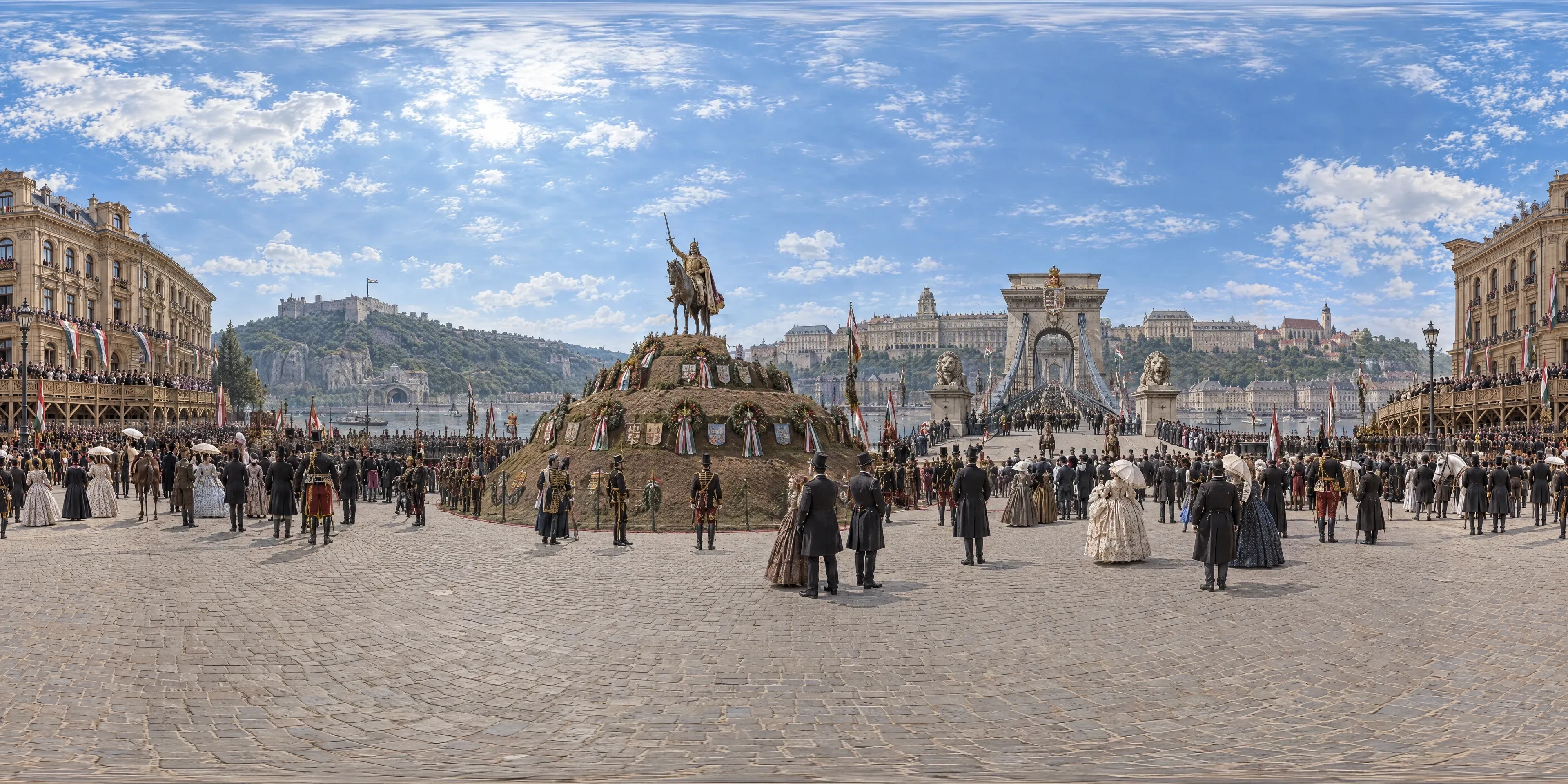
On 8 June 1867, crowned king in Buda to seal the Compromise with Austria, Franz Joseph rides across the Chain Bridge to Pest, swears the constitutional oath and gallops up a mound heaped from the earth of every county of the kingdom to cut the air with St Stephen's sword towards the four points of the compass. The ceremony seals the birth of Austria-Hungary.
- Year
- 1867
- Where
- Pest · HU
- Era
- Industrial
- Coordinates
- 47.500, 19.048
The moment
A coronation that started at six in the morning
The day began early. At six in the morning on Saturday 8 June 1867 the procession set out for the coronation church on Castle Hill in Buda, the church of Our Lady, now known as the Matthias Church. There Franz Joseph knelt on the altar steps, and Count Gyula Andrássy, the prime minister, and the archbishop primate placed the Holy Crown on his head.
Elisabeth was crowned queen in the same service, the Holy Crown held for a moment to her shoulder. During the High Mass that followed, Franz Liszt's Coronation Mass was performed.
The coronation sealed the Compromise with Austria and, with it, the birth of Austria-Hungary.
Half a cubic foot of earth from every county
The second half of the ceremony belonged to Pest. On horseback the king rode down through the Water Gate and across the Chain Bridge, opened in 1849 and guarded at each end by the stone lions János Marschalkó had carved in 1852.
In Pest he swore the constitutional oath on a platform three steps high, draped in cloth of gold. Then he galloped up the coronation mound, heaped on the square at the Pest end of the bridge, today's Széchenyi István tér.
The mound was built of soil from every county of the kingdom. Count Antal Szápáry had asked each county to send half a cubic foot of clean earth by the end of May. On top, the king drew St Stephen's sword and cut the air four times in the shape of a cross, towards the four points of the compass.
A skyline without Parliament
The view from the square showed the twin cities before their boom. Across the river the long Baroque royal palace stretched along Castle Hill, still without its later dome and wings, and the Austrian citadel squatted on Gellért Hill. The church of Our Lady did not yet have its neo-Gothic spire.
On the Pest side stood the new Academy of Sciences, finished in 1865, and the Lloyd building. There was no Parliament, no Margaret Bridge and no Fisherman's Bastion. The funicular up Castle Hill opened only in 1870.
A compromise that divided the kingdom
For Hungarians, 1867 opens the textbook chapter of the Dual Monarchy and the boom years that made Budapest a modern capital.
It divided opinion from the start. Lajos Kossuth, the exiled leader of 1848, condemned the Compromise from abroad, and Croats, Slovaks, Romanians and Serbs saw it as entrenching Hungarian dominance within the kingdom.
The man on the mound was also the same Franz Joseph whose armies, with Russian help, had crushed the Hungarian war of independence eighteen years earlier. The four strokes of the sword were a ceremony of reconciliation as much as of kingship, and not everyone was reconciled.
Sources
Further reading
Tagged
- hungary
- budapest
- chain-bridge
- coronation
- compromise-1867
- franz-joseph
- austria-hungary
- 19th-century
Published
See also

1848
Hungarian National Museum, Pest
At three in the afternoon of 15 March 1848, in pouring rain, some ten thousand people crowd the yard of the new National Museum in Pest while the young radicals of March read the Twelve Points from the stair parapet and hand out the first uncensored prints, among them Petőfi's National Song. The revolution takes Pest that day without bloodshed; the image of Petőfi reciting on these steps is a later legend.

1869
Court Opera on the Ringstraße, Vienna
On the evening of 25 May 1869 Emperor Franz Joseph opens the new Court Opera, the first great public building on Vienna's Ringstraße, with Mozart's Don Giovanni sung in German. Neither of its architects lives to see the night: both died in 1868, after Viennese mockery of the 'sunken box'.

1897
Giant Ferris Wheel, Prater, Vienna
On 3 July 1897, a hot summer day, Vienna's Giant Ferris Wheel opens in the Prater, built by English engineers for the jubilee of Emperor Franz Joseph's 50 years on the throne. Its 30 cabins turn up to 64.75 m above the canals of the 'Venice in Vienna' pleasure park, making it one of the largest wheels in the world; a ride costs a gulden.