Hungarian National Museum, Pest
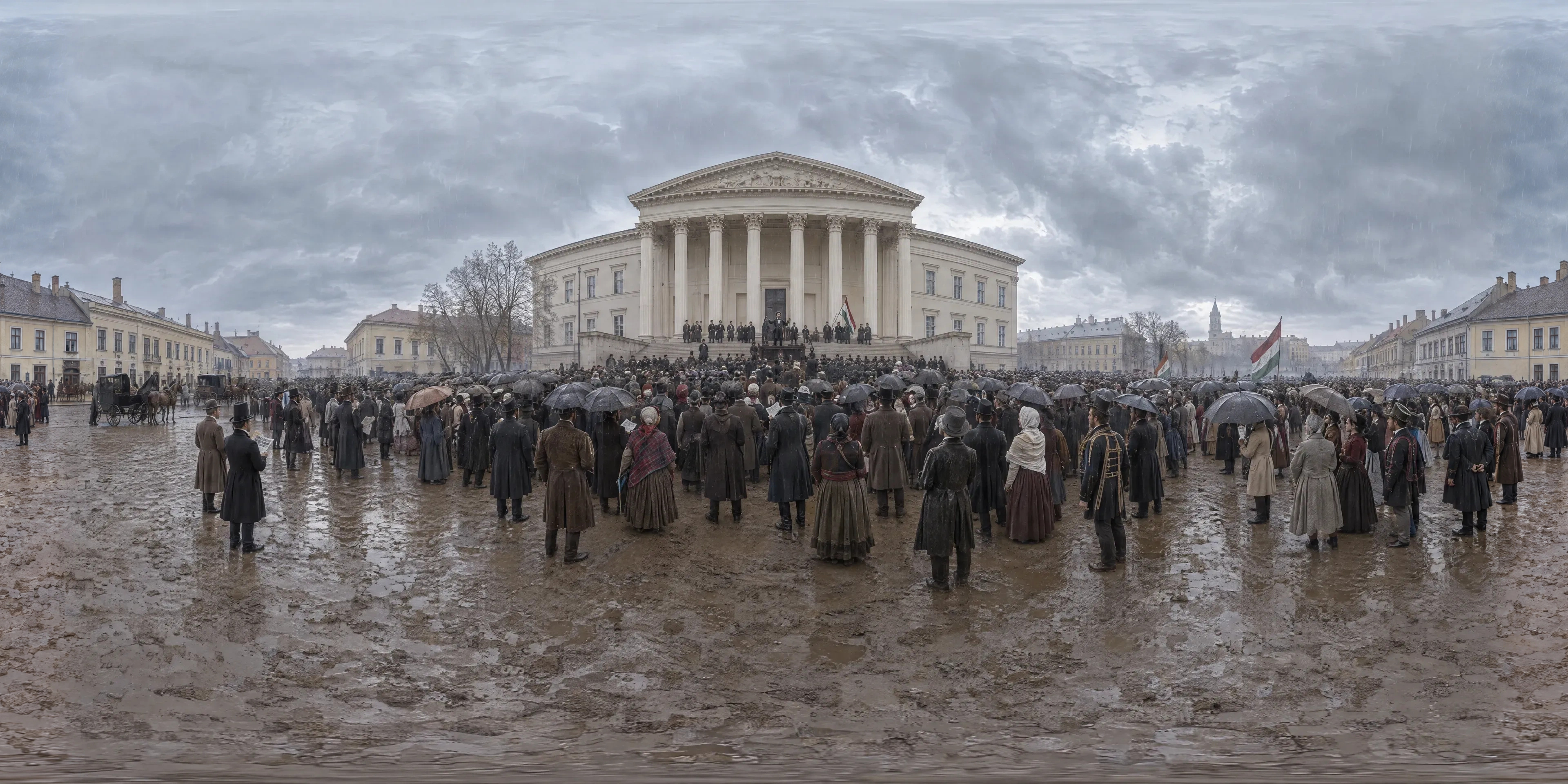
At three in the afternoon of 15 March 1848, in pouring rain, some ten thousand people crowd the yard of the new National Museum in Pest while the young radicals of March read the Twelve Points from the stair parapet and hand out the first uncensored prints, among them Petőfi's National Song. The revolution takes Pest that day without bloodshed; the image of Petőfi reciting on these steps is a later legend.
- Year
- 1848
- Where
- Pest · HU
- Era
- Industrial
- Coordinates
- 47.491, 19.062
The moment
The first prints without a censor
The revolution in Pest began in a café. On the morning of Wednesday 15 March 1848 the young radicals of the Pilvax, Sándor Petőfi among them, went from faculty to faculty of the university, reading their Twelve Points and reciting Petőfi's new poem, the National Song.
At about ten they reached the Landerer press on Hatvani Street and had both printed without the censor's approval, the first uncensored prints in Hungary. Petőfi had forgotten his manuscript and dictated the poem from memory. Outside, thousands waited in the pouring rain, and the copies were handed out as fast as they came off the press.
The first of the Twelve Points demanded exactly what they had just done: freedom of the press and the abolition of censorship.
Ten thousand in the rain at three
At three in the afternoon, in heavy rain, about ten thousand people filled the yard in front of the National Museum. The building was brand new: Mihály Pollack's Neoclassical block, completed in 1847, with a portico of eight Corinthian columns under a triangular pediment, above a broad flight of steps.
The yard was bare and muddy. Its trees were planted only between 1855 and 1857, the iron railings came in 1865, and the statues of writers followed between 1860 and 1893.
From the low side wall on the left of the steps, the young leaders read out the Twelve Points, while printed copies of the demands and of the poem passed from hand to hand. Umbrellas and tall hats filled the yard.
Petőfi on the steps is a legend
The best-known image of the day, Petőfi declaiming the National Song from the museum steps, is a later legend. In his own recollections Petőfi does not list the museum among the places where he recited the poem. He probably gave a speech there; the recital grew out of later memory.
The rest of the day moved quickly. At around five the crowd crossed to Buda to free the political prisoner Mihály Táncsics, and by evening the governing council in Buda had accepted all twelve demands. Pest and Buda were lit up in celebration.
The revolution had taken the twin cities in a single day, without bloodshed.
Why the museum steps still matter
The revolution became a war of independence. It ended with the Hungarian surrender at Világos in August 1849, after Tsar Nicholas I sent 200,000 Russian troops to help Austria.
15 March is now a national holiday. Hungarians pin red, white and green cockades to their coats, and the official speeches are made on these steps, where a plaque of 1890 on the parapet honours Petőfi.
The legend and the history share the same stone. Whatever Petőfi did or did not recite here, the museum yard is where Hungarians go to remember the day the censor lost.
Sources
Further reading
Tagged
- hungary
- budapest
- pest
- revolution-1848
- petofi
- national-museum
- 19th-century
- national-holiday
Published
See also

1867
Coronation Mound at the Chain Bridge, Pest
On 8 June 1867, crowned king in Buda to seal the Compromise with Austria, Franz Joseph rides across the Chain Bridge to Pest, swears the constitutional oath and gallops up a mound heaped from the earth of every county of the kingdom to cut the air with St Stephen's sword towards the four points of the compass. The ceremony seals the birth of Austria-Hungary.

1869
Court Opera on the Ringstraße, Vienna
On the evening of 25 May 1869 Emperor Franz Joseph opens the new Court Opera, the first great public building on Vienna's Ringstraße, with Mozart's Don Giovanni sung in German. Neither of its architects lives to see the night: both died in 1868, after Viennese mockery of the 'sunken box'.

1897
Giant Ferris Wheel, Prater, Vienna
On 3 July 1897, a hot summer day, Vienna's Giant Ferris Wheel opens in the Prater, built by English engineers for the jubilee of Emperor Franz Joseph's 50 years on the throne. Its 30 cabins turn up to 64.75 m above the canals of the 'Venice in Vienna' pleasure park, making it one of the largest wheels in the world; a ride costs a gulden.